Zing Forum

Reading

Breast Cancer Detection Web App: Practice of Neural Networks in Medical Diagnosis

This is a breast cancer detection web application based on machine learning and neural networks. It uses a trained neural network model to predict whether a tumor is benign or malignant, demonstrating the practical application value of AI in the field of medical diagnosis.

乳腺癌检测医疗AI神经网络Web应用机器学习早期筛查开源医疗
Published 2026-05-11 19:24Recent activity 2026-05-11 19:34Estimated read 6 min
Breast Cancer Detection Web App: Practice of Neural Networks in Medical Diagnosis
1

Section 01

Introduction: Core Value and Significance of the Breast Cancer Detection Web App

This article introduces an open-source breast cancer detection web application based on neural networks, integrating data science, machine learning, and web development technologies to provide a user-friendly interface for predicting whether breast tumors are benign or malignant. This project reflects the trend of AI healthcare democratization; it can serve as an early screening aid, a medical education tool, and a patient education platform. At the same time, attention should be paid to its technical limitations and ethical issues, and its open-source nature helps developers worldwide improve it together.


2

Section 02

Medical Background: Key Indicators for Breast Cancer Diagnosis

Breast cancer diagnosis relies on cytological examination indicators from fine-needle aspiration biopsies of the breast, including:

Cell Morphological Features

  • Nucleus radius: Malignant nuclei are large and irregular
  • Nucleus texture: Malignant cells have rougher texture
  • Nucleus perimeter: Malignant cells have irregular boundaries, with abnormal perimeter-to-area ratios
  • Nucleus area: Malignant nuclei have larger areas

Cellular Tissue Features

  • Smoothness: Malignant cells have irregular boundaries
  • Compactness: Reflects the ratio of nucleus to cytoplasm
  • Concavity: Malignant cells often show pleomorphism
  • Symmetry: Malignant cells are usually asymmetric
3

Section 03

Technical Architecture: Neural Network-Driven Prediction System

Machine Learning Core

Neural networks are used as the core algorithm, leveraging their strong nonlinear modeling capabilities to learn the feature differences between benign and malignant tumors.

Web Application Interface

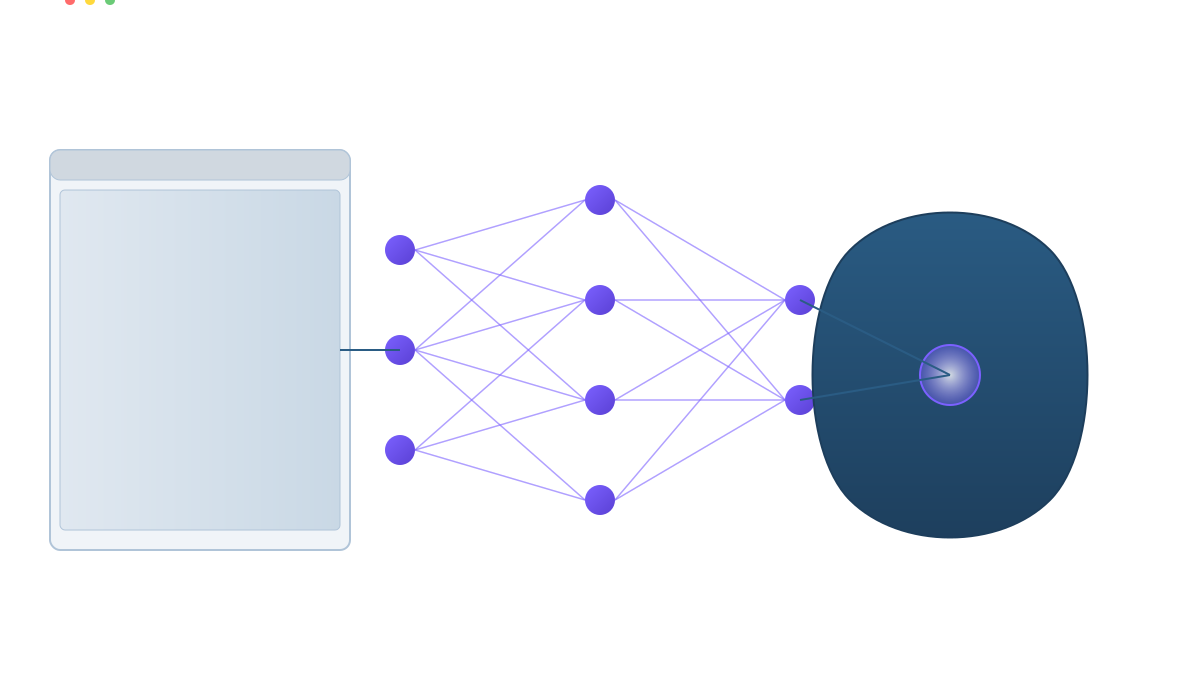
It provides an intuitive web form where users can input medical indicators to get prediction results; the code-free usage lowers the threshold for AI healthcare tools.

4

Section 04

Application Scenarios and Value: Multi-dimensional Practical Roles

  1. Early Screening Aid: Provides preliminary screening recommendations for primary institutions in areas with scarce medical resources and identifies high-risk cases.
  2. Medical Education and Training: Helps medical students understand the relationship between cytological features and tumor properties.
  3. Patient Education: Enables patients to understand the meaning of detection indicators and their impact on diagnosis results, enhancing trust.
5

Section 05

Technical Limitations and Ethical Considerations: Issues to Note

Model Accuracy Limitations

Prediction results are for reference only and cannot replace professional doctors' diagnoses; there is a risk of false positives and false negatives.

Data Privacy and Ethics

Strict compliance with data protection regulations is required; open-source projects ensure data processing security through code transparency.

Fairness and Bias

If training data is limited to specific populations, it may reduce prediction accuracy for other groups; fairness needs to be continuously monitored.

6

Section 06

Significance of Open Source: The Power of Technology for Good

Open-source projects allow developers worldwide to:

  • Review and improve algorithms
  • Adapt to local medical data
  • Integrate into complex medical information systems
  • Provide benchmark implementations for medical research
7

Section 07

Conclusion: Future Outlook of AI Healthcare

Although this application is technically simple, it represents an important direction in AI healthcare: encapsulating complex machine learning into easy-to-use tools to benefit a wider audience. With technological progress and data accumulation, we look forward to more AI healthcare applications contributing to human health.

