Zing Forum

Reading

WaterSeek: An Innovative Framework for Automatically Extracting Structured Data from Water Treatment Literature Using Large Language Models

WaterSeek is a lightweight framework that leverages large language models to extract structured data from electrochemical water treatment literature, supporting standardized database construction, machine learning modeling, and interpretable analysis of degradation kinetics.

大型语言模型文献挖掘电化学水处理数据提取机器学习降解动力学环境工程自然语言处理
Published 2026-05-15 16:25Recent activity 2026-05-15 16:30Estimated read 7 min
WaterSeek: An Innovative Framework for Automatically Extracting Structured Data from Water Treatment Literature Using Large Language Models
1

Section 01

Introduction: Core Value and Application Directions of the WaterSeek Framework

WaterSeek is a lightweight framework that uses large language models to extract structured data from electrochemical water treatment literature. It aims to solve the "data silo" problem caused by low efficiency of data extraction and inconsistent formats in this field, supporting standardized database construction, machine learning modeling, and interpretable analysis of degradation kinetics, thus providing key technical support for advancing electrochemical water treatment research.


2

Section 02

Research Background and Challenges

Electrochemical water treatment technology is an important research direction in the field of environmental engineering. However, the literature volume is huge and growing rapidly, making traditional manual data extraction time-consuming, labor-intensive, and error-prone. Differences in data formats, units, and reporting methods across studies lead to difficulties in data integration and comparison, forming "data silos" that severely hinder the development of systematic analysis and machine learning modeling. Efficient and accurate extraction of standardized data has become a key bottleneck in the field.

3

Section 03

Overview of the WaterSeek Framework

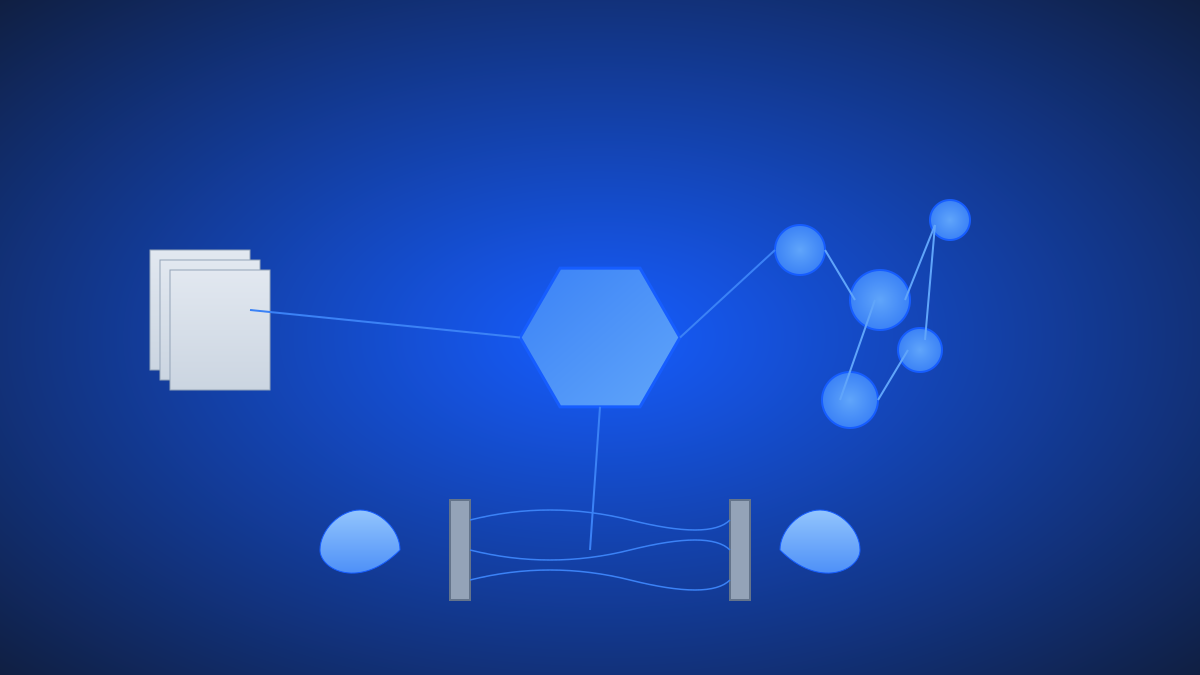
WaterSeek is a lightweight data extraction framework specifically designed for electrochemical water treatment literature. Its core innovation lies in combining the natural language understanding capabilities of large language models with domain expertise to realize the automatic conversion of unstructured text to structured data. It has clear design goals: not only to identify and extract key experimental parameters but also to ensure data standardization for subsequent database construction and machine learning analysis. It accurately identifies core information such as pollutant types and degradation conditions through predefined entity types and relationship patterns.

4

Section 04

Technical Architecture and Core Mechanisms

Literature Preprocessing Module

Extract PDF text, segment paragraphs, identify sentence boundaries, and accurately recognize key sections like titles, abstracts, and experimental methods to lay the foundation for subsequent extraction.

Entity Recognition and Relationship Extraction

Use carefully designed prompt engineering strategies to guide the language model to identify specific scientific entities (e.g., chemical names, concentration values) and handle diverse expressions (such as different concentration representation methods) using context understanding capabilities.

Data Standardization and Validation

A built-in unit conversion module unifies units, and a data validation mechanism identifies and marks extraction errors through cross-checking and rationality judgment.

5

Section 05

Application in Degradation Kinetics Analysis

Extraction of Reaction Order and Rate Constants

Automatically identify kinetic model parameters (reaction order, rate constant, half-life, etc.) reported in literature, providing a data basis for cross-study comparative analysis.

Correlation Analysis of Influencing Factors

Integrate multi-source literature data to analyze the quantitative relationship between conditional parameters (electrode material type, current density, solution pH, temperature, etc.) and degradation efficiency, discovering patterns that are difficult to observe in traditional single studies.

6

Section 06

Support for Machine Learning Modeling

Database Construction

The output structured data can be imported into relational or graph databases to build queryable and scalable literature knowledge bases, supporting keyword retrieval and complex queries based on entity relationships.

Predictive Model Development

Standardized data can be directly used for machine learning model training and validation, supporting the development of models for degradation efficiency prediction, optimal operating condition recommendation, etc., accelerating technology optimization and new application development.

7

Section 07

Practical Significance and Outlook

WaterSeek provides an effective solution for literature data mining in the field of environmental engineering, improving data extraction efficiency and accuracy, and establishing scalable and reproducible processing workflows. It helps researchers focus on scientific analysis, reduce time spent on data organization, and promote domain knowledge sharing and cross-study comparison. In the future, with the improvement of large language model capabilities and deeper domain adaptation, it is expected to be applied in more scientific fields to accelerate scientific discovery.

