Zing Forum

Reading

VoxelDM: A Diffusion Model for Directly Generating 3D Voxel Blueprints from Text

A two-stage generative AI pipeline built from scratch, which directly converts text prompts into structurally feasible 3D voxel blueprints (in .litematic format) via a latent diffusion architecture, supporting voxel construction scenarios like Minecraft.

文本到3D扩散模型体素生成Minecraft生成式AI潜在扩散3D建模litematic
Published 2026-05-10 12:26Recent activity 2026-05-10 12:30Estimated read 6 min
VoxelDM: A Diffusion Model for Directly Generating 3D Voxel Blueprints from Text
1

Section 01

Main Floor: Core Overview of VoxelDM

VoxelDM is an innovative generative AI system that uses a two-stage latent diffusion architecture to directly convert text prompts into structurally feasible 3D voxel blueprints (in .litematic format), supporting voxel construction scenarios like Minecraft. It breaks the traditional 3D modeling workflow and addresses key challenges in text-to-3D generation, such as semantic understanding, structural feasibility, and computational efficiency.


2

Section 02

Technical Background and Challenges

Text-to-3D generation faces multiple difficulties: semantic understanding needs to handle abstract concepts, spatial relationships, and size proportions; structural feasibility requires compliance with physical laws (e.g., gravity support), connectivity, and reasonable layout; in terms of computational efficiency, 3D data has high dimensionality, direct training is costly, and a balance between quality and speed must be struck.

3

Section 03

Two-Stage Architecture Design

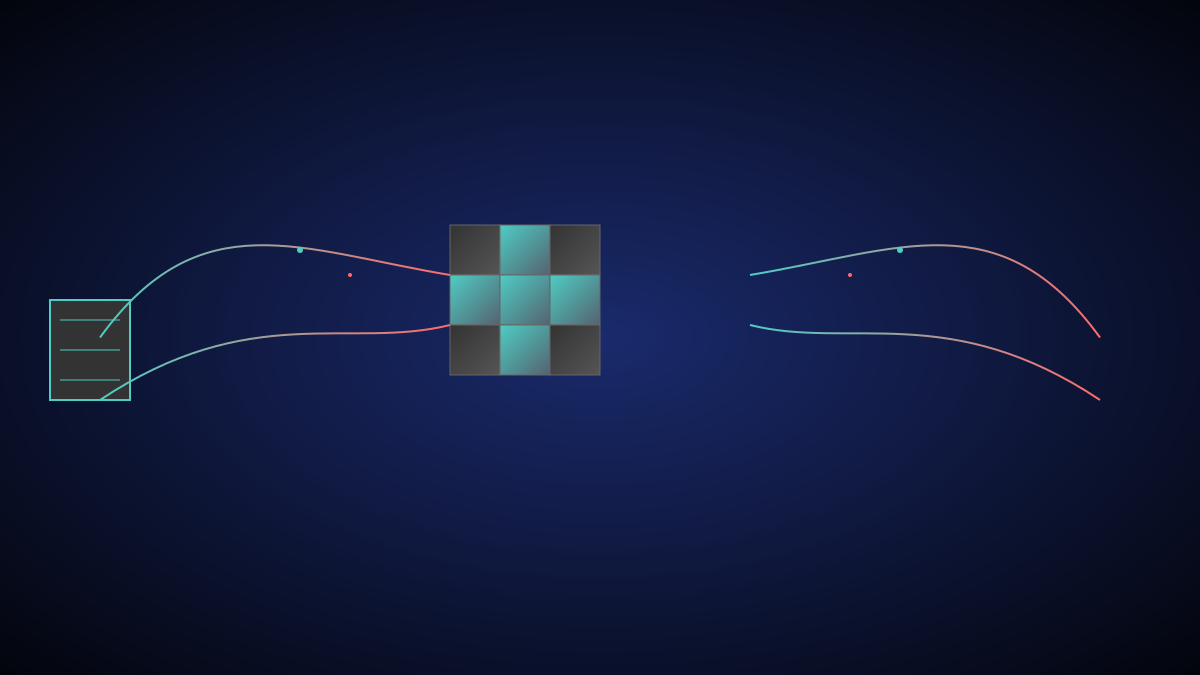
VoxelDM adopts a two-stage generation strategy: The first stage is text-to-latent representation, using a CLIP text encoder to capture semantic vectors and a conditional diffusion model with an improved U-Net to learn distributions in the latent space; The second stage is latent representation to voxel decoding, using a voxel decoder to upsample into a complete voxel grid, combined with post-processing optimizations (structural validation, hole filling, material mapping) to output the .litematic format.

4

Section 04

Model Architecture Details

The core is a 3D U-Net backbone network (3D convolution, skip connections, attention mechanism), and text condition injection uses cross-attention to fuse features; Training strategies include collecting Minecraft building data, automatically generating text descriptions (GPT-assisted), data augmentation, and the loss function covers reconstruction loss, adversarial loss, and structural regularization.

5

Section 05

Application Scenarios and Expansion Potential

Mainly applied to Minecraft game building creation (rapid prototyping, inspiration stimulation, education); Expansion potential includes voxel art animation, 3D printing model design, architectural visualization, virtual reality scene construction, etc.

6

Section 06

Technical Highlights and Innovations

VoxelDM's innovations include: End-to-end text-to-voxel generation simplifies the workflow; Structural feasibility guarantee ensures physical rationality; Open-source format compatibility (.litematic) enables seamless integration with mainstream tools; Implementation built from scratch demonstrates the capability of a complete technology stack.

7

Section 07

Limitations and Future Directions

Current limitations: Unstable quality in generating complex structures, unexpected results from unconventional descriptions, difficulty in generating large-scale buildings; High computational resource requirements; Insufficient coverage of dataset styles. Future directions: Support multi-modal input (sketches, reference images), interactive generation (iterative optimization, real-time preview), introduce larger models and reinforcement learning to improve quality.

8

Section 08

Summary and Outlook

VoxelDM combines diffusion model technology with voxel application scenarios, providing valuable references for the text-to-3D generation field. Although it is in the early stage, with iterations and dataset expansion, it is expected to make greater breakthroughs in generation quality and application scope, and is worthy of attention from players, creators, and developers.

