Zing Forum

Reading

video-to-text: An Intelligent Tool to Automatically Convert YouTube and Twitter/X Videos into Readable Articles

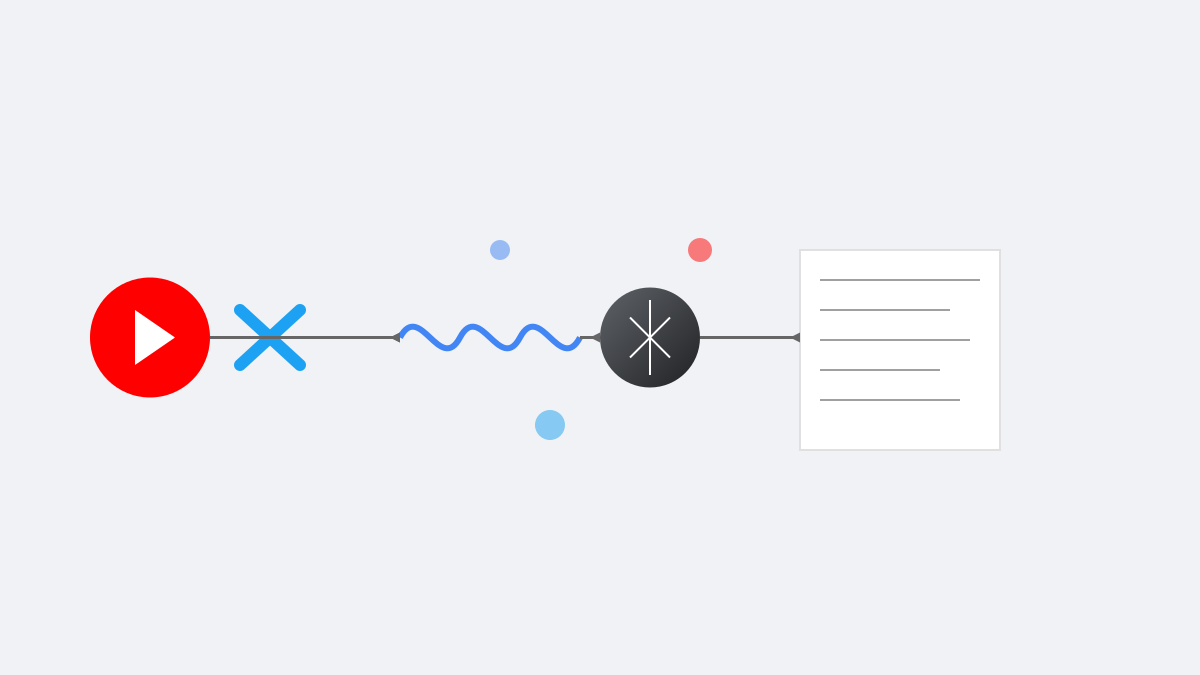
An open-source Python-based tool that converts video and podcast content into structured Brazilian Portuguese articles via local Whisper transcription and Claude/Gemma translation, generates static HTML pages, and supports SEO and LLMO optimization.

video-to-textYouTubeTwitter转录ClaudeWhisper静态HTML内容转换Python开源工具
Published 2026-04-11 12:25Recent activity 2026-04-11 12:33Estimated read 5 min
video-to-text: An Intelligent Tool to Automatically Convert YouTube and Twitter/X Videos into Readable Articles
1

Section 01

【Introduction】video-to-text: An Intelligent Tool to Convert Videos into Readable Articles

video-to-text is an open-source Python-based tool that can automatically transcribe and translate YouTube and Twitter/X videos into structured Brazilian Portuguese articles, and generate SEO-friendly static HTML pages. Its core features include local Whisper transcription and Claude/Gemma translation, addressing the pain point of low reading efficiency for video content, allowing users to read at their own pace and quickly locate key information.


2

Section 02

Project Background and Core Motivation

In the era of information explosion, video content is growing rapidly, but watching long videos is time-consuming and does not allow quick browsing. The project was born because the developer prefers reading over watching long videos. The goal is to build an end-to-end pipeline: obtain content from video URLs, automatically transcribe, translate, and reorganize into well-structured articles, and present them as static HTML for easy mobile reading.

3

Section 03

Technical Architecture and Implementation Principles

Adopts a modular architecture: Input layer receives URLs → Provider layer detects sources and invokes strategies → Processing layer uses Claude for translation and reorganization → Generation layer builds static HTML → Output layer presents. The Provider abstraction layer supports expansion; current strategies include YouTube (using youtube-transcript-api) and Twitter/X (download audio with yt-dlp + local transcription with mlx-whisper). After transcription, Claude processes: translate to Brazilian Portuguese, remove redundancy, filter ads, and split into chapters by topic.

4

Section 04

Reading Experience Design

Mobile-first design; static HTML without frameworks loads quickly. Supports three themes (Sépia default, bright, dark); progress tracking with automatic recovery, saved independently across devices; clickable chapter index for quick jumps; responsive layout adapts to small screens.

5

Section 05

Integration and Usage Methods

Integration with Hermes Agent: Users send links to Hermes → automatic processing → generate HTML and push → users receive links to read. Local deployment: Clone the repository, create a virtual environment, install dependencies, start the server; use the pipeline.py command to process videos, which automatically detects the URL source without needing to specify it.

6

Section 06

Application Cases and Project Significance

Cases include popular AI field articles such as "Claude Code Lead Talks About the Future of Programming". Significance: Convert passive viewing to active reading, improve efficiency (reading is 2-3 times faster than watching videos), enable flexible fragmented reading, easy retrieval and archiving, and accessibility; demonstrate the idea of open-source tool combination and extension design.

7

Section 07

Summary and Outlook

The project accurately addresses the pain points of video reading, with elegant technical implementation (modular, pure static output), excellent user experience, and convenient integration. In the future, as the capabilities of large models improve, the application scenarios of such automated content conversion tools will become more extensive.

