Zing Forum

Reading

TimePoint Flash: A Multi-Agent Generation System for Reconstructing Historical Scenes with 15 Agents

TimePoint Flash is an innovative multi-agent AI system that transforms natural language queries into realistic historical scene reconstructions through the collaboration of 15 specialized agents.

多智能体系统AI生成历史场景重建自然语言处理计算机视觉TimePoint Flash
Published 2026-05-28 08:13Recent activity 2026-05-28 08:22Estimated read 4 min
TimePoint Flash: A Multi-Agent Generation System for Reconstructing Historical Scenes with 15 Agents
1

Section 01

Introduction: TimePoint Flash—A Multi-Agent Generation System for Reconstructing Historical Scenes with 15 Agents

TimePoint Flash is a cutting-edge multi-agent AI system developed by the timepointai team. It transforms natural language queries into realistic historical scene reconstructions through the collaboration of 15 specialized agents. The system breaks down complex tasks into subtasks, achieving high-fidelity reproduction from text to visuals, and is applied in multiple fields such as education, film and television, and cultural heritage protection.


2

Section 02

Project Background and Overview

Original author/maintainer: timepointai; Source platform: GitHub; Release date: 2026-05-28. The core concept of the project is to decompose the historical scene generation task into multiple specialized subtasks, which are completed collaboratively by 15 agents to improve generation quality and system interpretability.

3

Section 03

Technical Architecture and Workflow

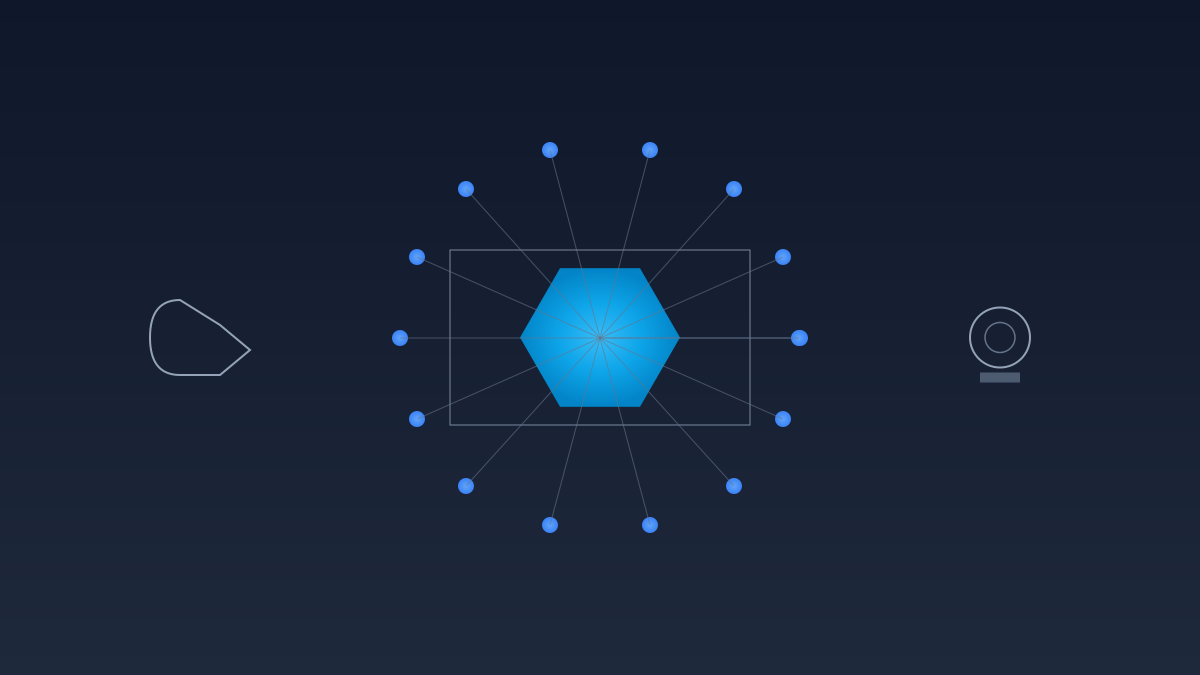
It adopts an innovative multi-agent architecture where each of the 15 agents is responsible for specific subtasks (such as time coordinate extraction, character portrait construction, visual rendering, etc.). Workflow: User inputs natural language query → Time coordinate extraction → Character portrait construction → Relationship graph mapping → Scene environment reconstruction → Visual rendering, etc., and finally generates a realistic historical scene.

4

Section 04

Application Scenarios and Practical Value

  • Education: Assists in history teaching
  • Film and television production: Generates concept art to reduce costs
  • Cultural heritage protection: Reconstructs lost scenes
  • Game development: Enriches historical materials
  • Academic research: Visualizes historical data to verify consistency
5

Section 05

Technical Challenges and Solutions

Challenges:

  • Balancing historical accuracy and artistic expression
  • Complexity of multi-agent coordination
  • Content consistency

Solutions:

  • Cross-validation by fact-checking agents
  • Hierarchical task scheduling mechanism
  • Shared state space to ensure consistency
6

Section 06

Future Outlook

In the future, it is expected to achieve higher-quality scene generation, supporting video and 3D model outputs; The modular design provides a reference paradigm for multi-agent applications in other fields.