Zing Forum

Reading

TaskFlow: An AI-Powered Real-Time Kanban App That Automatically Breaks Down Complex Goals into Executable Tasks

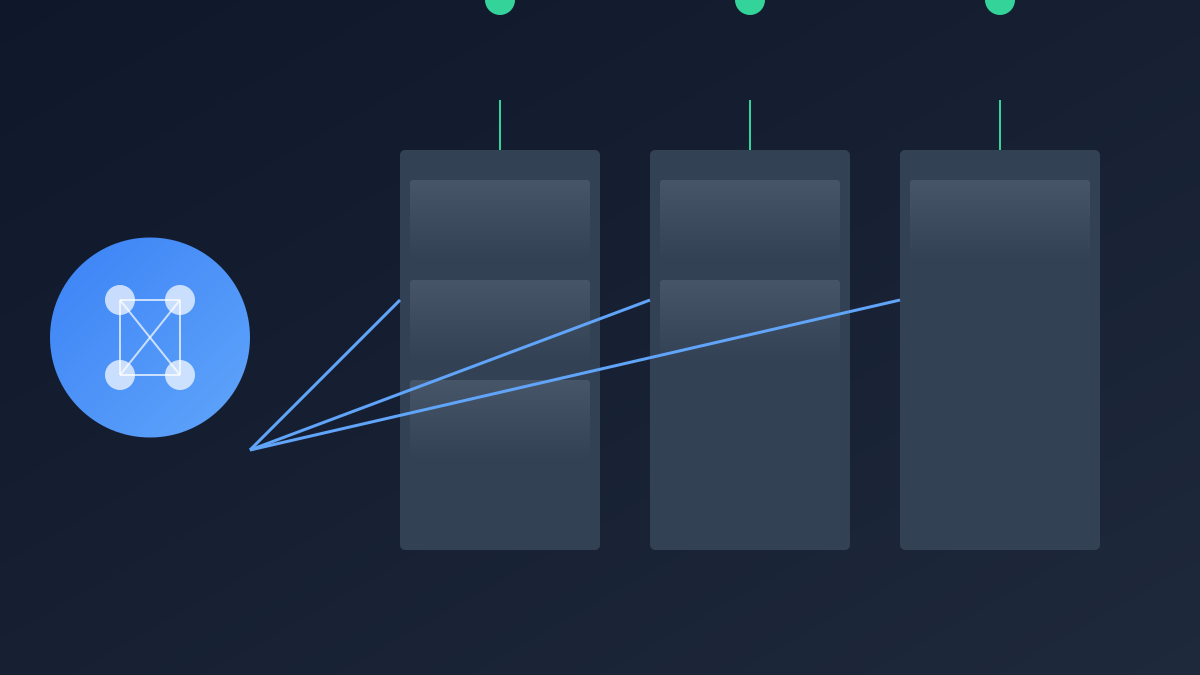
TaskFlow is a real-time kanban application deeply integrated with AI. It uses large language models to automatically break down complex goals into executable tasks while providing a smooth collaborative experience.

AI任务管理看板Kanban大语言模型实时协作生产力工具开源项目
Published 2026-04-30 05:36Recent activity 2026-04-30 09:42Estimated read 8 min
TaskFlow: An AI-Powered Real-Time Kanban App That Automatically Breaks Down Complex Goals into Executable Tasks
1

Section 01

[Introduction] TaskFlow: An AI-Powered Real-Time Kanban That Automatically Breaks Down Complex Goals into Executable Tasks

TaskFlow is a real-time kanban application deeply integrated with AI. Its core capability is using large language models to automatically break down abstract and complex goals into logically clear, priority-defined subtask sequences, while providing a delay-free real-time collaboration experience. It addresses the pain point of traditional task management tools being merely checklist recorders without intelligent assistance. Suitable for team collaboration and personal task planning, it is an open-source solution to boost productivity.


2

Section 02

Project Background: Why Do We Need AI-Powered Task Management?

In daily work and study, when facing vague goals like "complete a quarterly report" or "learn machine learning", traditional task management tools can only record to-dos but cannot provide intelligent planning. TaskFlow was born to address this pain point. It is not just a to-do list; it is an intelligent collaboration platform that understands user intent and automatically plans execution paths. By using large language models, it converts abstract goals into specific executable tasks, making complex work clear and manageable.

3

Section 03

Core Features: How Does AI Empower Task Management?

Intelligent Goal Decomposition

When users input high-level goals, the system calls large language models for analysis and generates logically clear, priority-defined subtasks (e.g., inputting "develop a machine learning classifier" generates a task chain including data collection, feature engineering, etc.), saving manual planning time and covering key steps.

Real-Time Collaboration Kanban

Adopting the Kanban methodology, it supports task status columns (To-Do/In Progress/Done), enabling delay-free collaboration with instant synchronization, intelligent conflict merging, and activity tracking—ideal for remote and agile teams.

Context-Aware Recommendations

AI learns user habits and provides proactive recommendations such as task completion time estimates, resource suggestions, dependency identification, and missing step prompts, evolving from a passive recording tool to an intelligent assistant.

4

Section 04

Technical Architecture: Design for a "Delay-Free" Experience

Frontend Architecture

Responsive design adapts to multiple devices. Two-way real-time communication is implemented via WebSocket, with operations synchronized to all collaborators' interfaces in milliseconds.

Backend Services

Distributed architecture supports horizontal scaling. State changes are recorded based on the event sourcing pattern, data synchronization is handled using an eventual consistency model, and it has a fault-tolerance mechanism with automatic failover.

AI Integration Layer

Deeply integrates mainstream large language model services while supporting local open-source model deployment. Users can choose cloud API (strong capability), local deployment (privacy protection), or hybrid mode (balance between cost and performance).

5

Section 05

Application Scenarios: Who Is TaskFlow For?

Software Development Teams

As an agile Sprint management tool, AI helps break down user stories into development tasks, and real-time collaboration enables distributed teams to work efficiently.

Academic Researchers

Plan complex experimental processes; AI identifies research milestones (literature review, experimental design, data analysis, etc.) to ensure projects progress as planned.

Individual Learners

Convert vague learning goals (e.g., "learn Python") into structured paths, recommend resources, and set checkpoints to help maintain motivation.

Project Management Office (PMO)

Coordinate cross-departmental large-scale projects; AI generates task dependency graphs and risk alerts to identify bottlenecks in advance.

6

Section 06

User Experience: A Smooth Closed Loop from Idea to Execution

TaskFlow's design philosophy is "reduce friction, increase flow", shortening the path from user's idea to execution:

  1. Quick Capture: Natural language input without complex syntax;
  2. Intelligent Planning: AI automatically suggests task structure and priorities;
  3. Flexible Adjustment: Drag-and-drop operations to reorganize tasks and adapt to changing needs;
  4. Progress Visualization: Agile metrics like burn-down charts and cumulative flow diagrams to track project health. This experience allows users to focus on core work without being hindered by the tool.
7

Section 07

Future Outlook and Summary

Future Outlook

TaskFlow represents the transformation of productivity tools from "recording-type" to "intelligent-type". In the future, it will implement features such as intelligent meeting summary extraction of action items, prediction of project delay risks, cross-project learning of best practices, and natural language query of project status.

Summary

TaskFlow combines large language model intelligence with real-time collaboration kanban, bringing new possibilities to task management and proving that AI can be a practical tool to improve work efficiency. For organizations and individuals who want to enhance collaboration efficiency and reduce planning burdens, it is an open-source solution worth trying, indicating that future productivity tools will be more "understanding" of users and more proactive in providing help.

