Zing Forum

Reading

Tableau × Claude: A Zero-Backend Architecture Solution for Integrating Data Visualization and AI Dialogue

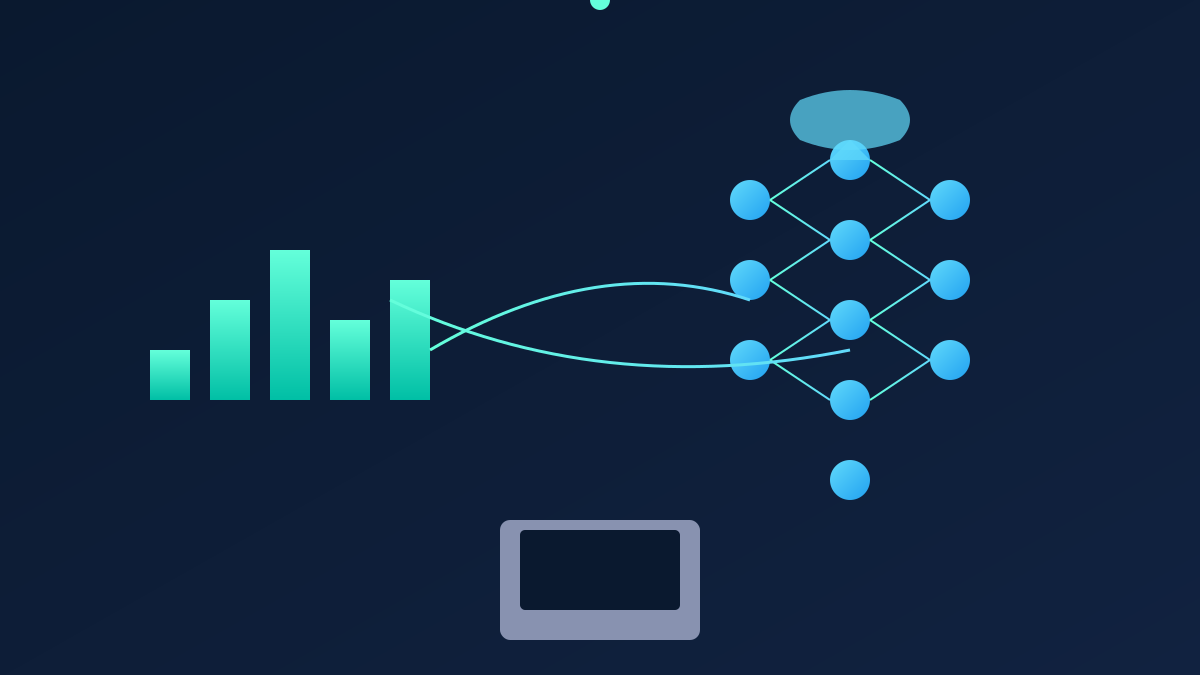
A pure client-side, zero-backend web application that combines Tableau Public's data visualization capabilities with Anthropic Claude's large language model, allowing users to explore data insights through natural language dialogue.

TableauClaude数据可视化零后端架构自然语言分析BI工具纯客户端应用
Published 2026-06-02 07:43Recent activity 2026-06-02 07:50Estimated read 6 min
Tableau × Claude: A Zero-Backend Architecture Solution for Integrating Data Visualization and AI Dialogue
1

Section 01

Introduction: Tableau×Claude Zero-Backend Solution for Integrating Data Visualization and AI Dialogue

This article introduces a pure client-side, zero-backend web application that combines Tableau Public's data visualization capabilities with Anthropic Claude's large language model, enabling users to explore data insights through natural language dialogue. This solution addresses the cognitive gap in the field of data visualization and has core advantages such as zero infrastructure cost, privacy-first approach, and immediate value.


2

Section 02

Problem Background: Cognitive Gap in Data Visualization and Limitations of Existing Solutions

The Tableau Public platform hosts over 1 million community workbooks, but there are significant pain points: discovery relies on keywords, technical extraction requires professional knowledge, insight synthesis is manual, and documentation is scarce. Existing integration solutions between Claude and Tableau either require a backend server (high cost) or developer setup (not user-friendly for non-technical users).

3

Section 03

Project Solution: Zero-Backend Architecture and Core Values

Pure client-side design, directly connecting to Tableau Public REST API and Anthropic Messages API (via browser-native fetch). Core values:

  1. Zero infrastructure cost (deployed as a single HTML file)
  2. Privacy-first (data/keys never leave the browser)
  3. Immediate value (get first insight within 60 seconds)
  4. Dual integration paths (Tableau Public search + manual context input) Advantages of pure client-side: simple deployment, privacy protection, low cost, and immediate availability.
4

Section 04

Use Cases and Workflow

Use Case 1: Public Workbook Exploration

  1. Enter keywords to search
  2. API returns a list of workbooks
  3. Select a workbook
  4. Extract structure and data summary
  5. Ask questions in natural language
  6. Claude generates answers

Use Case 2: Private Workbook Analysis

  1. Manually copy key information from the workbook
  2. Paste into the context input area
  3. Engage in dialogue for in-depth understanding
  4. Obtain AI-assisted insights
5

Section 05

Key Technical Implementation: Lightweight Stack and Security Measures

Frontend Tech Stack: HTML/CSS/JavaScript (no frameworks), native Fetch API, optional localStorage for key storage Security Measures:

  • Keys are stored only in memory (unless the user chooses to save them)
  • API calls are initiated directly from the browser (no intermediate server)
  • Supports Content Security Policy (CSP) configuration
6

Section 06

Project Significance and Industry Implications

For BI Tools: Demonstrates the possibility of integrating traditional BI with AI dialogue interfaces; future analysis may obtain insights through dialogue For Architecture Design: Zero-backend architecture is a new paradigm; pure frontend applications reduce development and operation costs and enhance privacy For Data Democratization: Lowers technical barriers, allowing non-technical users to self-service insights

7

Section 07

Limitations and Future Directions

Current Limitations: Relies on Tableau Public API functions, private workbooks require manual input, high-frequency use of Anthropic API incurs costs Future Directions: Expand more data sources, enhance context understanding (screenshots of visual analysis dashboards), add collaboration features

8

Section 08

Conclusion: A Small but Beautiful Innovation Example

Tableau×Claude is an elegant proof-of-concept project that solves real problems with a simple tech stack. This 'small but beautiful' solution reminds us: innovation does not necessarily require complex architecture; a single HTML file can also create value, making it a worthy example for AI-enhanced data analysis.