Zing Forum

Reading

SmartHealthCare AI: Technical Analysis of a Full-Stack Intelligent Medical Diagnosis Platform

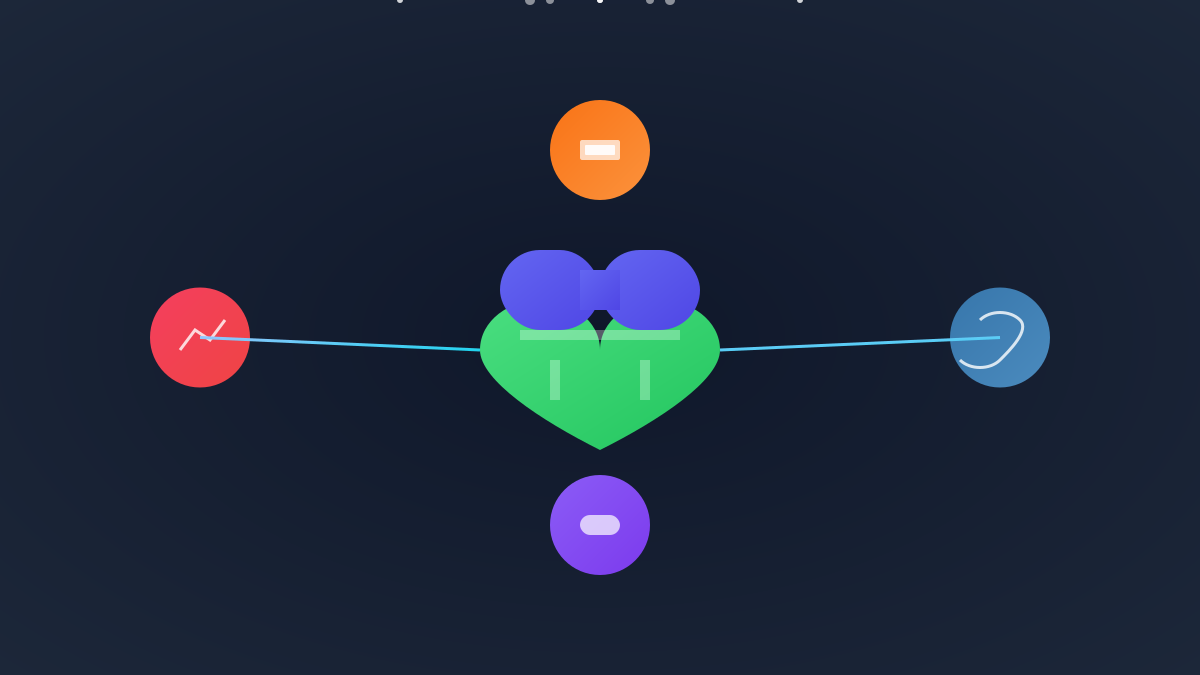
An in-depth analysis of the four core modules of the SmartHealthCare AI platform: Disease Prediction, Drug Recommendation, Heart Risk Assessment, and RAG Medical Assistant, exploring its technical architecture, machine learning model selection, and multimodal interaction design.

医疗AI机器学习StreamlitRAG健康科技疾病预测药物推荐Python
Published 2026-06-02 19:42Recent activity 2026-06-02 19:48Estimated read 8 min
SmartHealthCare AI: Technical Analysis of a Full-Stack Intelligent Medical Diagnosis Platform
1

Section 01

SmartHealthCare AI Platform Guide: Core Value and Module Overview of Full-Stack Intelligent Medical Diagnosis

SmartHealthCare AI v2.0.2 is a comprehensive intelligent medical diagnosis platform integrating four core modules: Disease Prediction, Drug Recommendation, Heart Risk Assessment, and RAG Medical Assistant. Built with Python and Streamlit, the platform follows the Material Design3 Expressive design specification, supporting theme switching and responsive layout. Its core value lies in integrating multiple independent AI functions into a unified interface, balancing accuracy and ease of use, and providing comprehensive health assessment services for medical practitioners and ordinary users.


3

Section 03

Analysis of Technical Architecture and Design Philosophy

Overall Architecture

The platform adopts a modular architecture, with the main entry home.py as the unified portal, sidebar navigation connecting the four modules, and the global theme managed by theme_config.py, supporting independent development and iteration of each module.

Frontend Design

Adopting the Material Design3 Expressive style, it reduces user anxiety through white space, rounded cards, and micro-interactions; differentiated font strategy: Outfit+Plus Jakarta Sans for the homepage, Nunito+Space Grotesk for drug recommendation, Sora+DM Sans for heart risk assessment, enhancing visual hierarchy.

4

Section 04

Technical Implementation Details of the Four Core Modules

Disease Prediction Module

Based on the Random Forest algorithm (emphasizing interpretability), it supports prediction of 41 diseases with the process: Symptom input → Multi-classification prediction → Return disease and confidence → Provide medical advice.

Drug Recommendation System

Based on cosine similarity, it recommends drugs from a library of 9720 medications, with core functions: intelligent search, drug comparison, detail page, watchlist, and interaction check (marking combinations requiring pharmacist review).

Heart Risk Assessment

Trained on the BRFSS 2022 dataset using the LightGBM model, it includes 6 tabs (risk assessment, SHAP interpretability, health tools, etc.) and supports PDF report export.

RAG Medical Assistant (Medibot)

Based on FAISS vector database + Groq Mistral LLM + voice input, it includes 5 tabs (symptom check, medication reminder, health score, etc.) and supports voice interaction and chat history export.

5

Section 05

Innovative Engineering Practices and User Experience Optimization

  • Floating Quick Navigation: Draggable component, no need to scroll to jump between sections/tabs, mobile-friendly.
  • Session Persistence: Operation states such as drug watchlist are retained after page refresh, improving experience continuity.
  • Statistics and Export: Medibot provides reading time estimation, word count, message count, and chat history export, respecting user data sovereignty.
6

Section 06

Application Value and Practical Scenario Roles

  1. Popularization of Preventive Medicine: Helps ordinary users conduct preliminary self-assessment, increasing the possibility of early disease detection.
  2. Medication Safety Education: Reduces the risk of irrational medication use through interaction checks.
  3. Medical Resource Diversion: Provides preliminary guidance for mild cases, reducing the pressure on medical institutions.
  4. Health Awareness Enhancement: Visual displays and interactive assessments cultivate users' health management habits.
7

Section 07

Limitations and Precautions

  1. Regulatory Compliance: Medical AI faces different regulatory requirements in different regions; full assessment is needed before deployment.
  2. Data Privacy: Health data is sensitive and requires strict protection measures.
  3. Model Limitations: Machine learning models have the risk of misdiagnosis; outputs should be labeled "For reference only, not constituting medical advice."
  4. Edge Cases: Rare diseases and complex cases may not be covered in the training data.
8

Section 08

Summary and Industry Insights

SmartHealthCare AI is a medical AI demo project with a complete tech stack and rich functions, reflecting an understanding of the specificity of medical AI (interpretability, user-friendliness, and data security are equally important). It provides reference architectures such as modular design and unified themes for developers; for medical technology practitioners, it demonstrates the potential of AI applications while reminding that technology deployment must advance in sync with ethics and regulation. Its pragmatic approach focuses on "auxiliary decision-making" and "health education" rather than replacing doctors.