Zing Forum

Reading

Sketcher: A Production-Grade AI Application for Turning Sketches into Anime Characters in Seconds

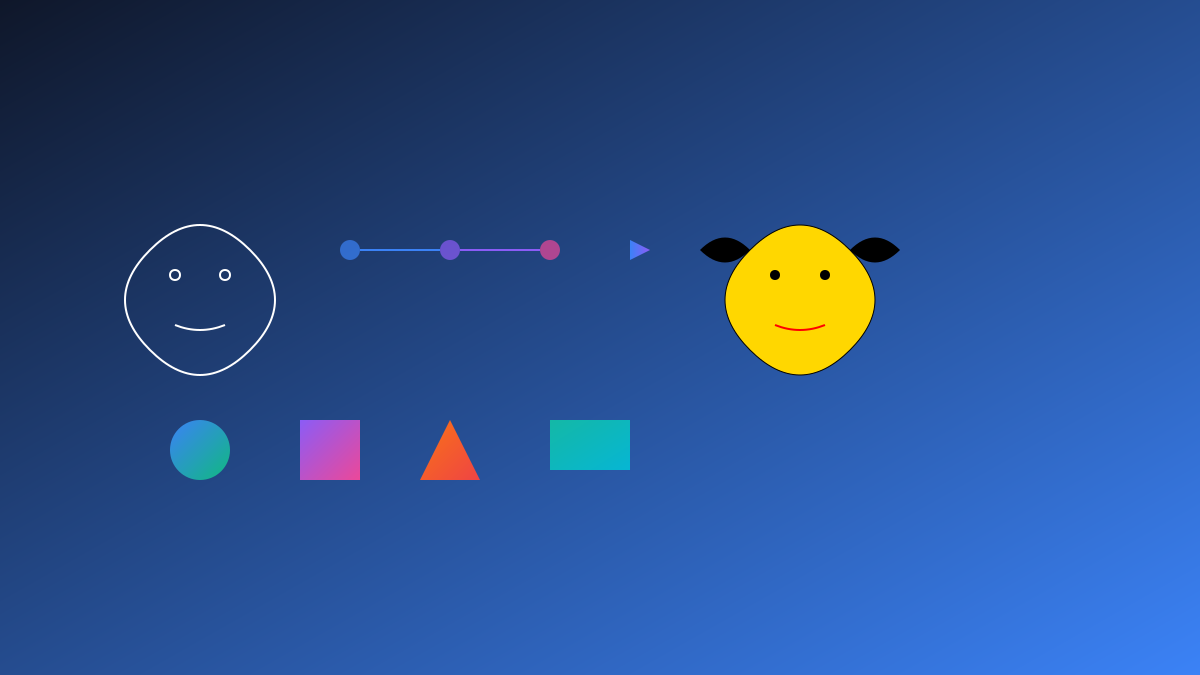
A sketch generation system based on Stable Diffusion XL and ControlNet, combining Next.js frontend and Modal GPU backend, enabling a complete workflow from hand-drawn sketches to high-quality characters in anime, cartoon, and watercolor styles.

Stable DiffusionControlNetAI绘画草图生成Next.jsModal文生图动漫生成
Published 2026-06-16 13:43Recent activity 2026-06-16 13:48Estimated read 6 min
Sketcher: A Production-Grade AI Application for Turning Sketches into Anime Characters in Seconds
1

Section 01

Sketcher Project Introduction: A Production-Grade AI Application for Turning Sketches into Anime Characters in Seconds

Sketcher is a production-grade AI web application based on Stable Diffusion XL and ControlNet, which can quickly convert hand-drawn sketches into high-quality characters in anime, cartoon, and watercolor styles. The project adopts a front-end and back-end separation architecture: the front-end is built with Next.js and deployed on Vercel, while the back-end uses Modal to provide GPU-accelerated inference services. It aims to lower the threshold for creation and shorten the conversion time from idea to finished product.


2

Section 02

Project Background and Overview

  • Original Author/Maintainer: AbdulahadIltaf
  • Source Platform: GitHub
  • Release Date: 2026-06-16

Sketcher is an AI web application for production environments. Its core generation pipeline is based on Stable Diffusion XL combined with ControlNet to achieve precise sketch condition control. The front-end and back-end separation architecture ensures efficient operation and low-latency access worldwide.

3

Section 03

Core Features and Multi-Style Support

Core Features

  • Intelligent sketch-to-image conversion: Lowers the creation threshold, allowing users to generate detailed character images without professional painting skills
  • Multi-style output: Supports three styles—anime, 3D toy, and watercolor—to meet diverse needs
  • Interactive canvas: Provides functions like freehand drawing, tracking overlay layers, and real-time preview, compatible with mobile touch operations.
4

Section 04

Technical Architecture Analysis

Front-end Layer

Developed with the Next.js framework, uses Canvas API to handle drawing input, deployed on Vercel to leverage edge network and serverless features

Back-end Layer

Inference services written in Python, deployed on the Modal platform (a serverless GPU computing platform designed for ML, with on-demand instance startup)

Generation Pipeline

  • SDXL: The base diffusion model responsible for high-quality image generation
  • ControlNet: Precisely follows the sketch's composition, pose, and outline, solving the structural control pain points of traditional text-to-image generation.
5

Section 05

Deployment and Usage Workflow

Back-end Deployment (Modal)

  1. Install the Modal client: pip install modal-client
  2. Deployment command: modal deploy backend.py
  3. Obtain the API endpoint and configure it in the front-end

Front-end Deployment (Vercel)

  1. Initialize a Next.js project
  2. Integrate canvas components and API calls
  3. Push the code to GitHub and deploy with one click on Vercel.
6

Section 06

Cost Optimization Strategies

  • Adopt Modal's GPU pay-as-you-go billing model (A10G/L4 instances)
  • Container-level model caching to avoid cold start overhead
  • Stateless API design supports horizontal scaling, automatically adjusting the number of instances based on traffic.
7

Section 07

Future Feature Plans

Sketcher plans to expand the following features in the future:

  • Facial consistency control
  • Text prompt refinement
  • Batch generation mode
  • User gallery and history records
  • LoRA style training support.
8

Section 08

Practical Significance and Insights

Sketcher demonstrates the modern AI application development paradigm: using open-source large models (SDXL, ControlNet) + cloud-native infrastructure (Vercel, Modal) to quickly build production-grade applications. It provides developers in the AI image generation field with a reference implementation that has a clear structure and decoupled components.

