Zing Forum

Reading

SevaSetu Smart Government Affairs Platform: AI and OCR Technology Reshape Government Form Processing Experience

Introduces the SevaSetu AI Smart Government Affairs Platform, which simplifies government form processing workflows using artificial intelligence and optical character recognition (OCR) technology, addresses the pain point of citizens repeatedly filling in personal information, and improves the efficiency of government services and user experience.

智能政务OCR表单处理人工智能政务服务文档识别自动填充数字化转型公民服务信息提取
Published 2026-06-01 15:15Recent activity 2026-06-01 15:21Estimated read 7 min
SevaSetu Smart Government Affairs Platform: AI and OCR Technology Reshape Government Form Processing Experience
1

Section 01

Introduction: SevaSetu Smart Government Affairs Platform—AI and OCR Technology Reshape Government Form Processing Experience

The SevaSetu AI Smart Government Affairs Platform targets the pain point of citizens repeatedly filling in personal information when handling government affairs. It uses artificial intelligence (AI) and optical character recognition (OCR) technology to simplify form processing workflows, enabling "one-time entry, multiple reuse" to improve the efficiency of government services and user experience. Through functions such as intelligent document recognition, information extraction, and cross-form data reuse, the platform solves the problem of repeated information entry and promotes the digital transformation of government services.


2

Section 02

Background: The Pain Point of Repeated Form Filling in Government Services

When citizens handle government services (such as passport applications, social security processing, tax declarations, etc.), they need to repeatedly fill in basic information like name, ID number, and address across different departments and forms. This not only wastes time but also easily leads to information inconsistencies due to manual errors, delaying service processing. This inefficient link is the core problem that the SevaSetu platform aims to solve.

3

Section 03

Methodology: Core Functions of the Platform and OCR Technology Support

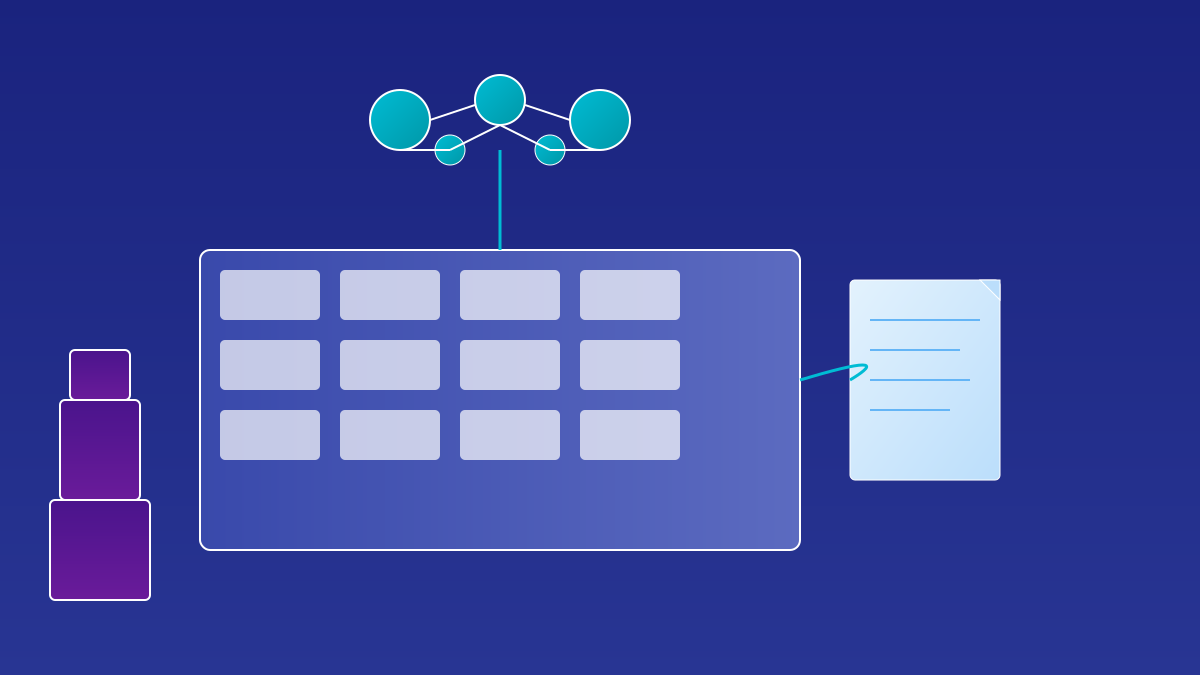
The core functions of the SevaSetu platform include intelligent document recognition, automatic information extraction, cross-form data reuse, and intelligent form filling. After users upload documents containing personal information, the system uses OCR technology to recognize text and converts it into structured data combined with deep learning models; Document Layout Analysis (DLA) identifies document regions, and Key Information Extraction (KIE) accurately locates fields; Image preprocessing (denoising, deskewing, etc.) improves the recognition accuracy of low-quality documents.

4

Section 04

Method Details: Implementation Mechanism of Intelligent Form Filling

The platform records the semantic equivalence relationships of different form fields (such as "ID number" and "Citizen Identity Number") through a field mapping knowledge base, uses natural language processing to parse field semantics, and automatically fills in information from the user's profile; The data verification module (mandatory item, format, and logic checks) ensures information completeness and consistency, reducing return cases.

5

Section 05

User Experience Design and Data Security Protection

The platform focuses on usability, with a simple interface guiding operations, supporting multi-modal interactions such as photo/scanning/file upload, and real-time preview of recognition results; Voice assistance and high-contrast mode cater to special groups; Mobile-first design adapts to various screens, and offline mode supports scenarios with unstable networks. In terms of data security, it uses end-to-end encryption, static encrypted storage, and role-based access control, complies with data protection regulations, and users have the right to view/modify/delete their data.

6

Section 06

Application Scenarios and Expansion Potential

The platform is suitable for high-frequency government services such as household registration management, social security processing, and tax declaration, freeing staff from tedious entry work; It can be extended to fields such as healthcare (medical record reuse), education (student status management), and finance (KYC optimization); Open APIs support third-party system integration, the AI continuous learning mechanism optimizes recognition accuracy, and crowdsourced verification improves model performance.

7

Section 07

Key Points of Technical Implementation

The front end uses a modern Web technology stack, and the back end uses a microservice architecture (modules such as OCR recognition and data storage are deployed independently); Containerization simplifies environment management, and model inference optimization balances accuracy and speed; Caching strategies reduce repeated calculations, and asynchronous queues handle high concurrency; The database supports structured/unstructured data storage, and index optimization improves query performance.

8

Section 08

Conclusion: Future Direction of Technology-Enabled Government Services

The SevaSetu platform combines AI and OCR to simplify form processing workflows, save citizens' time, and improve the quality of government services. Such user-centric innovative applications represent the evolutionary direction of government services, and intelligent form processing is expected to become a standard configuration, realizing the concept of "data runs more, people run less".