Zing Forum

Reading

SEI-GENA: Automatically Track 41 Global Research Funding Portals Using Generative AI

The SEI-GENA project, developed by the Stockholm Environment Institute (SEI), uses generative AI technology to automatically monitor 41 international research funding and tender portals worldwide, helping researchers access funding opportunities in a timely manner.

生成式AI科研资助招标信息斯德哥尔摩环境研究所UNDP世界银行绿色气候基金自动化语义分析开源
Published 2026-06-08 23:44Recent activity 2026-06-08 23:50Estimated read 6 min
SEI-GENA: Automatically Track 41 Global Research Funding Portals Using Generative AI
1

Section 01

Introduction: SEI-GENA—Automatically Track Global Research Funding Portals Using Generative AI

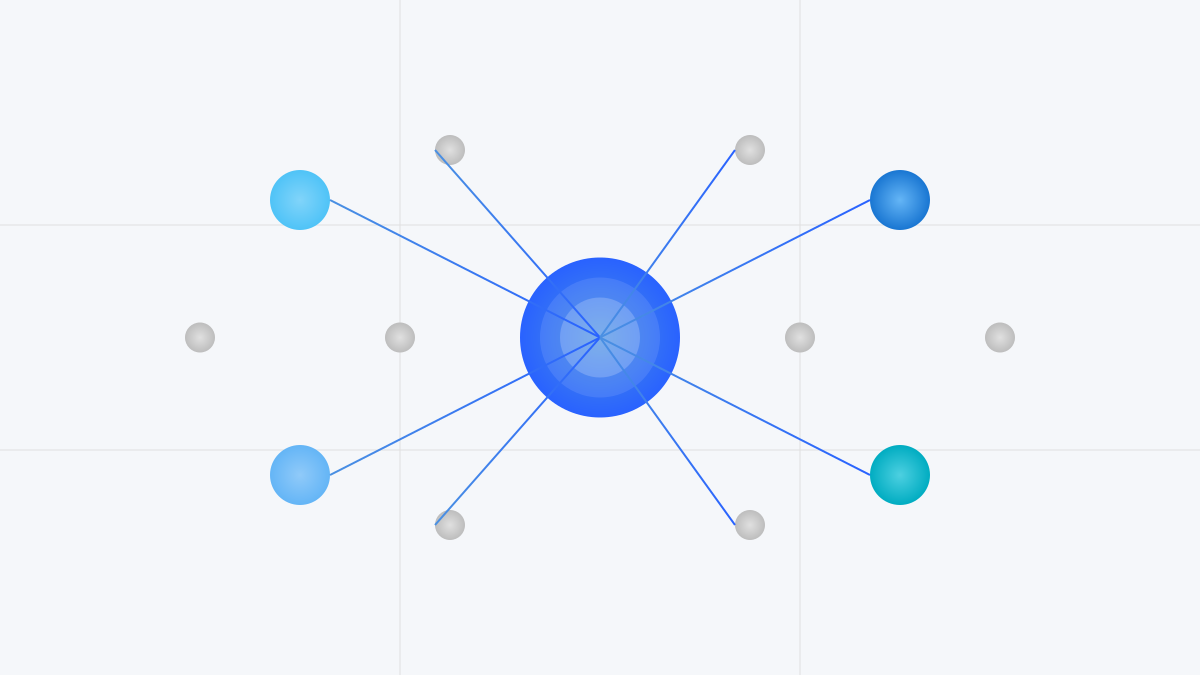
The SEI-GENA project, developed by the Stockholm Environment Institute (SEI), uses generative AI technology to automatically monitor 41 international research funding and tender portals worldwide, addressing the problems of fragmented information access and low efficiency faced by researchers. The full name of the project is "SEarch for International calls for proposals using GENerative Artificial intelligence", and it is currently in the second phase of expansion, adopting an open-source collaboration model.


2

Section 02

Project Background and Motivation

Traditionally, accessing international research funding information relies on manual browsing of dozens of websites, which is time-consuming and prone to omissions. As an independent international research institution, SEI launched the SEI-GENA project led by researcher Carlos Mendez to address the information fragmentation problem faced by researchers. Its core goal is to intelligently extract and organize funding opportunity information through automation and semantic analysis technologies.

3

Section 03

Technical Architecture and Coverage

SEI-GENA has entered the second phase and integrated 41 portals:

  • Latin America: 9 portals including MinCiencias, MinAmbiente, FontAgro;
  • UN and International Organizations: 10 portals including UNDP, World Bank, European Commission;
  • Environmental Special Programs: 9 portals including Green Climate Fund, GEF, WWF;
  • Charitable Foundations: 6 portals including Bezos Earth Fund, Clean Air Fund.
4

Section 04

Application Mechanism of Generative AI

The core innovation lies in the semantic analysis of generative AI:

  • Automated Extraction: Regularly access portals to extract complete structured information;
  • Semantic Analysis: Identify key information (amount, eligibility, deadline, etc.), classify tags, process multiple languages, and score relevance;
  • Intelligent Recommendation: Precisely push matching funding opportunities based on user interests.
5

Section 05

Practical Application Value

For researchers: Save time, access relevant opportunities in a timely manner, and gain a comprehensive understanding of the funding landscape; For institutions: Centralize management of funding intelligence, identify interdisciplinary opportunities, and support strategic planning; For development fields: Align with UN SDGs and facilitate the implementation of environmental and sustainable development projects.

6

Section 06

Open-Source and Collaboration Model

The project is open-sourced under the MIT License and released as a GitHub template repository, with scalability (modular integration, standardized format). The community can contribute portal code, improve algorithms, share data sources, and provide multilingual support.

7

Section 07

Project Limitations and Future Directions

Limitations: The complete automation and AI analysis code are not fully open-sourced; accuracy and recall rates need to be verified; multilingual support (e.g., Chinese, Arabic) needs optimization; Future: Develop a user-friendly UI, real-time push mechanism, introduce advanced LLMs to enhance semantic analysis, establish user feedback, and integrate academic databases.

8

Section 08

Summary and Insights

SEI-GENA demonstrates the innovative application of generative AI in research management, reducing the administrative burden on researchers. For Chinese institutions: Learn from the portal classification system, adopt the open-source collaboration model, and explore more scenarios of AI in research management. In the global competition for research funding, timely and accurate access to information is key, and the technical solution provided by this project is worth attention.

