Zing Forum

Reading

Detecting Insider Trading Using Graph Neural Networks: Identifying Suspicious Patterns in SEC Data

This article introduces an open-source project for insider trading detection based on graph neural networks (GNNs). The project models relationships between traders, stocks, and events to identify suspicious trading patterns from SEC filings, and combines explainable AI techniques to provide transparent analysis results.

图神经网络内幕交易检测SEC文件金融监管可解释AI异常检测RegTech
Published 2026-05-04 17:12Recent activity 2026-05-04 17:17Estimated read 6 min
Detecting Insider Trading Using Graph Neural Networks: Identifying Suspicious Patterns in SEC Data
1

Section 01

Introduction: Open-Source Project for Insider Trading Detection Using Graph Neural Networks

This article introduces the open-source project insider-trading-gnn. Addressing the challenge of insider trading regulation, it uses graph neural networks to model relationships between traders, stocks, and events, identifies suspicious patterns from SEC filings, and combines explainable AI to provide transparent analysis results, offering a data-driven solution for financial regulation and compliance risk management.


2

Section 02

Background and Motivation: Challenges in Insider Trading Detection and Opportunities with GNN Technology

Background and Motivation

Insider trading is a core challenge in financial regulation. Traditional methods rely on rule engines and statistical analysis, which struggle to capture complex multi-party relationships. With the development of graph neural network (GNN) technology, researchers are exploring modeling financial entities as graph structures and using relational reasoning to detect hidden abnormal behaviors.

3

Section 03

Core Technology: Heterogeneous Graph Modeling and Anomaly Detection Mechanisms

Core Technology and Architecture

Graph Structure Modeling

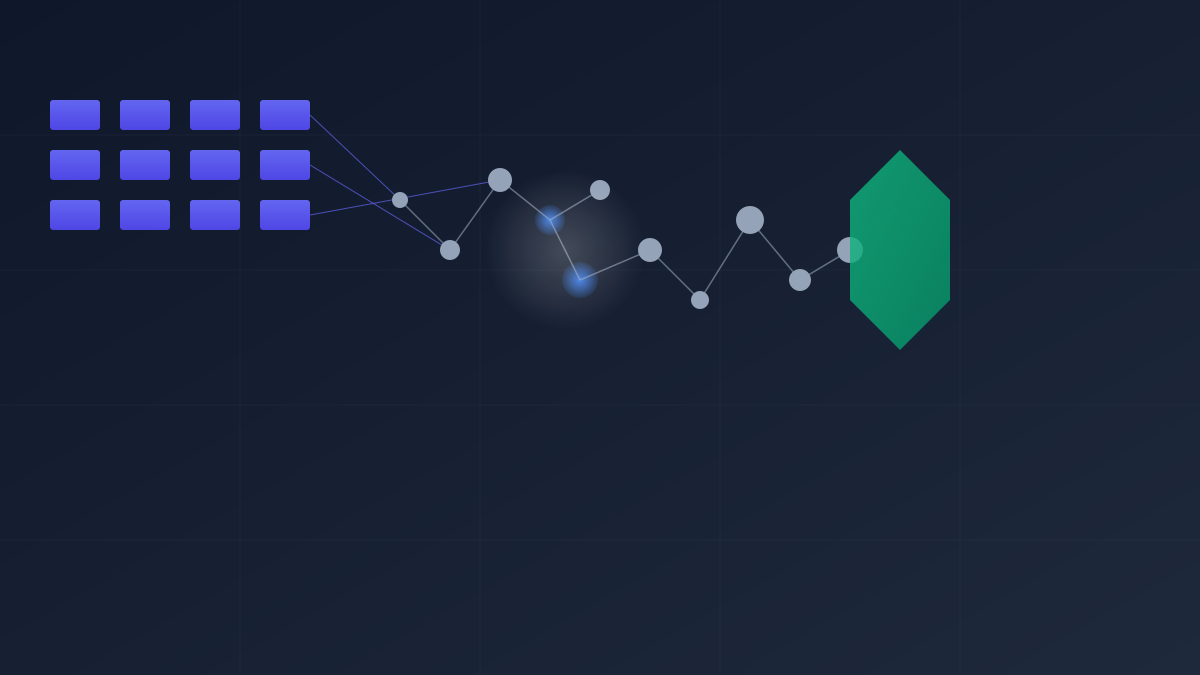
Adopts a heterogeneous graph architecture with three types of nodes: traders (insiders, institutional investors), stocks (securities), and events (trades, SEC filings, announcements). Edge relationships capture dynamic interactions such as "hold" and "trade".

Message Passing Mechanism

Uses multi-layer message passing via GCN/GAT to aggregate neighbor features and build high-order node representations, identifying indirect relationships (e.g., informed trading circles).

Anomaly Detection Strategy

Based on reconstruction error or graph-level classification, it identifies structural anomalies (e.g., early activation of information paths, abnormal proximity between trade and event nodes).

4

Section 04

Explainable AI: Technical Means to Meet Regulatory Audit Requirements

Integration of Explainable AI

Integrates three types of technologies:

  • Attention visualization: Displays graph paths and nodes focused on by the model
  • Subgraph explanation: Extracts key subgraphs that influence predictions
  • Feature attribution: Quantifies the impact of node attributes on anomaly scores This helps compliance personnel understand the basis for judgments and meets regulatory audit requirements.
5

Section 05

Data Pipeline: From SEC Filings to Graph Structure Construction

Data Pipeline and SEC Filing Processing

  1. Data collection: Obtain Form 4, Form 8-K, and other documents from SEC EDGAR
  2. Entity extraction: Use NLP to identify traders, companies, and transaction details
  3. Graph construction: Convert structured information into temporal graph snapshots
  4. Feature engineering: Calculate node features such as transaction statistics and network centrality
6

Section 06

Application Scenarios: Practical Value in RegTech and Compliance Risk Management

Application Scenarios and Value

  • RegTech: Assists the SEC in screening suspicious trading clues
  • Compliance risk management: Helps financial institutions monitor insider trading
  • Academic research: Provides tools for studies on market microstructure and information dissemination
7

Section 07

Limitations and Outlook: Data Challenges and Technical Upgrade Paths

Limitations and Outlook

Current challenges: Sparse data annotation and imbalanced positive/negative samples. Future directions: Introduce temporal GNNs to capture dynamic patterns, and combine large language models to enhance document understanding capabilities.

8

Section 08

Conclusion: Potential and Significance of GNNs in Financial Risk Management

Conclusion

insider-trading-gnn demonstrates the application potential of GNNs in financial risk management. By embedding domain knowledge into graph structures and using deep learning representation learning, it provides a data-driven and explainable path for insider trading detection, helping to improve market transparency and fairness.

