Zing Forum

Reading

Schema-Miner: A Human-Machine Collaborative Scientific Schema Mining Framework Based on Large Language Models

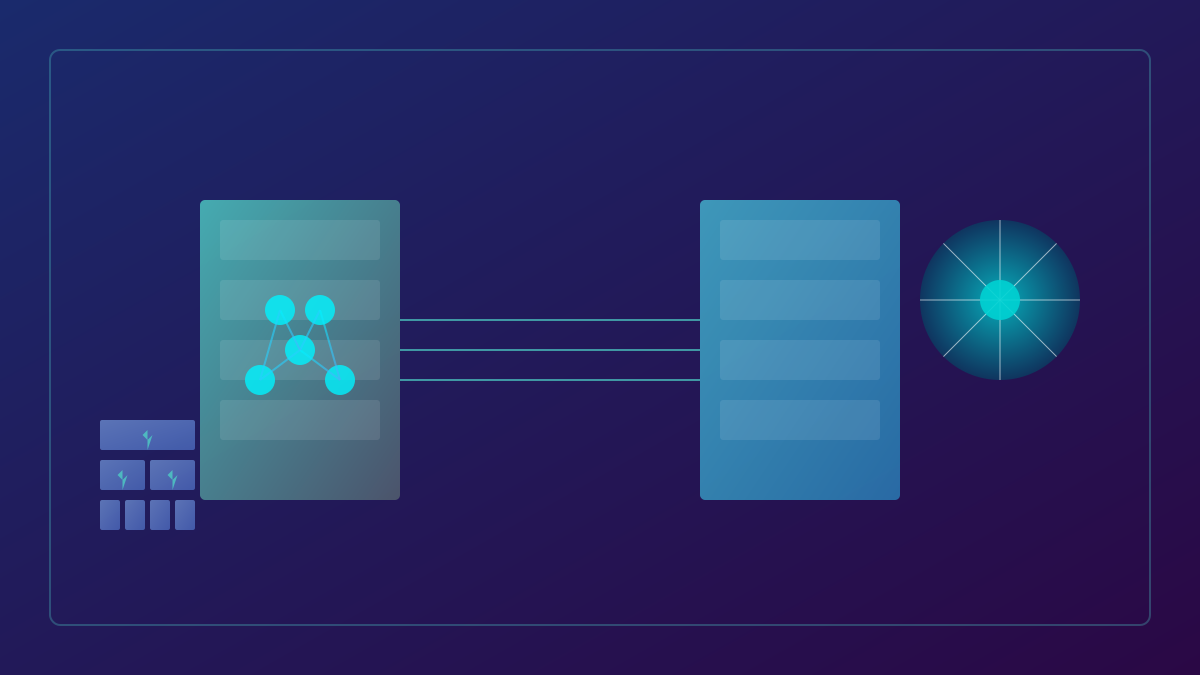
Schema-Miner is an innovative open-source framework that leverages large language models (LLMs) and continuous human feedback to automate and enhance scientific schema mining tasks. This tool uses a three-stage iterative process to extract and organize scientific attributes from unstructured text, anchors schema elements to formal ontologies (such as QUDT), and provides a new method for structured knowledge representation in scientific research.

大语言模型知识抽取模式挖掘人机协作科学文献本体工程自然语言处理知识图谱
Published 2026-08-11 22:46Recent activity 2026-08-11 22:54Estimated read 7 min
Schema-Miner: A Human-Machine Collaborative Scientific Schema Mining Framework Based on Large Language Models
1

Section 01

Schema-Miner: An Open-Source Human-in-the-Loop Framework for Scientific Schema Mining with LLMs

Schema-Miner is an innovative open-source framework developed by the sciknoworg organization. It combines large language models (LLMs) with continuous human feedback to automate and enhance scientific schema mining tasks. The framework uses a three-stage iterative process to extract and organize scientific attributes from unstructured text, and anchors schema elements to formal ontologies like QUDT, providing a new method for structured knowledge representation in scientific research.

Key resources:

2

Section 02

Background & Motivation

In scientific research, most knowledge exists as unstructured text in papers, reports, and technical documents. Traditional knowledge extraction methods require extensive manual annotation and domain expert involvement, which are inefficient and hard to scale.

While LLMs enable automation, pure automated approaches struggle to capture domain nuances and professional constraints. Thus, the human-in-the-loop paradigm was adopted—combining LLM automation with expert judgment to balance efficiency and accuracy in knowledge representation.

3

Section 03

Framework Overview & Core Features

Schema-Miner's core innovation is integrating LLMs with human feedback via an iterative process. Key features:

  1. Three-stage progressive schema discovery: From domain specs → curated literature → large corpus
  2. Multi-LLM provider support: OpenAI, HuggingFace, Ollama, GWDG/SAIA, OpenRouter
  3. Human-in-loop feedback: Expert input at key nodes to ensure schema quality
  4. Ontology grounding: Mapping schema elements to formal ontologies like QUDT
  5. Flexible deployment: Local GPU, remote API, or hybrid mode
4

Section 04

Technical Workflow & Ontology Anchoring

The framework uses a modular three-stage architecture:

  1. Initial Schema Mining: Uses domain specs (PDF/text) and LLM to generate initial JSON schema (configurable via PROCESS_NAME and PROCESS_DESCRIPTION)
  2. Preliminary Refinement: Combines curated papers with initial schema; expert feedback iteratively refines the schema
  3. Final Refinement: Processes large uncurated corpus to auto-integrate new attributes

Schema-Miner Pro adds ontology anchoring: Agentic AI uses semantic similarity and heuristics to map schema elements to ontologies like QUDT, enhancing standardization and interoperability.

5

Section 05

Application Scenarios & Value

Schema-Miner applies to multiple scientific fields:

  • Materials science: Extract experiment parameters to build knowledge graphs for new materials
  • Biomedicine: Analyze clinical trials to support evidence-based medicine and drug repurposing
  • Environmental science: Integrate climate/ecosystem knowledge for policy support
  • Chemical engineering: Extract reaction conditions to optimize production

Value: Converts unstructured literature into structured, computable knowledge; accelerates discovery and cross-disciplinary integration.

6

Section 06

Limitations & Future Directions

Current Limitations:

  1. Dependent on LLM quality (small models may lack complex concept understanding)
  2. Domain adaptation requires custom prompts and feedback mechanisms
  3. High compute resources for local GPU deployment

Future Directions:

  • Multi-modal support for charts/formulas
  • Domain-specific prompt libraries
  • Enhanced visualization for schema editing
  • Federated learning for sensitive data collaboration
7

Section 07

Installation & Quick Start

Installation:

  • PyPI: pip install schema-miner
  • Source: git clone https://github.com/sciknoworg/schema-miner.git && cd schema-miner && pip install -r requirements.txt

Configuration: Copy .env.example to .env and set:

  • LLM provider (OPENAI/SAIA/OLLAMA/HUGGINGFACE)
  • Model name, API keys
  • Process definitions (PROCESS_NAME, PROCESS_DESCRIPTION)
  • Data paths

Commands:

  • Stage1: schema-miner --stage 1
  • Stage2 with feedback: schema-miner --stage 2 --schema results/stage1/schema.json --expert-feedback feedback.txt
  • Stage3: schema-miner --stage3 --schema results/stage2/schema.json
  • Ontology grounding: schema-miner --ontology-grounding agentic --schema results/stage3/schema.json