Zing Forum

Reading

SAINT-G: Achieving Controllable Evolution of Artificial Intelligence via Verified Neural Grafting

The SAINT-G project explores a new paradigm for AI evolution—using verified neural grafting technology to achieve controllable, predictable, and interpretable incremental upgrades of AI systems.

neural graftingAI evolutionmodular AIvalidated learningcontrolled AI development
Published 2026-05-24 04:41Recent activity 2026-05-24 04:49Estimated read 6 min
SAINT-G: Achieving Controllable Evolution of Artificial Intelligence via Verified Neural Grafting
1

Section 01

SAINT-G Project Introduction: Achieving Controllable AI Evolution via Verified Neural Grafting

The SAINT-G project explores a new paradigm for controllable AI evolution—verified neural grafting technology—aimed at solving the high cost and uncontrollability issues of traditional large model training. Through a modular architecture, this technology "grafts" verified functional modules onto existing systems to achieve incremental upgrades, which are both interpretable and secure. However, it also faces challenges such as interface standardization, and may drive the AI industry toward composable agents in the future.


2

Section 02

Project Background and Core Issues

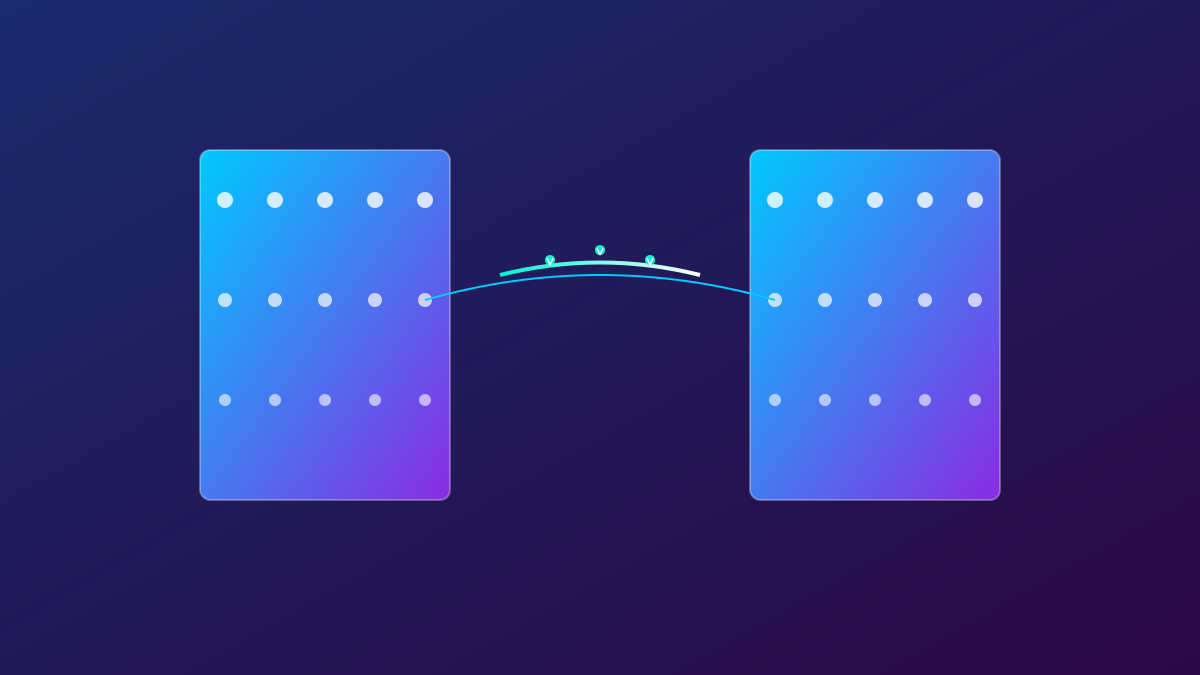
The current AI field faces a core challenge: How to ensure the controllability and predictability of evolution while improving model capabilities? Traditional large model training often uses a "scrap and rebuild" approach, which is costly and makes it difficult to trace the causes of capability changes. SAINT-G proposes the idea of verified neural grafting, drawing on the concept of biological organ transplantation, to achieve incremental expansion by introducing pre-verified functional modules instead of disruptive reconstruction.

3

Section 03

Principles of Neural Grafting Technology

The principle of neural grafting technology is based on a modular neural network architecture:

  1. Modular Design: Decompose the AI system into independent functional units (e.g., pattern recognition, logical reasoning) to support "plug-and-play" expansion;
  2. Verification and Compatibility Testing: Before grafting a new module, it must pass functional tests, compatibility checks, and security assessments to ensure it does not disrupt existing functions;
  3. Incremental Expansion: Introduce modules incrementally to accurately track the impact of each function on overall performance.
4

Section 04

Practical Significance of Controllable Evolution

The practical significance of controllable evolution includes:

  • Cost Reduction: Local updates replace full retraining, reducing computational resources and time consumption;
  • Improved Interpretability: Independent modules make it easier to locate problems;
  • Enhanced Security: Incremental updates reduce the risk of catastrophic forgetting and sudden capability changes;
  • Promoted Collaboration: The modular architecture supports independent module development and integration by different teams.
5

Section 05

Key Challenges in Technical Implementation

Technical implementation faces three major challenges:

  1. Module Interface Standardization: Requires unified communication protocols and representation formats, which need industry coordination;
  2. Capability Conflict Resolution: The problem of output coordination when multiple modules handle similar tasks;
  3. Long-term Stability: The increase in the number of modules leads to accumulated system complexity, requiring long-term operational stability.
6

Section 06

Future Outlook and Industry Impact

Future Outlook and Industry Impact:

  • Boom in Open Source Ecosystem: The modular architecture facilitates the formation of open-source module libraries, accelerating innovation;
  • Popularization of Enterprise Applications: Controllable evolution reduces the risk of enterprises adopting AI, supporting version management and incremental upgrades;
  • Regulatory-friendly Path: The interpretable and traceable evolution process provides a technical foundation for AI governance.
7

Section 07

Conclusion: The Transformation of AI from Black Box to Composable Agent

SAINT-G's verified neural grafting technology opens a new path for controllable AI evolution. Although it is in the early stage, its core concepts of modularity, verifiability, and incremental expansion provide ideas for solving the challenges of AI interpretability, security, and cost. As the technology matures, AI systems may shift from "black box behemoths" to "composable agents."

