Zing Forum

Reading

SAGI: A New Paradigm for Reconstructing General Artificial Intelligence from First Principles

SAGI proposes a brand-new general artificial intelligence architecture. Through the design of independent cognitive units and a distributed collaborative society, it systematically addresses the fundamental dilemmas of current large models, achieving endogenous task-driven capability, native embodied adaptation, and hierarchical value security.


通用人工智能AGI分布式架构AI安全具身智能开源项目
Published 2026-05-13 08:47Recent activity 2026-05-13 09:03Estimated read 5 min
SAGI: A New Paradigm for Reconstructing General Artificial Intelligence from First Principles
1

Section 01

[Introduction] SAGI: A New Paradigm for Reconstructing General Artificial Intelligence from First Principles

SAGI is an open-source project that proposes to redesign the general artificial intelligence architecture from first principles. Through a distributed collaborative society composed of independent cognitive units, it systematically solves the fundamental dilemmas of current large models, such as hallucinations, context window limitations, high computational costs, and fragile value alignment, achieving endogenous task-driven capability, native embodied adaptation, and hierarchical value security.

2

Section 02

Background: Bottlenecks Faced by Current Large Models

Current large language models centered on Transformer perform well in many tasks, but they are essentially probabilistic generation systems based on statistical pattern matching. They have insurmountable limitations such as hallucinations, context window constraints, high computational costs, and fragile alignment with human values. Against this background, the SAGI project proposes the proposition of redesigning the architecture from first principles.

3

Section 03

Methodology: Independent Cognitive Units and Distributed Collaborative Society

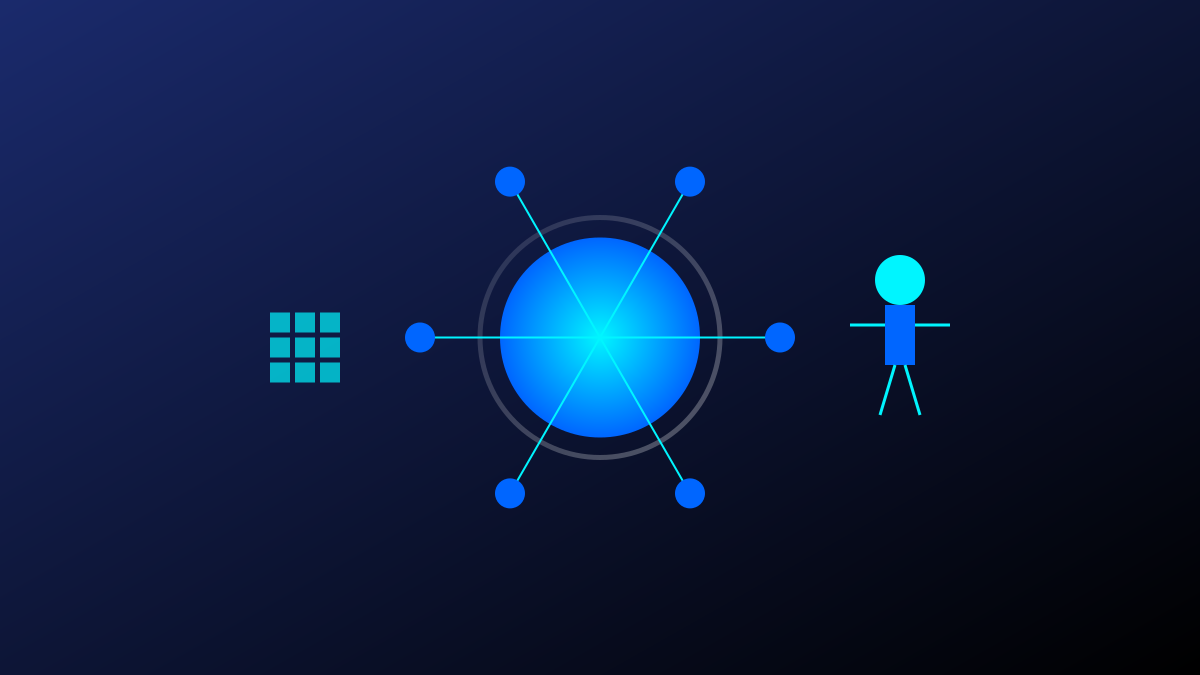
The core innovation of SAGI lies in the shift in architectural philosophy: building a distributed collaborative society composed of independent cognitive units. Each independent cognitive unit has complete perception, reasoning, decision-making, and execution capabilities, with advantages including modular interpretability, elastic fault tolerance, and parallel scalability. The distributed collaborative society forms a dynamic network through protocols, drawing on swarm intelligence to emerge collective intelligence.

4

Section 04

Three Solutions of SAGI to Address Large Model Dilemmas

Endogenous task-driven: Proactively perceive the environment, independently set goals and plan paths to adapt to dynamic scenarios. Native embodied adaptation: Consider embodied needs from the initial design stage, directly interact with physical devices, suitable for scenarios like robotics. Hierarchical value security: Unit-level built-in constraints, collaboration-level security protocols, and society-level value alignment, with multi-layer protection for greater robustness.

5

Section 05

Advantages of Lightweight and Scalable Architecture

Compared to large models with hundreds of billions of parameters, SAGI is lightweight, with advantages including low-threshold deployment (runs on ordinary hardware, lowering the entry barrier for startup teams), flexible customization (modular combination to adapt to different applications), and continuous evolution (online learning expansion without full retraining).

6

Section 06

Open-Source Spirit: Promoting the Democratization of AI Technology

SAGI uses the MIT license, and the authors waive all rights except the right of attribution. It aims to promote the democratization of general AI technology, allowing more people to participate and benefit, and highlighting the value of technology sharing in commercial competition.

7

Section 07

Conclusion: The Dawn and Prospects of Paradigm Shift

SAGI represents a technical exploration different from mainstream large models, providing a more sustainable, secure, and inclusive path. Although it is in the early stage and needs community improvement, the open-source spirit drives technological progress, which is worthy of attention from AI practitioners.
