Zing Forum

Reading

SaANN: Building a Self-Automated Artificial Neural Network from Scratch to Deeply Understand MLP Architecture Principles

This article deeply analyzes the SaANN open-source project, a multi-layer perceptron (MLP) neural network implemented from scratch. By examining its self-automated architecture design, forward and backward propagation mechanisms, activation functions, and optimization strategies, it helps readers establish a profound understanding of the internal working principles of neural networks, making it suitable for developers who wish to master deep learning fundamentals.

神经网络多层感知机反向传播深度学习激活函数机器学习基础从零实现
Published 2026-05-09 19:56Recent activity 2026-05-09 20:04Estimated read 6 min
SaANN: Building a Self-Automated Artificial Neural Network from Scratch to Deeply Understand MLP Architecture Principles
1

Section 01

SaANN Project Overview: Zero-to-One Understanding of MLP Architecture

SaANN (Self-automated Artificial Neural Network) is an open-source project that implements a multi-layer perceptron (MLP) from scratch. It aims to help developers deeply understand the internal working principles of neural networks—including forward/backward propagation, activation functions, and optimization strategies—by avoiding framework abstractions. This project is ideal for those who want to transition from API users to engineers with a solid grasp of deep learning fundamentals.


2

Section 02

Why Build Neural Networks from Scratch?

In an era of mature frameworks like PyTorch/TensorFlow, why start from zero? SaANN answers: true understanding comes from hands-on construction. When using model.fit(), questions like "how are gradients calculated?" or "how do activation functions affect learning?" can only be fully answered by diving into code. For ML learners, building from scratch is a milestone—signaling a shift from API user to principle-aware engineer. SaANN serves as both a teaching tool and an extensible base framework.

3

Section 03

MLP Architecture Basics & SaANN's Design

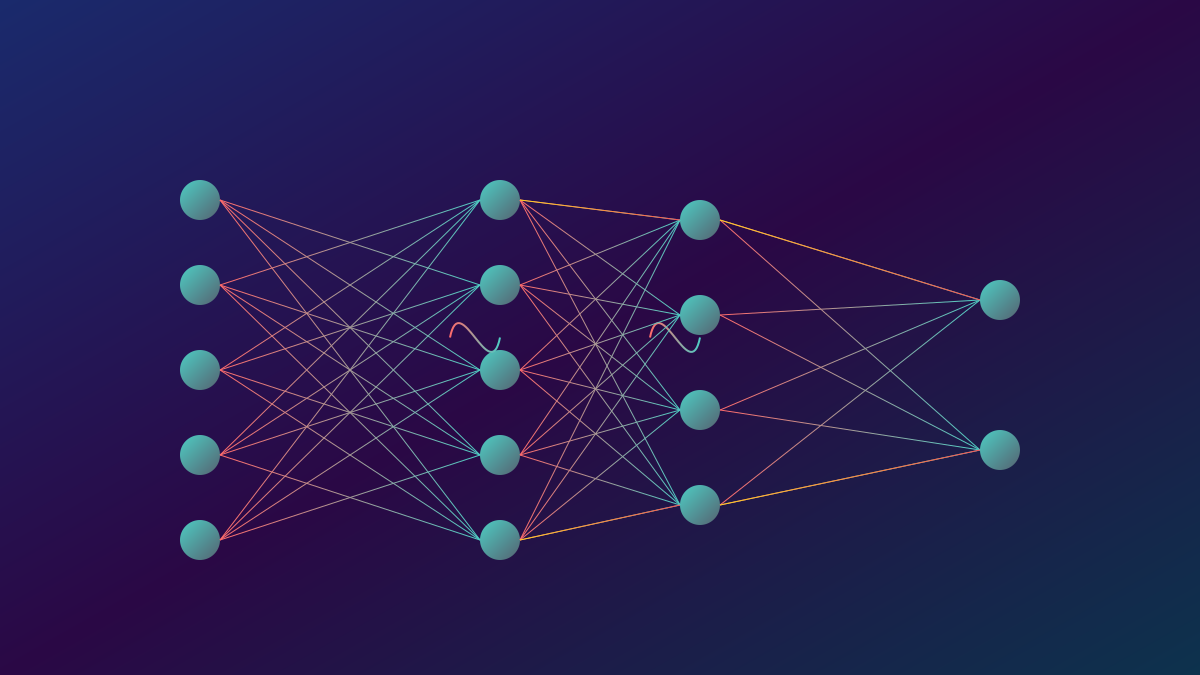
SaANN implements a classic MLP with input, hidden, and output layers. Layers are fully connected, with weights (signal strength) and biases (activation threshold) for each neuron. SaANN's design is modular and configurable: network layers, neuron counts, and activation functions can be adjusted flexibly, making it adaptable to different tasks/datasets.

4

Section 04

Forward & Backward Propagation: The Heart of Neural Networks

Forward Propagation: Converts input to output via linear transformations (z = sum(w_i x_i + b) ) and non-linear activation functions (Sigmoid, Tanh, ReLU). Output layer activation depends on task type (e.g., Softmax for multi-class classification). Backward Propagation: Uses chain rule to compute parameter gradients from prediction errors, then updates weights to minimize loss. SaANN implements full backprop and optimization strategies like SGD with momentum, helping users understand gradient flow and debugging.

5

Section 05

Loss Functions & Training Optimization

Loss Functions: Task-dependent—MSE for regression, cross-entropy for classification (binary/multi-class). Training: Iterative process (forward → loss → backward → update). Key hyperparameters:

  • Learning rate: Controls update step size (SaANN supports decay).
  • Batch size: Balances noise and stability.
  • Epochs: Early stopping prevents overfitting.
  • Initialization: Xavier/Glorot init stabilizes signal propagation.
6

Section 06

Self-Automated Features of SaANN

SaANN reduces manual work via:

  1. Auto Architecture: Suggests layers/neurons based on data/task (user can override).
  2. Adaptive Learning Rate: Adjusts if loss stagnates or spikes.
  3. Auto Preprocessing: Normalizes data, encodes categorical features automatically. These features make SaANN both a teaching tool and a practical prototyping framework.
7

Section 07

SaANN Use Cases & Practical Advice

Use Cases:

  • Education: Demo neural network principles (teachers/students).
  • Small Projects: Fast prototyping for simple tasks with small datasets.
  • Research: Experiment with new ideas before migrating to high-performance frameworks. Tips: Start by reading code → run examples → modify to experiment (e.g., add new activation functions).
8

Section 08

Conclusion: The Value of SaANN & Returning to Basics

SaANN highlights that deep learning's core lies in forward/backward propagation and gradient descent. For AI developers, building from scratch fosters intuition—critical for solving complex problems. SaANN bridges the gap between API usage and deep understanding, reminding us to prioritize foundational knowledge amid fast-evolving tech trends.

