Zing Forum

Reading

End-to-End Deep Learning Solution for IMDb Movie Review Sentiment Analysis Using Simple RNN

This project uses a Simple Recurrent Neural Network (RNN) for sentiment analysis on the IMDb movie review dataset, providing a complete end-to-end deep learning solution.

情感分析RNN深度学习自然语言处理IMDb数据集文本分类循环神经网络
Published 2026-06-17 03:15Recent activity 2026-06-17 03:26Estimated read 6 min
End-to-End Deep Learning Solution for IMDb Movie Review Sentiment Analysis Using Simple RNN
1

Section 01

Introduction: End-to-End Solution for IMDb Movie Review Sentiment Analysis Using Simple RNN

Core Project Information

2

Section 02

Background: Value of Sentiment Analysis and Evolution of NLP Technologies

Importance of Sentiment Analysis

In the era of information explosion, text sentiment analysis is a core NLP task that can automatically identify the emotional tendency of text. In the movie review scenario, it not only provides decision-making references for audiences but also helps producers understand feedback.

Dataset Selection

The IMDb movie review dataset (50,000 labeled positive/negative reviews) is used. Its texts have varying lengths and diverse styles, making it suitable for testing model performance.

Background of Technological Evolution

Before the rise of deep learning, sentiment analysis relied on rules or traditional ML (such as Naive Bayes, SVM), requiring a lot of manual feature engineering and struggling to capture deep semantics.

3

Section 03

Methodology: Technical Core of Simple RNN

Advantages of Simple RNN

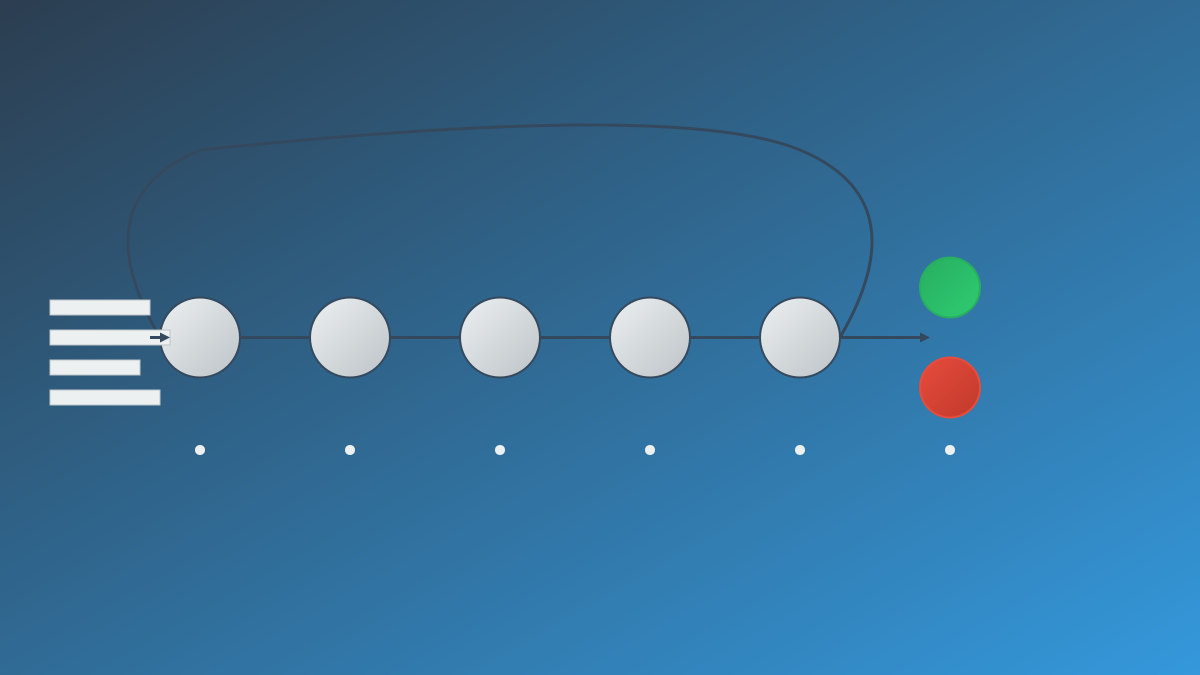
RNN is designed for sequence data, has memory capabilities, and can capture word order and context dependencies (e.g., the emotional difference between "This movie is not very good" and "This movie is not too good").

Reasons for Selection

The project uses Simple RNN instead of LSTM/GRU for teaching purposes: to help learners understand basic structures and transition to advanced architectures after mastering core concepts. Despite the gradient vanishing issue for long sequences, it still has good effects on medium-length reviews.

4

Section 04

Engineering Practice: Key Steps of the End-to-End System

Data Preprocessing

Includes steps like text cleaning, tokenization, vocabulary construction, sequence padding, etc., to ensure data meets model input requirements.

Model Training

Involves hyperparameter tuning, overfitting prevention (e.g., regularization), and training process monitoring.

Evaluation

Requires designing reasonable metrics (such as accuracy, F1-score) to measure model performance. These engineering details are key to model deployment; reproducing the project can accumulate practical experience.

5

Section 05

Application Scenarios and Expansion Directions

Application Migration

The framework can be migrated to other scenarios: product review analysis, social media public opinion monitoring, customer feedback processing—just replace the training data to adapt to needs.

Technical Upgrades

After mastering Simple RNN, you can try: upgrading to LSTM/BiLSTM to solve long sequence problems, introducing attention mechanisms, using pre-trained word embeddings (like Word2Vec, GloVe) to enhance semantic representation.

6

Section 06

Conclusion: Value of Basic Learning

This project is an excellent practice for deep learning beginners, focusing on the complete implementation of basic concepts (RNN, sequence modeling, text classification). A solid foundation is key to deepening into the AI field—understanding underlying principles is more important than chasing the latest models; it helps learners adapt to technological changes and master core thinking methods.



