Zing Forum

Reading

Building a RAG System from Scratch: Creating an Enterprise-Grade Document Q&A Engine with LangChain and Groq

This article details how to build a complete Retrieval-Augmented Generation (RAG) system using LangChain, Groq LLM, and ChromaDB to enable intelligent Q&A on PDF documents and address the hallucination issue of large language models.

RAGLangChainGroqChromaDBLLM文档问答检索增强生成向量数据库PDF处理
Published 2026-06-11 08:04Recent activity 2026-06-11 08:19Estimated read 7 min
Building a RAG System from Scratch: Creating an Enterprise-Grade Document Q&A Engine with LangChain and Groq
1

Section 01

Introduction: Building an Enterprise-Grade RAG Document Q&A System from Scratch

This article explains how to build a complete Retrieval-Augmented Generation (RAG) system using LangChain, Groq LLM, and ChromaDB to enable intelligent Q&A on PDF documents and resolve the hallucination problem of large language models. The content is based on the GitHub open-source project LLM-Powered Document Retrieval System (RAG) (author: pratikgaikar2903, published on 2026-06-11), covering core points such as system architecture, technical implementation, application scenarios, and optimization directions.


2

Section 02

Background: Why Do We Need RAG Systems?

Large Language Models (LLMs) have static knowledge and are prone to 'hallucinations' (generating incorrect content), which is a fatal flaw for enterprise applications (e.g., customer service providing wrong information). RAG technology solves this hallucination issue by first retrieving relevant information from private document libraries as context, then allowing the model to generate answers based on facts.

3

Section 03

System Architecture Overview

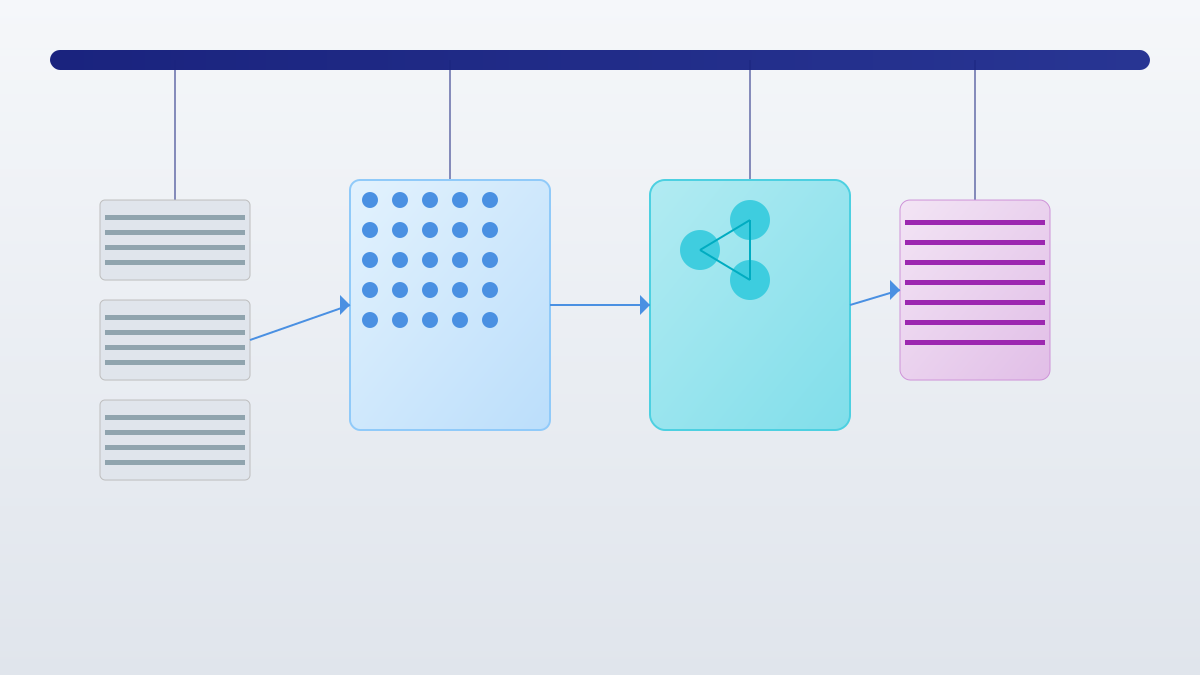
The RAG system adopts a modular design with core components including:

  1. Document loading and processing layer: Extract PDF text using pypdf;
  2. Text splitting and vectorization: Split text chunks with langchain-text-splitters, convert to vectors using HuggingFace embedding models;
  3. Vector storage and retrieval: Store vectors in ChromaDB and support similarity search;
  4. LLM layer: Groq's llama-3.1-8b-instant model (high inference speed);
  5. Orchestration framework: Define processing pipelines declaratively using LangChain Expression Language (LCEL).
4

Section 04

Technical Implementation Details

Implementation steps include:

  • Environment preparation: Install dependencies like langchain-core, langchain-groq, and chromadb;
  • API key management: Load Groq API keys securely via userdata in Colab;
  • RAGSystem class: Encapsulate the workflow—users only need to provide document paths and vector storage directories;
  • Document ingestion: Call ingest_documents() to read PDFs, split text, generate vectors, and store them in ChromaDB (persisted to disk);
  • Query process: Vectorize the question → similarity retrieval → build context → prompt engineering → call Groq to generate answers.
5

Section 05

RAG vs Fine-Tuning: A Selection Guide

Limitations of fine-tuning: High cost, difficulty in updating knowledge, no traceability, and remaining hallucination risks; Advantages of RAG: Real-time access to the latest documents, traceable sources, cost-effectiveness, and flexibility to switch knowledge bases; Conclusion: Most enterprise scenarios choose RAG; fine-tuning is suitable for changing model behavior or output formats.

6

Section 06

Practical Application Scenarios

The system can be applied to:

  1. Enterprise internal knowledge base Q&A (query policies, technical documents);
  2. Intelligent customer service assistant (provide 7×24 services based on product manuals/FAQs);
  3. Legal document analysis (quickly locate contract/regulation clauses);
  4. Academic research assistance (accelerate literature reviews via Q&A on document libraries);
  5. Resume screening (quickly find candidates with desired skills).
7

Section 07

Advanced Optimization Directions

Optimization suggestions for production environments:

  1. Hybrid retrieval strategy (vector + keyword BM25 + graph retrieval);
  2. Re-ranking (use Cross-Encoder models to improve relevance);
  3. Query rewriting and expansion (generate multiple related queries and merge results);
  4. Multimodal support (use CLIP models to process images/tables);
  5. Conversation history management (support multi-turn dialogues);
  6. Answer verification and confidence assessment (fact-checking; prompt or transfer to humans when uncertain).
8

Section 08

Summary and Insights

RAG technology combines LLM generation capabilities with reliable knowledge retrieval, making it an important direction for AI applications. This project demonstrates how to quickly build a RAG system using open-source toolchains:

  • For developers: Lowers the threshold for intelligent Q&A systems—no need to train large models;
  • For enterprises: Safe and controllable, with private data stored on their own infrastructure;
  • Trend: Vector databases, embedding models, and LLM inference services are mature—now is the best time to learn and apply RAG.

