Zing Forum

Reading

Multimodal RAG API: An Intelligent Retrieval-Generation System Integrating Text and Images

Discusses the architecture of the multimodal RAG API that supports text and image inputs, analyzing its implementation principles, technical challenges, and application prospects.

多模态RAGMultimodal图像检索视觉问答CLIP向量嵌入大语言模型API设计
Published 2026-06-07 20:39Recent activity 2026-06-07 20:55Estimated read 8 min
Multimodal RAG API: An Intelligent Retrieval-Generation System Integrating Text and Images
1

Section 01

[Introduction] Multimodal RAG API: An Intelligent Retrieval-Generation System Integrating Text and Images

Project Core Overview

The Multimodal RAG API developed by D-techno (Source: GitHub Multimodal-RAG-API, Release Date: June 7, 2026) extends traditional text-based RAG to the image domain, supporting text + image inputs and generating intelligent responses through the combination of vector embedding and large language models.

Core Value

It addresses the limitation of pure text RAG that cannot utilize visual information such as images and charts, enabling AI to "understand" pictures and answer based on their content, thus expanding application scenarios.

Key Components

Includes multimodal encoders (e.g., CLIP), multimodal vector databases, vision-language large models (e.g., GPT-4V), and an API service layer.

Main Challenges

Faces issues like modal alignment, depth of image understanding, computational resource requirements, and data privacy.


2

Section 02

Background: Limitations of Traditional RAG and Multimodal Needs

Traditional RAG systems only focus on the retrieval and generation of text data, but a large amount of information in the real world exists in the form of images, charts, and screenshots, which pure text RAG cannot effectively utilize.

Multimodal RAG represents the next stage of information retrieval and generative AI. By uniformly processing text and visual content, it enables AI systems to understand images and answer questions based on their content, greatly expanding application scenarios.

3

Section 03

Core Architecture and Technical Implementation Methods

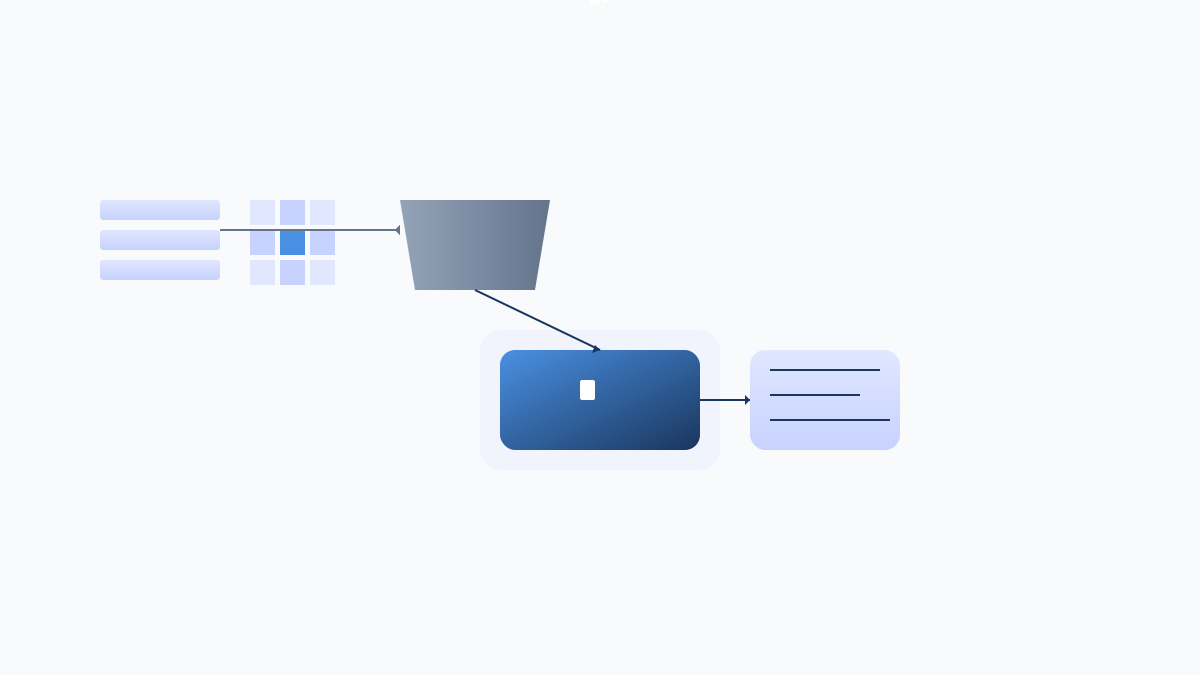
Multimodal RAG adds visual processing capabilities to the classic RAG architecture, with core components including:

  1. Multimodal Encoder: Such as CLIP/OpenCLIP, which maps text and images to the same vector space, providing a foundation for cross-modal retrieval.
  2. Multimodal Vector Database: Supports hybrid queries (text-to-image, image-to-text, cross-modal matching).
  3. Vision-Language Large Model: Such as GPT-4V, Claude3, LLaVA, which accepts image + text inputs to generate answers.
  4. API Service Layer: Handles concurrent requests, load balancing, caching, etc., to ensure high availability and performance.
4

Section 04

Technical Challenges and Response Considerations

Multimodal RAG faces more challenges than pure text RAG:

  • Modal Alignment: CLIP provides basic alignment, but its effect may be insufficient for specific domains/content, requiring fine-tuning for adaptation.
  • Image Understanding: Professional content like complex charts and medical images needs preprocessing such as OCR and object detection.
  • Computational Resources: Image encoding and multimodal reasoning have high requirements for GPU/memory, so efficient service under resource constraints needs to be addressed.
  • Data Privacy: Image data is sensitive, requiring security measures like encryption and access control.
5

Section 05

Application Scenarios and Commercial Value

The Multimodal RAG API has application value in multiple fields:

  • E-commerce Retail: Upload product images to query information and recommend similar products; process text-image content on product detail pages to answer user questions.
  • Education and Training: Students upload textbook screenshots/homework images to ask questions, understanding formulas and charts in STEM fields.
  • Medical Imaging: Doctors upload images to retrieve cases and literature for auxiliary diagnosis (compliance required).
  • Document Intelligence: Process technical documents with charts to answer questions related to architecture diagrams/flowcharts.
  • Social Media: Analyze text-image content to generate tags and detect violations.
6

Section 06

Comparative Analysis and Future Trends

Comparison with Pure Text RAG

Dimension Pure Text RAG Multimodal RAG
Input Type Text only Text + Image
Encoder Text embedding model Multimodal encoder (e.g., CLIP)
Vector Dimension Usually 768/1024 dimensions Usually 512/768 dimensions
Application Scenarios Document Q&A, knowledge base Visual Q&A, image retrieval
Computational Cost Relatively low Higher (image processing overhead)
Accuracy Challenge Retrieval relevance Cross-modal alignment quality

Future Trends

  • Integrate more modalities (video, audio, 3D models);
  • End-to-end optimization to improve efficiency;
  • Edge computing and model compression to achieve real-time response;
  • Emergence of domain-specific models (medical, legal, etc.).

Summary

This project represents an important evolutionary direction of information retrieval technology. Despite facing challenges, with technological progress, multimodal RAG will play a key role in AI applications and is worth developers' attention and investment.

