Zing Forum

Reading

RAG Technology in Practice: Building a Retrieval-Augmented Generation-Based Intelligent Q&A System

An in-depth analysis of the RAG (Retrieval-Augmented Generation) technical architecture, from vector embedding to LLM integration, exploring how to build an accurate and traceable AI Q&A system.

RAG检索增强生成大语言模型向量嵌入问答系统知识检索AI架构语义搜索
Published 2026-04-30 03:15Recent activity 2026-04-30 03:17Estimated read 6 min
RAG Technology in Practice: Building a Retrieval-Augmented Generation-Based Intelligent Q&A System
1

Section 01

[Introduction] RAG Technology: Solving LLM Hallucinations and Building Trustworthy Intelligent Q&A Systems

Against the backdrop of the rapid development of Large Language Models (LLMs), RAG (Retrieval-Augmented Generation) technology effectively addresses the "hallucination" problem in AI responses by integrating external knowledge retrieval and generation capabilities, building an accurate and traceable intelligent Q&A system. This article will analyze aspects such as conceptual principles, system architecture, technical advantages, implementation key points, and cutting-edge developments to provide references for practical applications.


2

Section 02

Concept and Principles of RAG: Breaking the Knowledge Limitations of LLMs

RAG is an architectural paradigm that integrates information retrieval systems with generative AI models. Its core idea is to retrieve relevant background information from external knowledge bases before generating answers, using this context to guide the model to produce evidence-based content. It breaks the limitation of traditional LLMs that only rely on training memory, reduces hallucinations, and provides traceable information sources—just like scholars consulting authoritative materials to enhance credibility when answering questions.

3

Section 03

RAG System Architecture: Detailed Explanation of Three Core Components

A complete RAG system consists of three closely collaborating components:

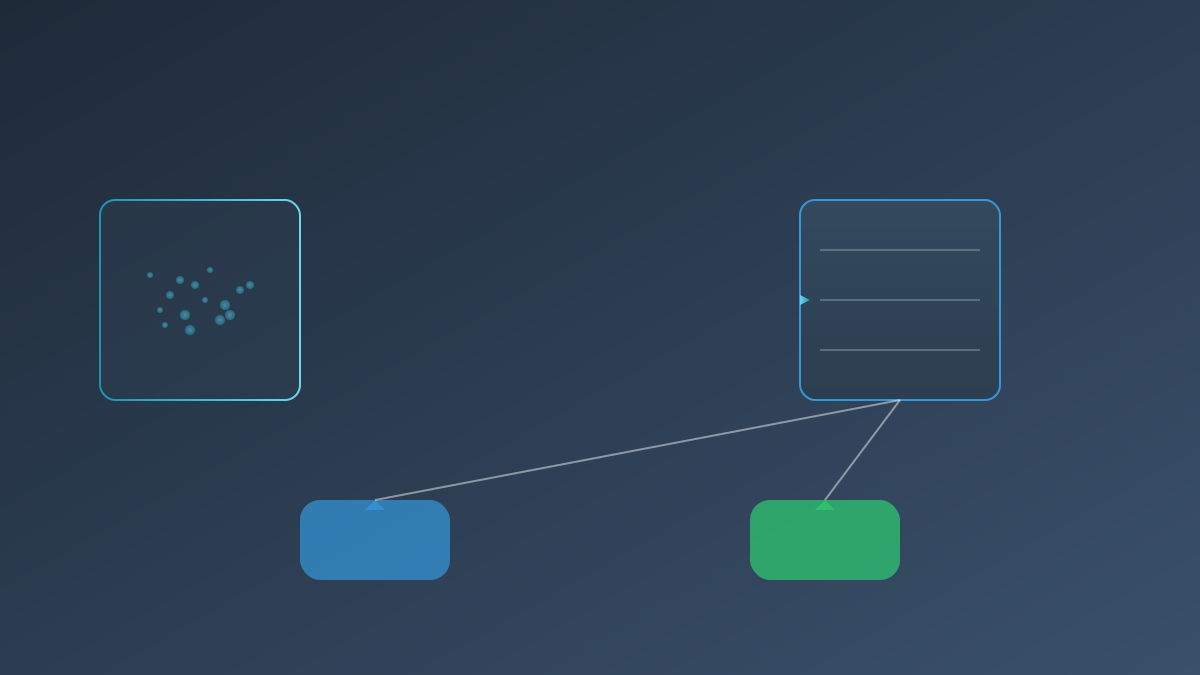
  1. Document Processing and Vector Storage: After cleaning and chunking, original documents are converted into high-dimensional vectors via embedding models (e.g., OpenAI text-embedding, Sentence-BERT) and stored in vector databases (Pinecone, Weaviate, etc.);
  2. Semantic Retrieval Engine: After vectorization of user queries, similarity searches are performed in the vector database to recall Top-K relevant document fragments;
  3. Generative Language Model: The retrieved fragments and the question form a context prompt, which is input into the LLM to generate answers based on reference information, allowing access to private or up-to-date knowledge.
4

Section 04

Technical Advantages and Applicable Scenarios of RAG

The notable advantages of RAG include:

  • Improved Accuracy: Reduces hallucination risks based on real documents;
  • Enhanced Interpretability: Displays source documents for user verification;
  • Flexible Knowledge Updates: No need to retrain the model—updating the knowledge base is sufficient to acquire new information. Applicable scenarios: Enterprise knowledge base Q&A, customer service intelligent assistants, legal/medical literature analysis, technical document queries, and other fields requiring high accuracy and traceability.
5

Section 05

Key Implementation Points and Optimization Strategies for RAG

Building a production-grade RAG requires attention to:

  • Document Chunking: Determine the optimal chunk size and overlap strategy through experiments to avoid context loss or information dilution;
  • Retrieval Quality Optimization: Adopt technologies such as hybrid search (vector + keyword), re-ranking models, and query expansion;
  • Prompt Engineering: Organize documents reasonably, handle conflicting information, and guide the model to honestly admit insufficient information.
6

Section 06

Cutting-Edge Developments and Future Outlook of RAG

RAG technology is evolving rapidly:

  • Multimodal RAG: Supports retrieval of non-text content such as images and audio;
  • Agentic RAG: Introduces autonomous decision-making capabilities to enable multi-round retrieval and reasoning;
  • GraphRAG: Combines knowledge graphs to provide structured information organization. With the advancement of embedding models and vector databases, RAG will become a standard paradigm for building reliable AI applications, helping LLMs land in practical business scenarios.

