Zing Forum

Reading

Building an Intelligent Q&A System for Academic Papers: Practical Analysis of RAG Technology

This article provides an in-depth analysis of the implementation plan for an academic paper Q&A system based on Retrieval-Augmented Generation (RAG) technology, covering core technical aspects such as semantic search, vector embedding, and integration with large language models.

RAG检索增强生成学术论文语义搜索向量嵌入大语言模型问答系统自然语言处理
Published 2026-06-15 21:42Recent activity 2026-06-15 21:52Estimated read 6 min
Building an Intelligent Q&A System for Academic Papers: Practical Analysis of RAG Technology
1

Section 01

[Introduction] Core Analysis of Building an RAG-Based Intelligent Q&A System for Academic Papers

This article analyzes the implementation plan of an academic paper Q&A system based on Retrieval-Augmented Generation (RAG) technology, with the core goal of solving the problem of low efficiency in traditional keyword search in academic research. The system was released by antonypradeep54 on GitHub (project name: RAG-research-paper-qa-system, release date: June 15, 2026), integrating semantic search, vector embedding, and large language models to achieve accurate and traceable Q&A capabilities.


2

Section 02

Background and Problems: Pain Points of Academic Retrieval and RAG's Solutions

In academic research, traditional keyword search struggles to capture users' true intentions, leading to low information retrieval efficiency. Retrieval-Augmented Generation (RAG) technology combines external knowledge retrieval with large language models, leveraging the model's language understanding capabilities while citing real literature to alleviate the "hallucination" problem of generative models, providing new ideas for intelligent literature Q&A.

3

Section 03

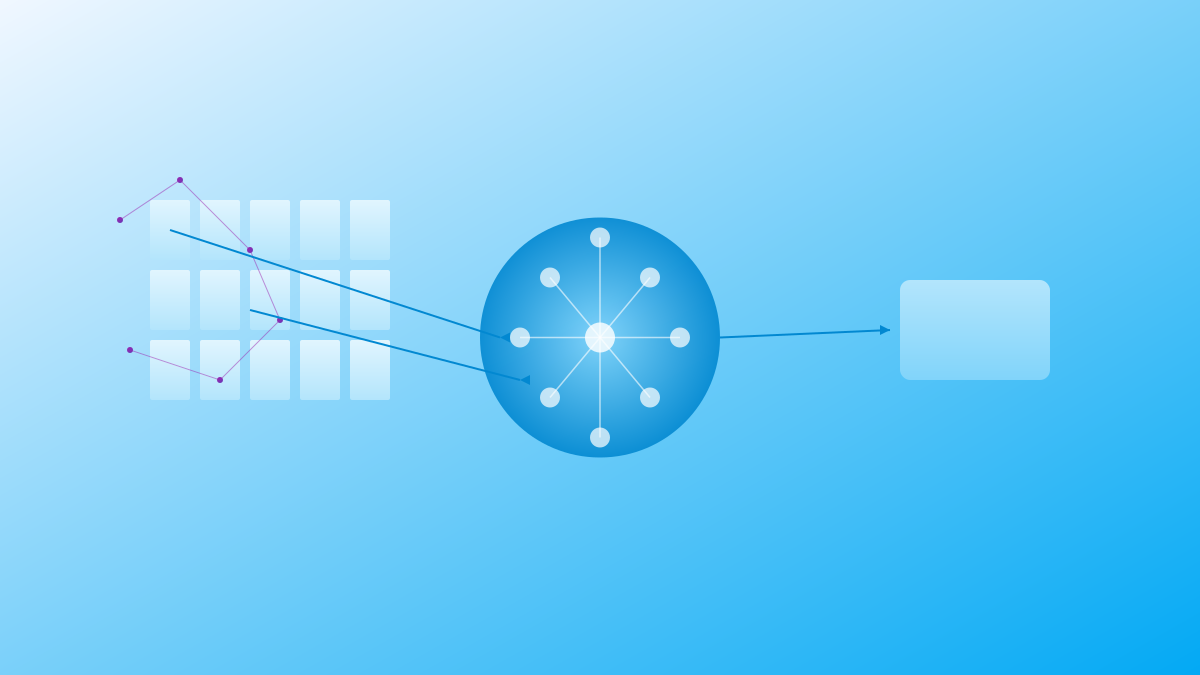
System Architecture: Four Key Layers of End-to-End Design

The system adopts an end-to-end architecture, including four key layers:

  1. Data Ingestion Layer: Process PDF papers, perform text extraction, chunking (balance granularity and context) and metadata retention;
  2. Vector Embedding Layer: Use pre-trained models (e.g., OpenAI text-embedding, Sentence-BERT) to convert text into semantic vectors;
  3. Vector Storage Layer: Use vector databases like Pinecone, Weaviate to store vectors, supporting efficient similarity search;
  4. Retrieval-Generation Layer: Convert user questions into vectors, retrieve relevant fragments, then input to large language models to generate answers.
4

Section 04

Key Technologies: Semantic Search, Context Integration, and Citation Traceability

Key technical implementations include:

  1. Semantic Search: Different from BM25 keyword search, it can understand deep meanings (e.g., "Transformer advantages" matches content related to "self-attention mechanism");
  2. Context Integration: Solve the window overflow problem of multi-fragment splicing through reordering and summary compression;
  3. Citation Traceability: Clearly label the original source (paper title, author, page number, etc.) corresponding to the answer's viewpoints, enhancing credibility and traceability.
5

Section 05

Application Scenarios: Literature Review, Cross-Domain Integration, and Fact-Checking

Application scenarios and value of the system:

  1. Literature Review Assistance: Natural language queries quickly locate relevant research, aligning with human thinking habits;
  2. Cross-Paper Knowledge Integration: Integrate information from papers in different fields (e.g., "Application of deep learning in medical imaging" combines computer vision and medical literature);
  3. Rapid Fact-Checking: Instantly query uncertain concepts/data while reading papers, assisting understanding and verification.
6

Section 06

Challenges and Optimization: Retrieval Accuracy, Multimodal Processing, and Real-Time Updates

Technical challenges and optimization directions:

  1. Retrieval Accuracy Optimization: Mix sparse retrieval (BM25) and dense retrieval (vector search) to solve term/abbreviation processing issues;
  2. Multimodal Content Processing: Need to improve indexing and retrieval capabilities for non-text information like charts and formulas;
  3. Real-Time Updates and Incremental Indexing: Support continuous updates of the literature library, handling version updates, retractions, etc.
7

Section 07

Summary and Outlook: Value of RAG and Recommendations for Developers

Summary: RAG technology provides an effective path for intelligent Q&A of academic literature, balancing answer quality and information traceability. In the future, with the advancement of models and databases, the system will become more powerful. Recommendations for developers: Start with clear application scenarios, use open-source components for prototype verification, and gradually optimize retrieval and generation quality; pay attention to data privacy and copyright compliance to ensure the system operates legally and compliantly.

