Zing Forum

Reading

RAG Technology Reshapes Recruitment Processes: Analysis of an Intelligent Resume Summary Generation System

This project builds an end-to-end AI pipeline that integrates Retrieval-Augmented Generation (RAG) technology with large language models to enable automated resume understanding and professional summary generation, providing a technical solution to improve human efficiency in recruitment scenarios.

RAGRetrieval-Augmented Generationresume parsingrecruitment automationlarge language modelsinformation retrievalHR technatural language processingdocument understanding
Published 2026-05-14 02:20Recent activity 2026-05-14 02:31Estimated read 6 min
RAG Technology Reshapes Recruitment Processes: Analysis of an Intelligent Resume Summary Generation System
1

Section 01

RAG Technology Reshapes Recruitment Processes: Analysis of an Intelligent Resume Summary Generation System

This project builds an end-to-end AI pipeline that integrates Retrieval-Augmented Generation (RAG) technology with large language models to enable automated resume understanding and professional summary generation. It addresses pain points in recruitment scenarios such as time-consuming resume screening, information overload, and subjective bias, providing a technical solution to improve human efficiency.

2

Section 02

Information Processing Challenges in the Recruitment Industry

In the field of human resource management, resume screening is one of the most time-consuming and critical processes. Large enterprises receive an average of over 250 resumes per job posting, and recruiters spend only 6-7 seconds on initial screening per resume, which easily leads to overlooking high-quality candidates. Traditional screening relies on manual work, with pain points such as uneven information density, subjective bias, difficulty in skill matching, and lack of standardization. AI technology (especially LLMs) provides new ideas for automation and intelligence.

3

Section 03

RAG Architecture and System End-to-End Pipeline

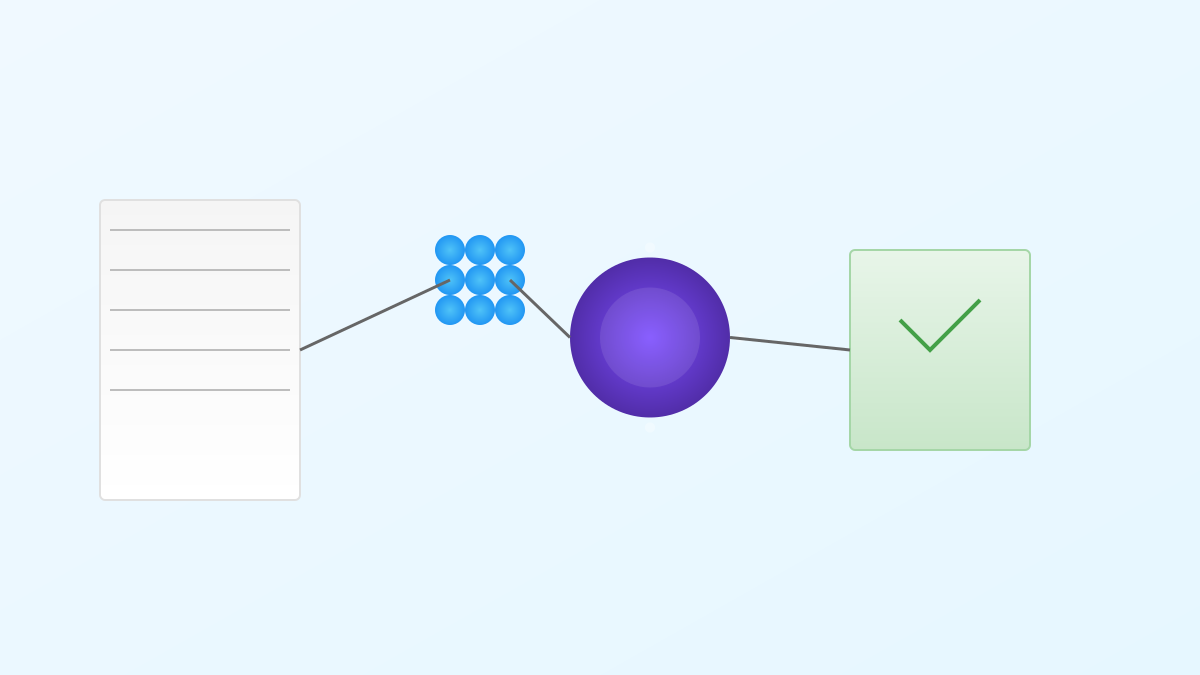
The core technology is RAG, which combines the accuracy of information retrieval with the flexibility of generative models to solve the hallucination problem of pure generative models. The RAG workflow consists of two stages: retrieval (resumes split into semantic units → embedded vectors → knowledge base similarity retrieval) and generation (retrieved information + original resume input into LLM to generate industry-aligned summaries). The resume processing scenario is suitable for RAG: high requirements for factual accuracy, reliance on domain knowledge, and need to balance personalization and standardization. The system architecture includes a document parsing layer (multi-format parsing, information extraction, semantic understanding), a vector retrieval layer (text chunking, domain-fine-tuned embedding model, vector database, knowledge base construction), a summary generation layer (prompt engineering, multi-dimensional summary, controllable generation), and a post-processing optimization layer (fact-checking, format standardization, quality scoring).

4

Section 04

Technology Selection and Implementation Details

LLM selection supports OpenAI GPT (effect priority), open-source models (privacy-sensitive scenarios), and domain-specialized models (more professional for recruitment scenarios). Retrieval enhancement strategies include hybrid retrieval (keyword + semantic matching), re-ranking, and query expansion. The evaluation system includes automatic metrics (ROUGE, BLEU), manual evaluation, and continuous optimization via A/B testing.

5

Section 05

Application Scenarios and Value Proposition

Recruitment teams: rapid initial screening to generate standardized summaries, job-candidate matching scoring, talent profile analysis; Candidates: resume diagnosis, job recommendation, job search guidance; HR systems: resume database activation, natural language talent search, data analysis (skill trends, etc.).

6

Section 06

Technical Challenges and Solutions

Challenge 1: Resume format diversity → multi-modal document understanding (layout analysis + OCR + structured extraction); Challenge 2: Domain term understanding → building domain knowledge graphs + custom vocabulary expansion; Challenge 3: Privacy compliance → private deployment + data desensitization + informed consent; Challenge 4: Bias and fairness → regular bias audits + manual review.

7

Section 07

Future Development Directions and Conclusion

Future directions: multi-modal resume understanding (portfolios, videos, etc.), real-time interactive optimization (conversational queries), predictive analysis (onboarding success rate, etc.), cross-language capabilities. Conclusion: RAG technology reshapes recruitment methods through efficient information processing. Technology does not replace professional judgment; human-machine collaboration is the ultimate form.


