Zing Forum

Reading

RadField3D-NN: Efficient Estimation of Spatially Resolved Radiation Fields Using Neural Networks

The RadField3D-NN project introduces neural network technology into the field of radiation field computation, providing a fast and differentiable alternative to traditional Monte Carlo simulation methods, with significant application value in medical physics and radiation protection.

neural networkradiation fielddose calculationmedical physicsmachine learningMonte Carlocomputational physics
Published 2026-06-16 00:46Recent activity 2026-06-16 00:50Estimated read 5 min
RadField3D-NN: Efficient Estimation of Spatially Resolved Radiation Fields Using Neural Networks
1

Section 01

[Introduction] RadField3D-NN: An Innovative Solution for Accelerating Radiation Field Estimation with Neural Networks

RadField3D-NN is an open-source project developed by Centrasis (released on GitHub on June 15, 2026, link: https://github.com/Centrasis/radfield3d-nn). Its core is to replace traditional Monte Carlo simulations with neural networks to achieve fast and differentiable estimation of spatially resolved radiation fields, which has significant application value in medical physics, radiation protection, and other fields.


2

Section 02

Background: Traditional Bottlenecks in Radiation Field Computation and Opportunities from Deep Learning

Traditional Monte Carlo simulations have high accuracy but extremely high computational costs (a single 3D simulation takes hours to days), limiting real-time applications and parameter optimization. With the maturity of deep learning technology, neural networks offer fast forward inference and support gradient computation, providing a new direction to address this bottleneck.

3

Section 03

Technical Approach: Core Architecture and Mechanisms of RadField3D-NN

Core Idea

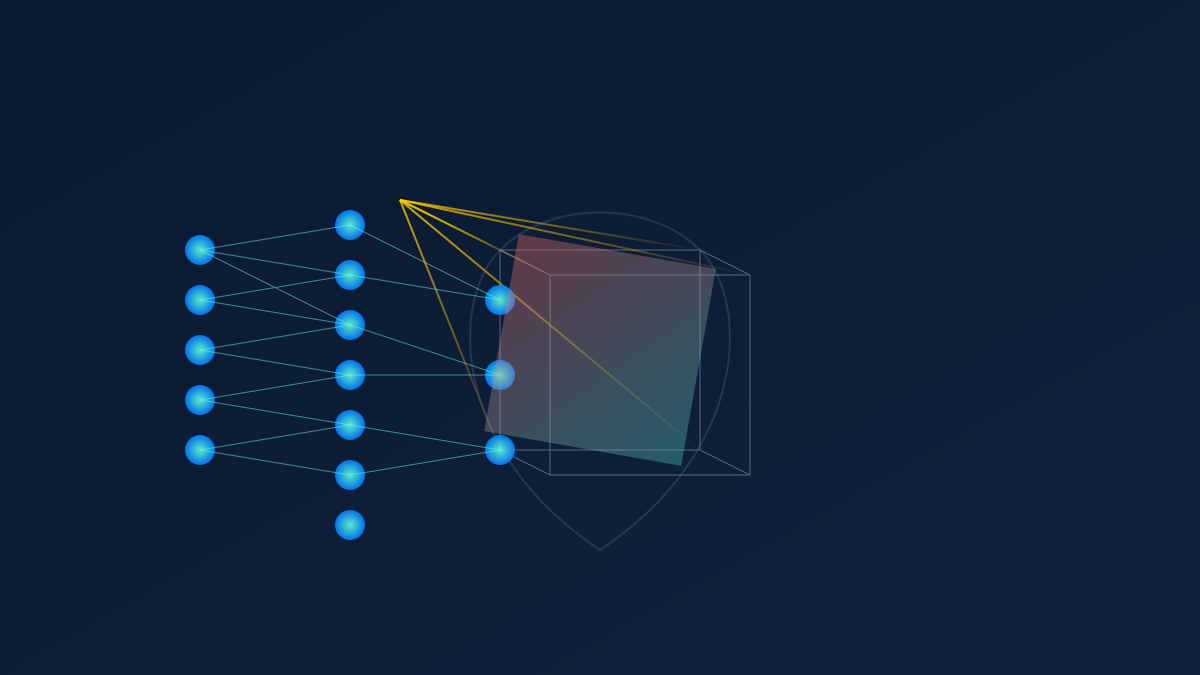
Use neural networks to learn the mapping from radiation source configuration to 3D dose distribution; after training, it can predict radiation fields for any configuration in milliseconds

Key Mechanisms

  1. Spatial Representation: May use voxelization or implicit neural representation (e.g., NeRF-style coordinate networks)
  2. Network Architecture: May use MLP, CNN, or encoder-decoder structures (e.g., U-Net)
  3. Training Data: Derived from high-fidelity Monte Carlo simulations (GEANT4), parametric sampling, and physical symmetry enhancement
  4. Differentiability Advantage: Supports gradient-based optimization of source configurations, sensitivity analysis, and end-to-end inverse design
4

Section 04

Application Scenarios: Practical Value of RadField3D-NN

  1. Radiation Therapy Plan Optimization: Quickly evaluate irradiation schemes and accelerate the treatment planning process
  2. Radiation Protection Design: Quickly evaluate shielding effectiveness and balance safety and cost
  3. Real-Time Dose Monitoring: Integrate into real-time systems to provide dose warnings for interventional radiology
  4. Scientific Research and Education: Lower the threshold for exploring complex dose distributions
5

Section 05

Challenges and Future Directions

Current Challenges

  • Precision generalization: Unseen configurations may be unreliable
  • Uncertainty quantification: Difficult to assess prediction confidence
  • Physical constraints: Pure data-driven models may violate physical laws
  • Multi-scale modeling: Need to handle complex behaviors across different spatial scales

Future Directions

Improve architecture and accumulate data to enhance precision; develop Bayesian networks to address uncertainty; embed physical constraints; optimize multi-scale modeling

6

Section 06

Conclusion: Significance and Potential of RadField3D-NN

RadField3D-NN is a typical case of the integration of AI and computational physics, breaking through the bottlenecks of traditional simulations. In the future, it is expected to become a standard component in radiation therapy planning or be embedded in intelligent monitoring devices to improve the efficiency of medical nuclear safety. It is an excellent entry point for AI + scientific computing developers.

