Zing Forum

Reading

Qwen-Agent: In-depth Analysis of the Customizable AI Agent Framework Based on Tongyi Qianwen

This article provides an in-depth introduction to the architecture design, core functional modules of the open-source Qwen-Agent framework, and its application practices in building intelligent agent systems. It explores how to quickly develop AI applications with tool calling, multi-turn dialogue, and complex task execution capabilities using this framework.

Qwen-Agent通义千问AI代理大语言模型工具调用开源框架智能对话LLM应用
Published 2026-05-05 21:45Recent activity 2026-05-05 21:50Estimated read 7 min
Qwen-Agent: In-depth Analysis of the Customizable AI Agent Framework Based on Tongyi Qianwen
1

Section 01

Guide to In-depth Analysis of the Qwen-Agent Framework

This article provides an in-depth analysis of Qwen-Agent, an open-source AI agent framework based on Tongyi Qianwen. It covers its architecture design, core functional modules (tool calling, memory management, multi-agent collaboration), typical application scenarios, and technical implementation highlights, aiming to help developers quickly build AI applications with complex task execution capabilities.

2

Section 02

Demand for AI Agent Frameworks in the Era of Large Language Models

With the rapid improvement of Large Language Model (LLM) capabilities, AI agents have become a key bridge connecting model capabilities to practical applications. Simple conversational interactions cannot meet the needs of complex business scenarios; developers urgently need a framework that can deeply integrate LLMs with external tools, knowledge bases, and business processes. Qwen-Agent is an open-source project born in this context, providing a complete solution for agent development based on the Tongyi Qianwen model.

3

Section 03

Core Design Philosophy and Layered Architecture of Qwen-Agent

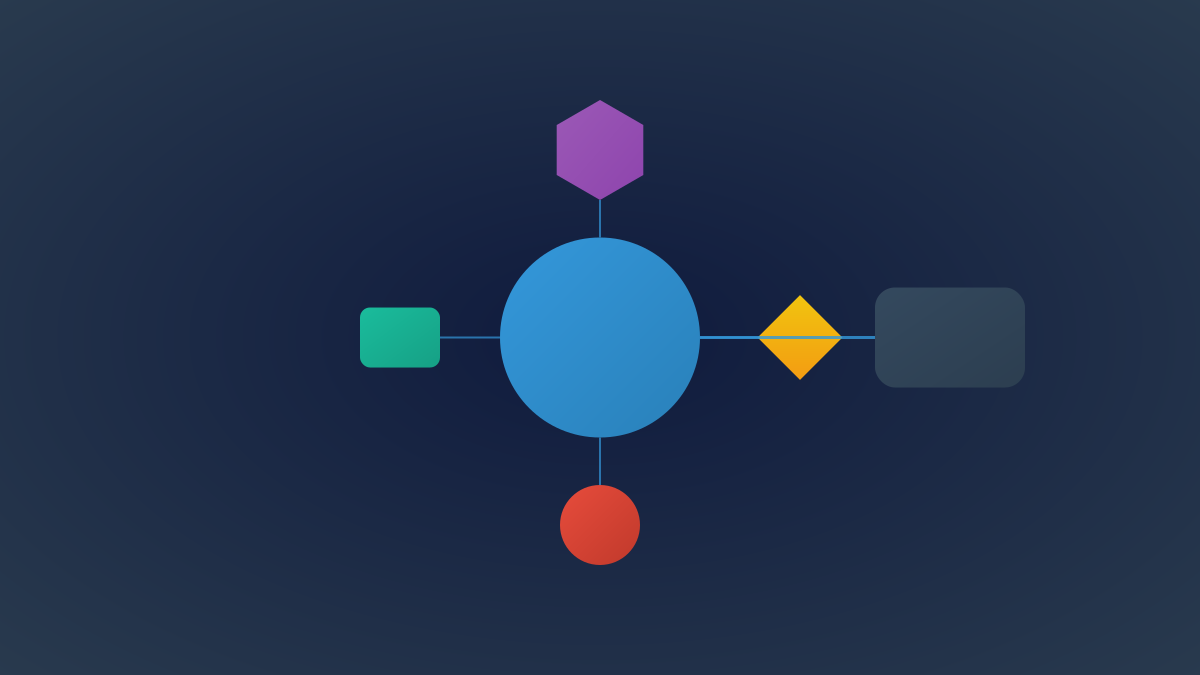
Qwen-Agent follows three core principles: modularity, scalability, and ease of use. Modularity allows components to be used or replaced independently; scalability adapts to scales from simple chatbots to complex multi-agent systems; ease of use is reflected in concise APIs and rich examples. The framework adopts a layered architecture: the bottom layer is the model interface layer (communicating with Qwen series models), the middle layer is the capability extension layer (tool calling, memory management, knowledge retrieval, etc.), and the upper layer is the application orchestration layer (combining agents to complete complex tasks).

4

Section 04

Detailed Explanation of Qwen-Agent's Key Functional Modules

Tool Calling and Function Execution

Tool calling is a core feature. Developers define tool logic via Python functions and annotate descriptions; the framework automatically handles tool selection, parameter parsing, and result feedback. It supports synchronous/asynchronous execution and hybrid scenarios, and injects results into the context to facilitate multi-turn reasoning.

Memory and Context Management

It supports strategies like sliding window, summarization, and vector memory, adapting to different scenarios (e.g., summarization memory for customer service, vector memory for code assistants). It also supports custom storage backends (memory, files, Redis, etc.).

Multi-Agent Collaboration Orchestration

It allows defining agent interaction processes and building workflows such as sequential, conditional branching, and parallel ones. For example, document processing can be decomposed into parsing, analysis, review, and formatting agents, and the framework handles message passing and state synchronization.

5

Section 05

Practical Applications of Qwen-Agent in Typical Scenarios

Intelligent Customer Service and Dialogue Systems

Integrate enterprise knowledge bases (PDF, Word, web pages, etc.) to answer inquiries, and combine tool calls to perform operations like order queries and appointments, achieving end-to-end automation.

Code Assistants and Development Tools

Supports code explanation, refactoring, and test generation. It integrates a code execution environment to verify correctness and provide accurate suggestions.

Data Analysis and Report Generation

Connects to SQL, Excel, or API data sources to perform queries, cleaning, analysis, and visualization, and generates insight reports through natural language interaction.

6

Section 06

Technical Implementation Highlights of Qwen-Agent

Engineering implementation highlights include: well-designed system prompt templates to optimize instruction-following capabilities; streaming response support for real-time output to enhance user experience; type-safe design using Python type hints to catch potential errors; providing Gradio/Streamlit integration examples for quick UI setup; and supporting OpenAI-compatible APIs for easy production deployment.

7

Section 07

Ecological Development and Community Contributions of Qwen-Agent

As an important part of the Tongyi Qianwen ecosystem, Qwen-Agent iterates synchronously with Qwen models to support new features and uses the Apache 2.0 license to encourage community contributions. Currently, the community has expanded to vertical scenarios such as legal assistants and medical consultation. For developers, the framework encapsulates agent development patterns, helps understand principles through clear code and documentation, and mastering its development skills is a core competency for AI application engineers.


