Zing Forum

Reading

PyTorch Image Classification Practice: Learning the Art of Balancing Regularization and Generalization with Small Datasets

This article introduces a learning project that builds a CNN image classifier using PyTorch, exploring the practical effects of overfitting, regularization techniques, and hyperparameter tuning on small datasets through experiments.

PyTorch卷积神经网络图像分类过拟合正则化深度学习CNN超参数调优小数据集机器学习
Published 2026-06-14 01:16Recent activity 2026-06-14 01:25Estimated read 6 min
PyTorch Image Classification Practice: Learning the Art of Balancing Regularization and Generalization with Small Datasets
1

Section 01

[Introduction] PyTorch Image Classification with Small Datasets: Exploring the Balance Between Regularization and Generalization

This article introduces ishaandindwar's PyTorch image classification project on GitHub. Using a self-built small dataset of 104 images across four categories (bottles, headphones, Spider-Man dolls, watches), it constructs a CNN model and experimentally explores the practical effects of overfitting, regularization techniques, and hyperparameter tuning. The core is to understand the art of balancing regularization and generalization with small datasets.


2

Section 02

[Background] Project Origin and Dataset Construction

Project Source: Original author/maintainer ishaandindwar, platform GitHub, original title image-classifier-neural-network, link https://github.com/ishaandindwar/image-classifier-neural-network, release date June 13, 2026.

Learning Motivation: Understand how neural network training behavior changes with parameters and regularization techniques; the small dataset setup makes it easy to observe overfitting.

Dataset Features: 26 images per category, 4 categories total (104 images), taken under different angles and lighting conditions; advantages of self-built dataset: controllable quality, fast iteration, full understanding of data.

3

Section 03

[Methodology] CNN Model Architecture and Training Configuration

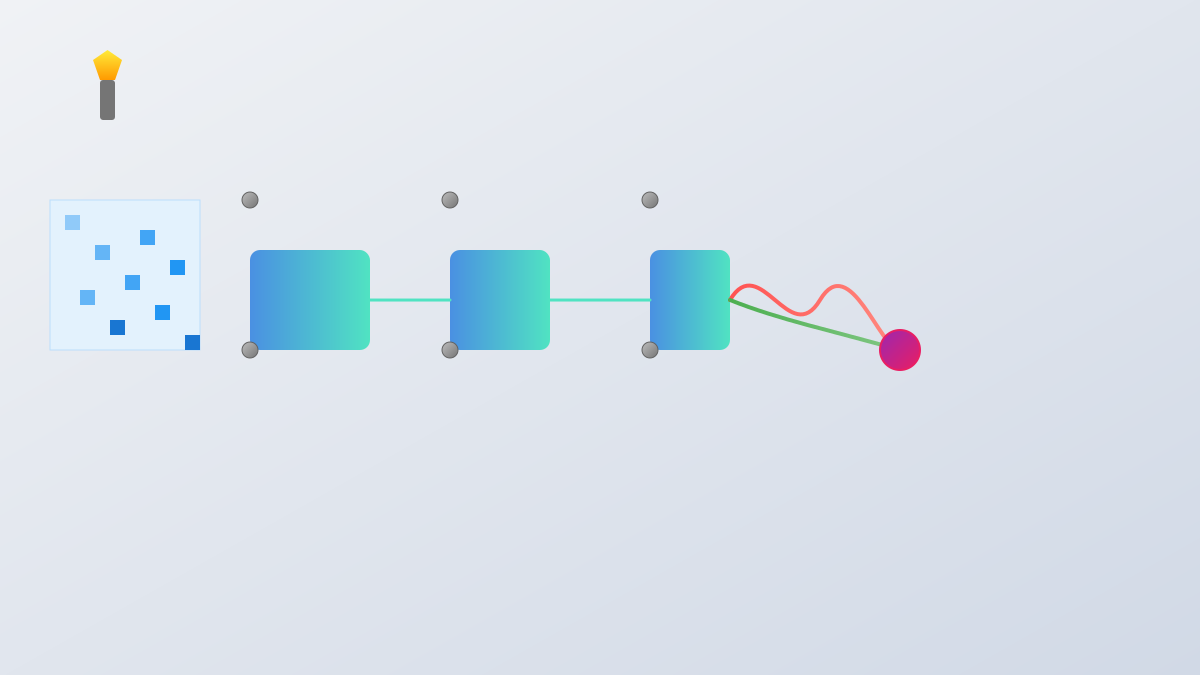
Network Structure: Classic CNN including convolutional layers (extract spatial features), batch normalization (accelerate convergence + regularization), pooling layers (dimensionality reduction + translation invariance), Dropout layers (prevent overfitting), fully connected layers (classification decisions).

Training Configuration: Optimizer Adam, learning rate 0.001, batch size 16, training epochs 15, Dropout rate 0.3, loss function cross-entropy loss; uses training-validation split, backpropagation to update weights.

4

Section 04

[Evidence] Experimental Process and Key Findings

Experiment 1: Initial training-validation accuracy is about 71%, with high training accuracy but low validation accuracy—typical overfitting.

Experiment 2: After applying L2 regularization (weight decay 1e-4), validation accuracy drops to about 43% due to underfitting caused by the overly small dataset, revealing that regularization is not always beneficial.

Experiment 3: After comprehensive tuning (adjusting Dropout, learning rate, epochs, batch size), validation accuracy reaches about 76% and the loss gap narrows; optimal training duration is 12-14 epochs, as further training leads to overfitting.

5

Section 05

[Conclusion] Core Learning Takeaways and Project Value

Core Takeaways: Lowering training loss does not equal improving validation accuracy; overfitting and generalization need to be balanced (empirical risk/structural risk minimization, bias-variance tradeoff); hyperparameters (learning rate, batch size, etc.) have significant impacts; regularization is a double-edged sword (easy to underfit with small datasets).

Project Value: Educational value (moderate scale, clear problem, complete experiments, detailed records); practical insights (start with small datasets, monitor training dynamics, use regularization cautiously, apply early stopping, record experiments).

6

Section 06

[Suggestions] Project Expansion Directions

Expandable directions:

  1. Data augmentation (rotation, flipping, etc.)
  2. Transfer learning (pre-trained models like ResNet)
  3. Complex architectures (ResNet residual connections, Inception modules)
  4. Learning rate scheduling
  5. Cross-validation
  6. Expand more categories
7

Section 07

[Summary] Core Project Value and Learning Significance

Although small in scale, this project has rich learning value, showing overfitting issues in small datasets and attempted solutions; the author not only learned to build a CNN with PyTorch but also understood the difference between overfitting and generalization, limitations of regularization, impact of hyperparameters, and importance of experimental records; hands-on experiments plus observation and reflection are far better than theoretical reading; the core truth is that models need to balance learning and regularization to achieve good generalization.

