Zing Forum

Reading

Python Neural Network Chatbot: Local Implementation Using TensorFlow and NLTK

A simple neural network chatbot built with Python, TensorFlow, and NLTK, supporting custom intent training, running purely on CPU without API keys, ideal for beginners learning natural language processing.

聊天机器人自然语言处理TensorFlowNLTK神经网络意图识别PythonNLP入门
Published 2026-05-12 11:25Recent activity 2026-05-12 11:31Estimated read 8 min
Python Neural Network Chatbot: Local Implementation Using TensorFlow and NLTK
1

Section 01

Introduction to the Python Neural Network Chatbot Project

This article introduces a local neural network chatbot project based on Python, TensorFlow, and NLTK. The project supports custom intent training, runs purely on CPU without API keys, and is suitable for beginners to learn natural language processing (NLP) and deep learning applications. Its core features include local operation, lightweight implementation, and strong customizability, making it an excellent project for understanding core NLP concepts and deep learning practices.


2

Section 02

Project Background and Overview

Chatbots are classic applications in the NLP field, widely used from intelligent customer service to personal assistants. For beginners, building a chatbot is an excellent practice to understand NLP and deep learning. This project "Chatbot-using-python" provides a concise and complete implementation solution, combining TensorFlow and NLTK to build a neural network-based intent recognition dialogue system. It does not require a GPU or external APIs, runs completely locally, and is suitable for beginners to learn and experiment with.

3

Section 03

Technical Architecture and Methods

The project adopts an intent classification architecture, with core tasks divided into intent recognition and response generation.

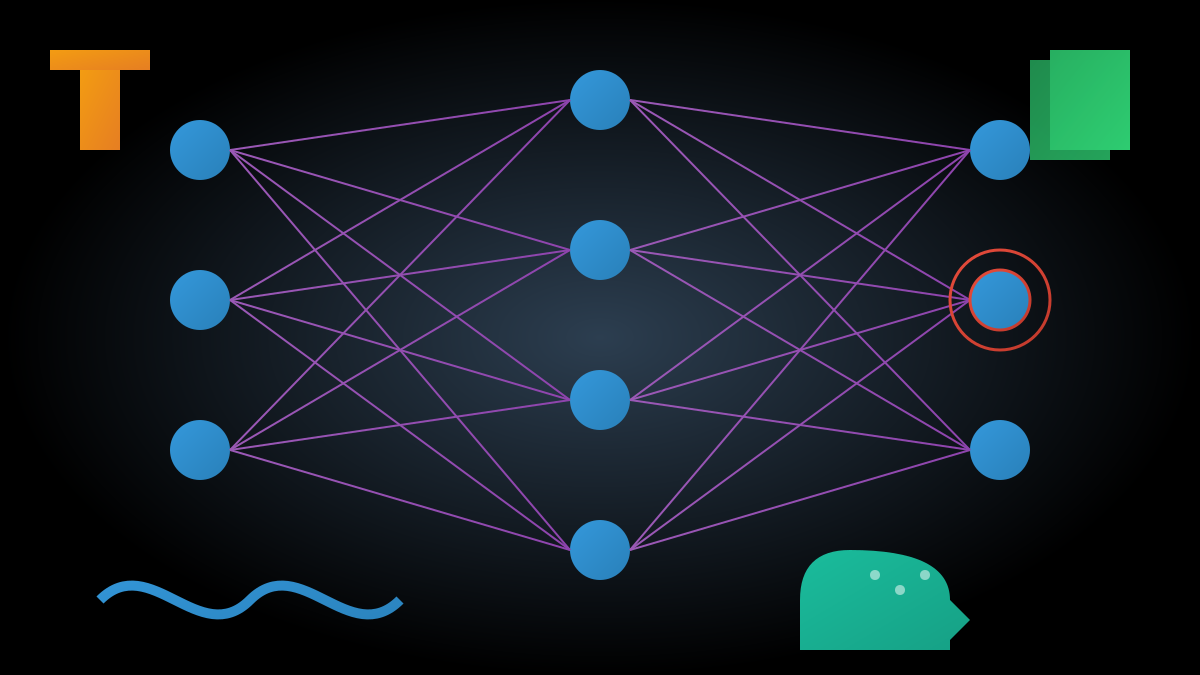
  • Intent Recognition Module: Uses a fully connected neural network classifier. The input is text features encoded by a bag-of-words model, the hidden layer uses ReLU activation, and the output layer uses Softmax to output a probability distribution. Training data is stored in intents.json (including intents, example sentences, and response templates).
  • NLP Process: NLTK handles word segmentation, stemming, and stopword filtering; the bag-of-words model converts text into fixed-length vectors (efficient though it loses word order).
  • Response Generation: After classifying into an intent, a corresponding response template is randomly selected and returned.
4

Section 04

Project Structure and Usage

Project Structure: Core files include chat.py (main program entry), new.py (model training script), intents.json (intent definition), chatbot_model.h5 (model weights), words.pkl (vocabulary list), and classes.pkl (intent categories). Usage Flow:

  1. Training: Edit intents.json to define intents (labels, example sentences, responses), then run new.py to train the model (saves weights and vocabulary list).
  2. Inference: Run chat.py to start the dialogue. The system preprocesses the input → predicts the intent → returns a random response. It runs purely on local CPU without needing internet access.
5

Section 05

Technical Highlights of the Project

This project has three key highlights:

  1. Pure Local Operation: Does not rely on cloud APIs, no quota consumption, ensures data privacy, suitable for data-sensitive scenarios.
  2. Lightweight Implementation: Concise code, clear logic, no complex dependency configuration, easy for beginners to understand and extend.
  3. Strong Customizability: New intents can be added or samples/responses extended by modifying intents.json; non-technical personnel can also participate in customization.
6

Section 06

Learning Value of the Project

For beginners in NLP and deep learning, the project has significant learning value:

  • Demonstrates the complete machine learning process: data preparation → model training → inference deployment.
  • Helps understand the collaboration between traditional NLP feature engineering (bag-of-words model) and deep learning models.
  • Enables mastery of intent classification (a core task of dialogue systems), laying a foundation for learning complex models such as Transformers.
7

Section 07

Limitations and Expansion Directions

Limitations: The bag-of-words model loses word order and semantic information, leading to limited ability to understand complex semantics; template responses lack flexibility and cannot handle open-domain free dialogue. Expansion Directions:

  • Replace the bag-of-words model with Word Embedding to capture semantics.
  • Use stronger model architectures such as LSTM or Transformer.
  • Integrate a knowledge base to implement factual question answering.
  • Add dialogue state tracking to support multi-turn conversations.
8

Section 08

Project Summary

The "Chatbot-using-python" project implements a fully functional neural network chatbot in a concise way, making it an excellent practical material for beginners to learn NLP and deep learning. Its features of local operation and zero API dependency make it suitable for teaching demonstrations and personal experiments. By understanding and expanding this project, learners can gradually master the core skills of building complex dialogue systems.

