Zing Forum

Reading

Building a Neural Network from Scratch: Implementing Core Deep Learning Algorithms in Pure Python

A project that does not rely on external libraries like NumPy or TensorFlow, using pure Python to implement core neural network components including matrix operations, activation functions, backpropagation, and optimizers.

神经网络Python反向传播深度学习梯度下降矩阵运算激活函数优化器从零实现
Published 2026-05-16 14:55Recent activity 2026-05-16 15:04Estimated read 6 min
Building a Neural Network from Scratch: Implementing Core Deep Learning Algorithms in Pure Python
1

Section 01

Introduction: Core Value of Building a Pure Python Neural Network from Scratch

This project aims to bridge the understanding gap caused by the convenience of deep learning frameworks. It implements core neural network components (matrix operations, activation functions, backpropagation, optimizers, etc.) using pure Python without relying on external libraries like NumPy or TensorFlow. Its core value lies in educational significance—allowing learners to understand the internal mechanisms of deep learning through a "white-box" experience, rather than just knowing how to call APIs.


2

Section 02

Background and Project Positioning

In today's era of highly developed deep learning frameworks, practitioners often can call APIs to train models but have only a superficial understanding of internal mechanisms. This project is positioned as an educational tool: it strips away abstraction layers, exposes details of each component, allows learners to see the process of data flow, gradient calculation, and weight updates, and provides a "white-box" learning experience that frameworks cannot offer.

3

Section 03

Technical Implementation Principles and Core Components

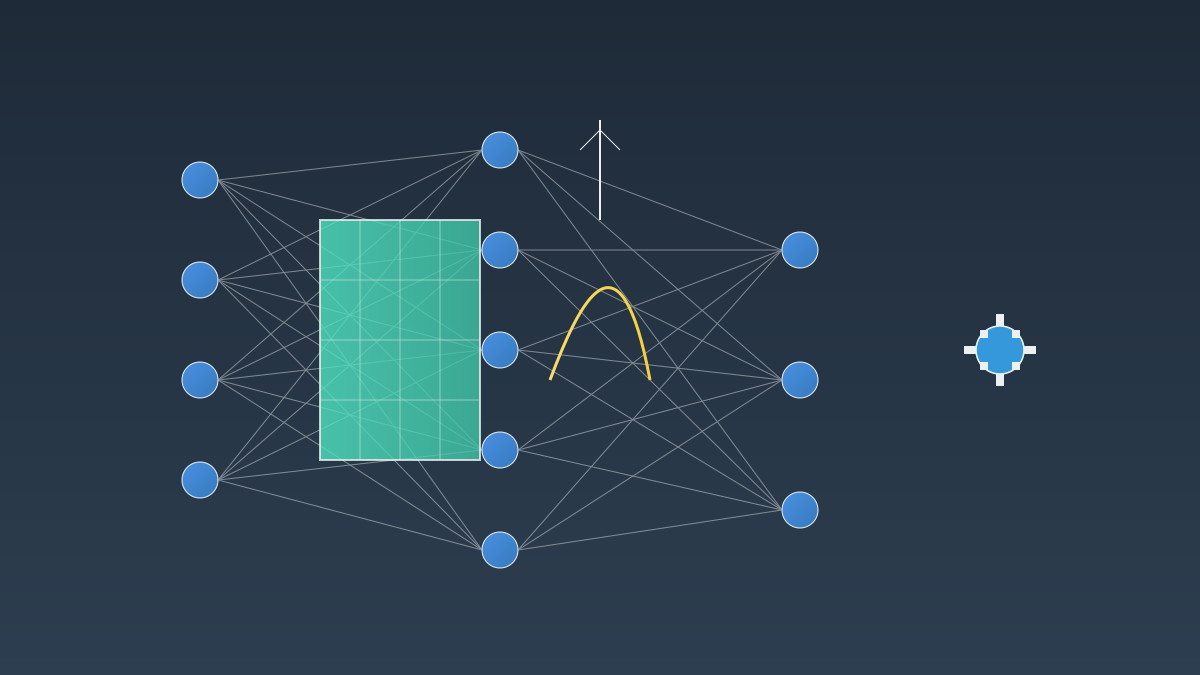
The project strictly adheres to the principle of no external dependencies, using only Python standard libraries (math, random, csv, json). The core component implementations include:

  • Matrix operations: Manually implemented matrix multiplication, transposition, and element-wise operations;
  • Activation functions: Forward and backward propagation for Sigmoid, ReLU, and Tanh;
  • Loss functions: MSE, cross-entropy, and their gradients;
  • Backpropagation: Calculation of parameter gradients via the chain rule;
  • Optimizers: Batch gradient descent, SGD, and learning rate scheduling.
4

Section 04

Project Structure and Usage Flow

The project uses a modular design:

  • File organization: main.py (entry point), network.py (core implementation), utils.py (tools), config.json (configuration), train_data.csv (data);
  • Configuration-driven: Adjust network structure, activation functions, optimizers, etc., by modifying config.json;
  • Training flow: Data loading → Initialization → Iterative training (forward propagation → loss calculation → backpropagation → weight update) → Monitoring → Save results.
5

Section 05

Educational Value and Learning Path

This project helps learners deeply understand core concepts: weights and biases, forward/backward propagation, gradients and convergence, overfitting and generalization. It also serves as practice material for Python: data structures, file operations, modular programming, and debugging skills.

6

Section 06

Limitations and Improvement Directions

The pure Python implementation has limited performance (no vectorization/GPU acceleration), making it suitable for learning rather than large-scale applications. Improvement directions include: extending convolutional/recurrent layers, adding regularization/batch normalization, implementing more optimizers (e.g., Adam), and adding training visualization (loss curves, weight distributions).

7

Section 07

Comparison with Other Learning Resources

This project complements other resources:

  • Compared to framework tutorials: Teaches tool principles rather than usage;
  • Compared to theoretical courses: Provides runnable code to concretize abstract theories;
  • Compared to visualization tools: Allows modifying experiments and observing effect changes.
8

Section 08

Summary

This project demonstrates core deep learning mechanisms in a plain way—no fancy features, only essential algorithm implementations. For learners who want to understand why and how neural networks work, simplicity is its greatest advantage. Hand-writing a neural network means mastering basic concepts like backpropagation and gradient descent; this ability is of great value when facing new models, making it an excellent teaching material.

