Zing Forum

Reading

Pose AI Processor: A Local Privacy-First Video Pose Analysis Tool

A lightweight, privacy-focused desktop application that uses CPU-optimized pose estimation and local large language models to analyze human poses in videos. It adopts a modular 10-file architecture and supports MediaPipe pose detection and LM Studio local AI analysis.

姿态估计MediaPipe本地AI隐私保护计算机视觉LM StudioPython姿态分析健康管理开源工具
Published 2026-06-16 16:15Recent activity 2026-06-16 16:19Estimated read 6 min
Pose AI Processor: A Local Privacy-First Video Pose Analysis Tool
1

Section 01

Introduction: Core Overview of Pose AI Processor

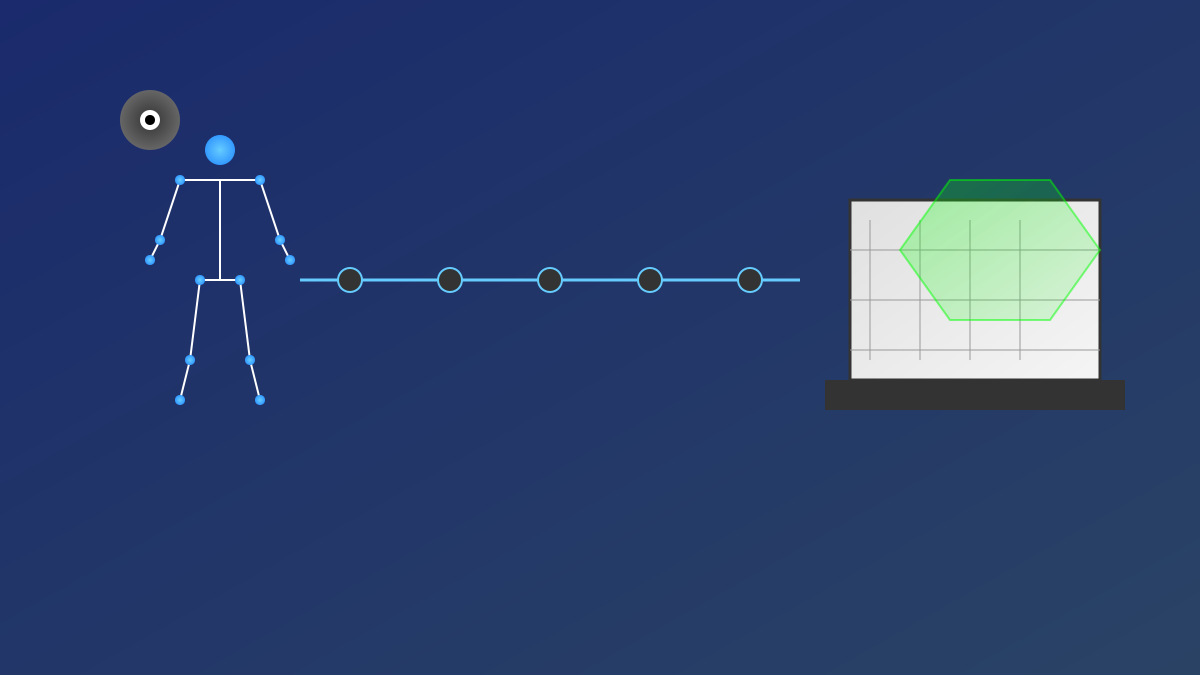
Pose AI Processor is a local privacy-first desktop application that uses lightweight CPU-optimized pose estimation and local large language models to analyze poses in videos. Its core features include fully local operation (no cloud dependency), a modular 10-file architecture, support for MediaPipe pose detection and LM Studio local AI integration. It aims to address the privacy leakage risks and usage costs of traditional cloud-based pose analysis solutions, and is suitable for scenarios such as health management and sports training.


2

Section 02

Project Background and Design Motivation

The popularity of remote work and online learning has led to prominent health issues caused by poor sitting posture. Traditional pose analysis relying on cloud APIs has privacy leakage risks and ongoing costs. This tool takes fully local operation as its core design principle, providing professional posture assessment without the need for internet connection, fundamentally ensuring the privacy and security of user data.

3

Section 03

Core Technologies and Architecture Design

  1. Local Privacy Protection: Runs entirely locally, analyzes via LM Studio local server, no external API keys, data not uploaded to third-party servers;
  2. CPU-Optimized Pose Detection: Uses Google MediaPipe framework, detects 33 human key points in real time, and can run smoothly on low-end devices after deep optimization;
  3. Modular 10-File Architecture: Follows the principle of separation of concerns, each module is responsible for specific functions such as UI rendering and video processing, improving maintainability and collaboration efficiency;
  4. Modern UI: Built on CustomTkinter, supports theme switching, and uses background threads to handle time-consuming operations to ensure interface responsiveness.
4

Section 04

Tech Stack and Implementation Details

  • Programming Language and UI: Python 3.9+, CustomTkinter combined with Tkinter ensures cross-platform compatibility;
  • Computer Vision and AI: MediaPipe handles pose detection, OpenCV processes video frames, communicates with LM Studio local server via HTTP (supports models like Llama/Mistral);
  • Data Management: Generates timestamped JSON output (including pose data and metadata), supports optional SQLite database integration.
5

Section 05

Application Scenarios and Value

  • Personal Health Management: Analyzes sitting posture during desk work, identifies bad postures and provides improvement suggestions;
  • Sports Training Assistance: Evaluates the standardization of fitness movements to avoid sports injuries;
  • Telemedicine Rehabilitation: Provides movement completion analysis data for patients' rehabilitation training;
  • Research and Education: Supports data collection for ergonomics research and can be used as an AI teaching case.
6

Section 06

Quick Usage Guide

  1. Prepare LM Studio: After downloading and installing, load a large language model, start the local server and listen on port 1234;
  2. Run the Project: Git clone the repository, install dependencies, then start the main program to analyze videos; Hardware requirements: A modern computer that supports Python 3.9, no GPU required.
7

Section 07

Summary and Future Outlook

This tool represents an emerging paradigm of local AI workflows, balancing AI convenience and data privacy control. The modular architecture provides a foundation for function expansion. In the future, features such as real-time camera analysis, detailed posture reports, and historical data trend analysis can be expected. It is suitable for developers and users who care about privacy protection to explore and use.

