Zing Forum

Reading

PlausiDen-GraphNet: A Real-Time Visualization and Interactive Environment for Neural Network Architecture Design

A neural network architecture workbench supporting real-time REPL, 3D visualization, and instant intervention, compatible with multiple architectures such as HDC/VSA, Transformer, and Mamba

神经网络可视化HDCVSATransformerMamba交互式开发深度学习工具Rust实时调试
Published 2026-05-22 03:15Recent activity 2026-05-22 03:17Estimated read 5 min
PlausiDen-GraphNet: A Real-Time Visualization and Interactive Environment for Neural Network Architecture Design
1

Section 01

PlausiDen-GraphNet: A Real-Time Visualization and Interactive Workbench for Neural Network Architectures

PlausiDen-GraphNet is a real-time interactive graphical environment designed for neural network architects, positioned as the "graphing calculator for AI". It breaks the traditional "write code-run-debug" cycle, providing an immediate visualization, modification, and feedback workflow. Its core goal is to lower the cognitive threshold for architecture design, supporting real-time REPL, 3D visualization, and instant intervention, and is compatible with multiple architectures such as HDC/VSA, Transformer, and Mamba.


2

Section 02

Technical Background and Design Philosophy: Reimagining Existing Toolchains with Visualization First

Existing frameworks like PyTorch/TensorFlow are cumbersome during the architecture exploration phase, requiring a lot of boilerplate code to view internal states and making debugging difficult. PlausiDen-GraphNet adopts a "visualization first" design philosophy. Its tech stack includes a Rust core engine (ensuring performance and memory safety), PyO3 Python bindings (seamless integration into the Python ecosystem), and a unified adapter layer (supporting multiple models), with a layered architecture balancing performance and convenience.

3

Section 03

Core Features: Multi-Dimensional Visualization and Real-Time Intervention Debugging

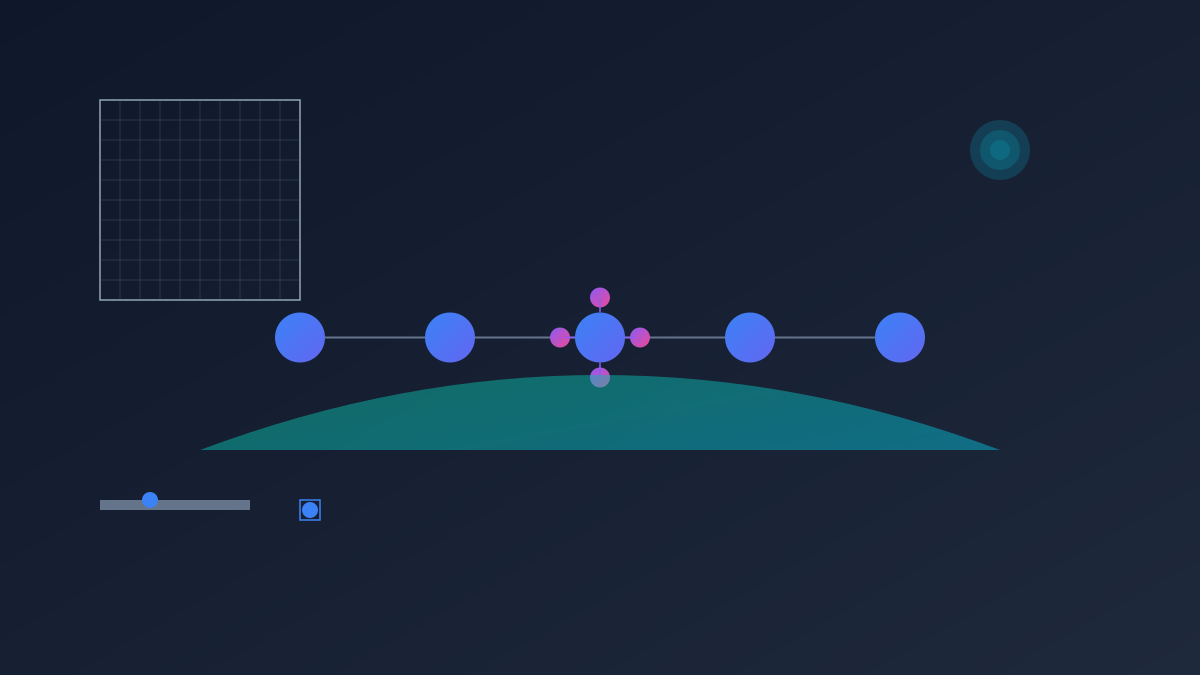
Multi-Dimensional Visualization: 2D architecture diagram (node-edge structure display), 3D rotatable view (understanding deep topology), real-time activation heatmap (dynamically showing activation states), hypervector point cloud (semantic clustering for HDC/VSA scenarios); Real-Time Intervention Debugging: Modify weights, add operations, remove components, time-travel debugging (single-step/rollback/breakpoints), executed at approximately 30FPS frame rate; Resource Monitoring: Real-time display of RAM, GPU memory, CPU utilization, energy consumption estimation, and computing cost.

4

Section 04

Supported Model Architectures: First-Class Support for Multiple Architectures

Compatible with multiple architectures: PlausiDen Stack (emerging paradigm combining HDC/VSA), Transformer (HuggingFace ecosystem), Mamba (state space model), Graph Neural Networks (native support), custom PyTorch/JAX models (thin adapter integration).

5

Section 05

Modular Architecture and Engineering Practices: Rust Core + Python Ecosystem

Modular design: crates/graphnet-engine (Rust core: Model trait, execution engine, intervention API, etc.), crates/graphnet-bindings (PyO3 bindings), python/graphnet/ (Python package interface), examples/ (Jupyter tutorials). Testing uses proptest property testing, cargo mutants mutation testing, cargo fuzz fuzz testing, and visual regression testing, adhering to the "test-first" principle.

6

Section 06

Practical Application Scenarios: Adaptation to Multiple Scenarios like Teaching, Research, and Debugging

Applicable scenarios: Teaching Demonstrations (real-time display of neural network working principles), Architecture Research (quickly validate new ideas), Debugging Complex Models (visualize activation patterns to find bugs), Hyperdimensional Computing Exploration (intuitive tool for HDC/VSA researchers).

7

Section 07

Future Outlook: From Interaction-First to Standard Configuration

Future development directions: Improve HDC graphical interface, enhance math panel, structured logging system, future-oriented abstraction layer design, and full implementation of the AVP-2 security protocol. PlausiDen-GraphNet represents a new paradigm of "interaction-first" deep learning tools, and as model complexity increases, it may become a standard configuration.

