Zing Forum

Reading

PhishGuard: An Intelligent Phishing Link Detection System Integrating Threat Intelligence and Machine Learning

This article provides an in-depth analysis of the PhishGuard project, exploring how it identifies malicious phishing URLs through multi-dimensional detection mechanisms—including threat intelligence queries, heuristic rule analysis, and machine learning models—to offer practical references for cybersecurity protection.

钓鱼检测网络安全威胁情报机器学习URL分析恶意链接安全防护深度学习网络钓鱼安全工具
Published 2026-08-11 23:19Recent activity 2026-08-11 23:25Estimated read 9 min
PhishGuard: An Intelligent Phishing Link Detection System Integrating Threat Intelligence and Machine Learning
1

Section 01

PhishGuard: Guide to an Intelligent Phishing Link Detection System Integrating Multiple Technologies

PhishGuard Guide

PhishGuard is an intelligent phishing link detection system that integrates threat intelligence, heuristic rules, and machine learning. It aims to address the lag issue of traditional blacklist protection, and real-time identifies malicious URLs through multi-dimensional mechanisms, providing practical solutions for cybersecurity protection. Its core adopts a three-layer detection architecture to achieve in-depth defense and effectively reduce false negatives and false positives.


2

Section 02

Current State of Phishing Attack Threats and Limitations of Traditional Protection

Current State of Phishing Attack Threats and Limitations of Traditional Protection

In the digital age, phishing attacks are one of the most common cyber threats. Over 90% of cyber attacks start with phishing emails, and users find it hard to distinguish the authenticity of links with the naked eye. Traditional blacklist filtering has lag issues and cannot cope with the endless emergence of new phishing websites, so a real-time intelligent detection system is needed.

3

Section 03

Design Philosophy of PhishGuard's Three-Layer Detection Architecture

Design Philosophy of Three-Layer Detection Architecture

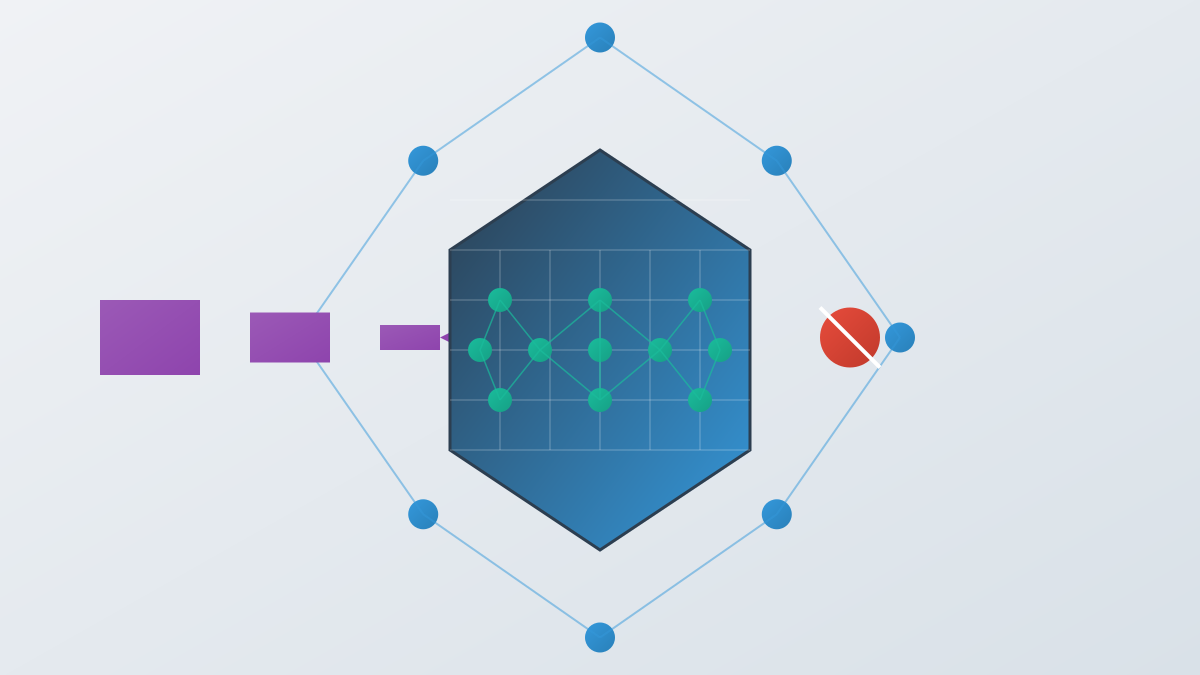
PhishGuard adopts a three-layer architecture of "Threat Intelligence + Heuristic Rules + Machine Learning":

  • Threat Intelligence Layer: Quickly identifies known malicious URLs, but is ineffective against new threats;
  • Heuristic Rules Layer: Analyzes features like URL structure and domain name to cover unrecorded typical phishing patterns;
  • Machine Learning Layer: Learns the differences between normal and phishing websites, handles edge cases, and has generalization capabilities. The combination of multiple layers achieves complementarity and maximizes defense effectiveness.
4

Section 04

Specific Implementation of Threat Intelligence and Heuristic Rules

Specific Implementation of Threat Intelligence and Heuristic Rules

Threat Intelligence Layer: Integrates authoritative sources like Google Safe Browsing and VirusTotal, makes comprehensive judgments through API queries, relies on community collective defense, but has limitations in coverage and timeliness. Heuristic Rules Layer:

  • URL structure: IP instead of domain name, excessive subdomains, overly long/encoded characters, etc.;
  • Domain name features: Impersonating well-known brands (typosquatting), domain age, WHOIS information;
  • SSL certificate: Check validity, issuing authority, domain name matching degree;
  • Page content: Sensitive forms, brand visual elements, suspicious JS code. These rules codify expert experience and fill the blind spots of the intelligence layer.
5

Section 05

Technical Details of the Machine Learning Layer

Technical Details of the Machine Learning Layer

Feature Engineering: Extracts highly discriminative features such as URL length, number of special characters, domain name length, and sensitive vocabulary; Model Selection: Balances accuracy and efficiency, optional models include Random Forest, SVM, Gradient Boosting Tree, or deep learning models, which need to meet real-time requirements; Training Data: Requires a large number of labeled samples, ensuring real distribution and regular updates; Evaluation Metrics: Uses precision, recall, F1 score, ROC-AUC, etc., to evaluate and handle class imbalance scenarios. The machine learning layer is the "brain" of the system, handling new phishing techniques.

6

Section 06

Key Points of System Architecture and Application Scenarios

Key Points of System Architecture and Application Scenarios

Architecture Key Points:

  • Real-time performance: Parallel execution of intelligence queries, optimization of model inference speed, setting timeout mechanisms;
  • Scalability: Microservice splitting, message queue asynchronous processing, load balancing;
  • Result credibility: Integrate multi-layer results to output confidence and handle conflicts;
  • False positive handling: Collect user feedback to continuously optimize rules and models. Application Scenarios:
  • Browser plug-in: Detect and warn of suspicious links in the background;
  • Email gateway: Scan email links to block phishing emails;
  • SOC: Batch detect suspicious URLs to assist threat hunting;
  • User education: Enhancing security awareness is the last line of defense.
7

Section 07

Limitations of PhishGuard and Future Development Directions

Limitations and Future Development Directions

Limitations:

  • Adversarial samples: Attackers can design features to bypass machine learning models;
  • Short links/redirects: Hiding real addresses increases detection difficulty;
  • Dynamic content: Returning different content based on visitor characteristics makes static analysis ineffective. Future Outlook:
  • Combine large language models to improve semantic understanding capabilities;
  • Use graph neural networks to analyze website associations and identify clusters;
  • Introduce adversarial training to enhance model robustness;
  • Track redirect chains and dynamic content analysis technologies.
8

Section 08

Summary and Usage Recommendations

Summary and Usage Recommendations

PhishGuard demonstrates a layered defense approach integrating multiple technologies and is a practical case for phishing detection. For developers, it is a learning sample for converting security knowledge into code; for users, understanding its principles helps enhance security awareness. Recommendations:

  • Integrate it into browsers or email systems for use;
  • Combine with user education to strengthen protection effects;
  • Pay attention to system updates to cope with new threats.

