Zing Forum

Reading

OrKa: Modular AI Agent Orchestration System, Enabling Large Language Models with Traceable Reasoning Capabilities

OrKa is a modular orchestration system that transforms large language models into composable agents, supporting reasoning, fact-checking, and transparent, traceable answer construction.

AI编排大语言模型智能体可解释AI事实核查模块化设计LLMPython
Published 2026-06-09 23:45Recent activity 2026-06-09 23:51Estimated read 9 min
OrKa: Modular AI Agent Orchestration System, Enabling Large Language Models with Traceable Reasoning Capabilities
1

Section 01

OrKa: Introduction to the Modular AI Agent Orchestration System

OrKa: Modular AI Agent Orchestration System, Enabling Large Language Models with Traceable Reasoning Capabilities

Abstract: OrKa is a modular orchestration system that transforms large language models into composable agents, supporting reasoning, fact-checking, and transparent, traceable answer construction.

Original Author/Maintainer: marcosomma Source Platform: GitHub Original Project Name: orka-reasoning Original Link: https://github.com/marcosomma/orka-reasoning Release Date: April 18, 2025 Last Updated: June 9, 2026 License: Apache License 2.0 Project Official Website: https://orkacore.com/

OrKa aims to address the problem that traditional LLM calls lack systematic reasoning chains and fact-checking mechanisms, providing a modular framework to build reliable and interpretable agent systems.


2

Section 02

Project Background and Motivation

With the rapid improvement of large language model (LLM) capabilities, how to transform these powerful models into truly reliable and interpretable agent systems has become a core challenge in AI application development. Traditional LLM calls often lack systematic reasoning chains and fact-checking mechanisms, leading to output results that are difficult to verify and trace.

OrKa (Orchestrator Kit for Agentic Reasoning) is an open-source project born to solve this problem. It provides a set of modular AI orchestration frameworks, enabling developers to encapsulate LLMs into composable agents with reasoning capabilities, fact-checking functions, and transparent traceability mechanisms.

3

Section 03

Core Architecture and Design Philosophy

Modular Agent Design

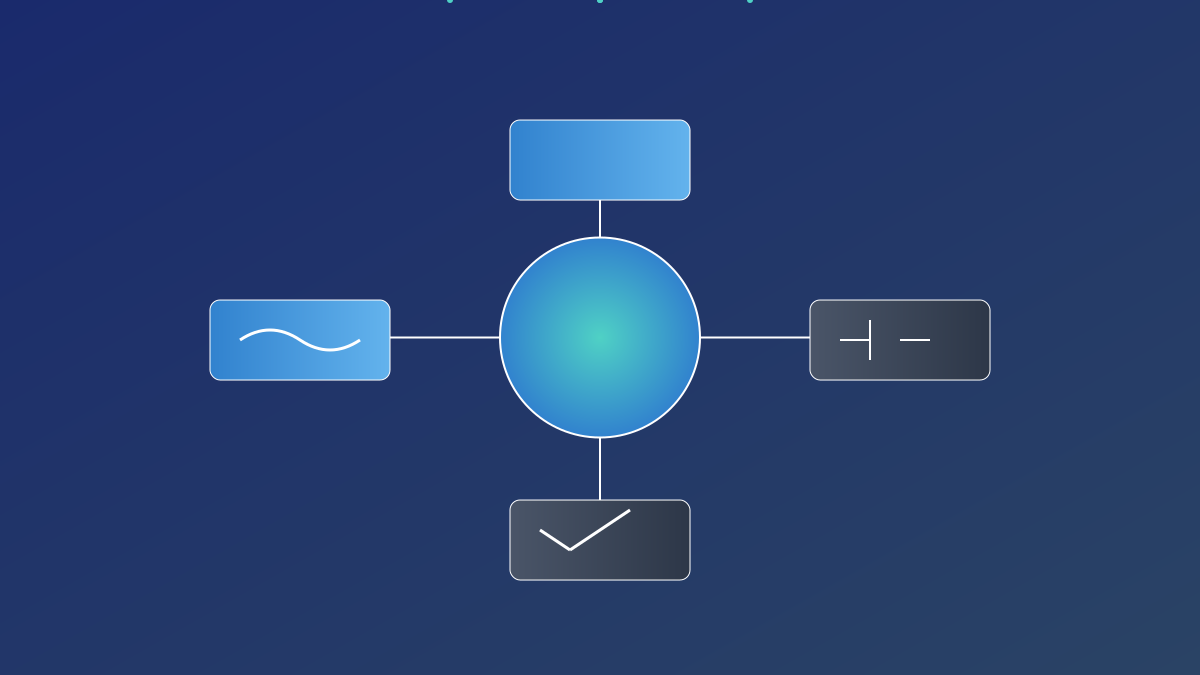
OrKa adopts a modular architecture concept, decomposing complex AI workflows into independent, reusable components (such as reasoning, knowledge retrieval, fact verification, etc.). Developers can build applications like assembling building blocks, maintaining system maintainability and scalability.

Traceable Reasoning Chain

OrKa's core feature is transparent traceability. During execution, it automatically records the complete reasoning chain:

  • Intermediate reasoning steps and their basis
  • Cited external knowledge sources
  • Fact-checking results and judgment logic
  • Final answer construction process This enhances system interpretability and provides support for auditing, debugging, and optimization.

Built-in Fact-Checking Mechanism

OrKa incorporates fact-checking as a first-class citizen into its architecture. When agents generate answers, they automatically verify key claims, mark credibility, and supplement information as needed, significantly reducing the probability of hallucination issues.

4

Section 04

Key Technical Implementation Points

Technology Stack and Dependencies

OrKa is mainly built based on Python, with a code size of approximately 103KB, following the Apache 2.0 protocol. It adopts a standard Python project structure, including a test suite (tests directory), sample code (examples directory), and documentation (docs directory).

Project Activity

As of June 2026, the project has received 96 Stars and 13 Forks, with high community recognition. Maintenance is active; the latest update was on June 9, 2026, and the author continues to iterate and improve.

5

Section 05

Application Scenarios and Practical Value

Enterprise-level Knowledge Q&A System

OrKa's modular design and traceability capabilities are suitable for building internal enterprise intelligent Q&A systems. Users can verify the basis of answers, meeting the demand for interpretability in critical scenarios.

Research Assistance and Literature Analysis

For research work involving processing large amounts of literature and cross-validating information, OrKa's fact-checking and traceability functions can reduce manual verification workload and ensure the reliability of analysis results.

Multi-agent Collaboration System

OrKa agents are highly composable. Developers can build multi-agent collaboration systems, allowing agents with different expertise to collaborate on complex analysis tasks.

6

Section 06

Project Ecosystem and Participation Methods

OrKa has a sound open-source governance structure:

  • Code of Conduct: CODE_OF_CONDUCT.md clearly defines community participation norms
  • Contribution Guide: CONTRIBUTING.md guides new contributors to participate
  • Security Policy: SECURITY.md explains the security vulnerability reporting process
  • Changelog: CHANGELOG.MD records version iteration history

The project also provides GitHub Actions workflows for automated testing and continuous integration to ensure code quality.

7

Section 07

Summary and Outlook

OrKa represents a technical path to transform large language models from 'black-box predictors' to 'interpretable reasoning engines'. Today, as AI penetrates key business areas, interpretability and verifiability have become essential capabilities.

For developers who want to build production-level AI applications, OrKa provides a well-thought-out architectural reference. Even if you don't use this framework directly, its modular design, traceability mechanism, and fact-checking concepts are worth learning from.

We look forward to the project's continuous iteration, more practical application cases, and further exploration by the community in the field of AI interpretability.

