Zing Forum

Reading

Building an Enterprise-Grade AI Demand Forecasting System with Zero Cost on Oracle Cloud: The Intelligent Revolution in Auto Parts Supply Chain

A car after-sales parts demand forecasting system built entirely on Oracle Cloud Free Tier, integrating time series forecasting, vector search, and generative AI to provide intelligent support for supply chain procurement decisions.

Oracle Cloud需求预测供应链汽车零配件时间序列预测向量搜索生成式AIOracle APEX机器学习
Published 2026-05-24 03:12Recent activity 2026-05-24 03:17Estimated read 8 min
Building an Enterprise-Grade AI Demand Forecasting System with Zero Cost on Oracle Cloud: The Intelligent Revolution in Auto Parts Supply Chain
1

Section 01

Introduction: Building an Enterprise-Grade Auto Parts Demand Forecasting System with Zero Cost on Oracle Cloud

This article introduces the open-source project supply-chain-demand-workbench published by Gary D. Hall (30 years of experience in auto after-sales supply chain, Oracle APEX certified developer) on GitHub. Built on Oracle Cloud Free Tier, this system integrates time series forecasting, vector search, and generative AI technologies to solve the complexity of auto parts demand forecasting, provide intelligent support for supply chain procurement decisions, and realize an enterprise-grade AI application with zero infrastructure cost. Project link: https://github.com/garyhapex/supply-chain-demand-workbench (Release date: May 23, 2026).


2

Section 02

Background: Challenges in Auto Parts Demand Forecasting

The demand for auto after-sales parts has seasonal (e.g., surging demand for brake pads in winter), regional (high demand for ABS sensors in cold areas), and customer-specific characteristics. Traditional procurement decisions rely on experienced buyers, but manual processing cannot simultaneously handle the complex time series and correlations of dozens of products, multiple customer groups, and cross-month historical data, which easily leads to low decision efficiency or inaccuracy.

3

Section 03

Project Overview: AI-Driven Demand Forecasting Workbench

Supply Chain Demand Workbench is an AI application designed specifically for auto after-sales parts distribution. Its core values include: 1. Time series models trained with Oracle Machine Learning automatically identify demand anomalies; 2. Recommend procurement order quantities; 3. Answer business queries in natural language. Built by industry experts, it deeply addresses the pain points from the warehouse frontline to the procurement desk, helping buyers make quick and informed decisions.

4

Section 04

Technical Architecture: Full-Stack Oracle Ecosystem (Zero Cost)

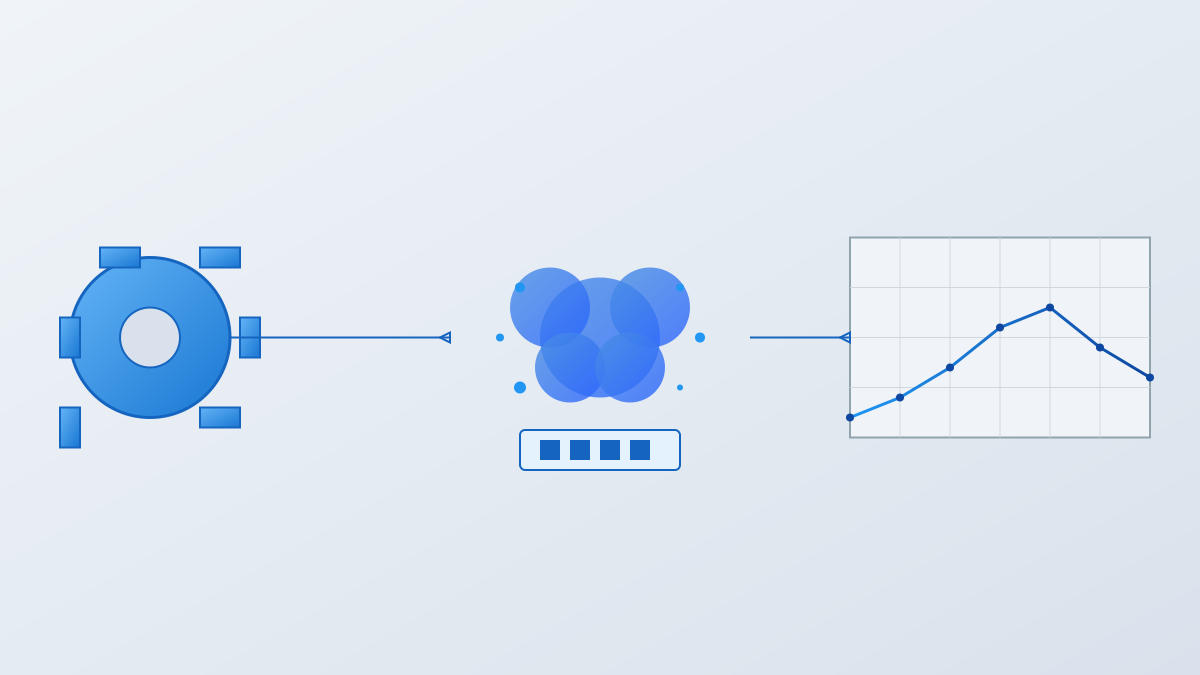
All components of the system run on Oracle Cloud Always Free Tier:

Core Components

Technical Component Function
Oracle APEX 24.2 UI layer (dynamic interaction, reports)
OML4SQL Exponential smoothing time series forecasting (8 models, 36 months of historical data)
Oracle 26ai Vector Search 36-dimensional demand vector cosine similarity calculation (pattern matching)
APEX_AI + OCI Generative AI Natural language queries (voice input + RAG enhancement)
Oracle Autonomous Database 19 data tables (SCDW_ prefix, compatible with Oracle EBS)
OCI Email Delivery Automatic email alerts for anomalies

Database Design

The 19 tables are divided into three categories: reference data tables (6 tables: product type, region, etc.), EBS mirror tables (4 tables: material, order, etc.), and dedicated business tables (9 tables: historical orders, forecast results, etc.), which are easy for EBS developers to extend.

5

Section 05

Detailed Explanation of Core Function Modules

The system includes five major modules:

  1. Buyer Operation Dashboard: Centrally displays risk products, anomaly alerts, order fulfillment rate, and model accuracy, reducing system switching;
  2. OML Demand Forecasting: Product-level forecasting (with confidence interval and recommended procurement quantity, trained on 36 months of historical data using 8 models);
  3. AI Query Interface: Supports natural language/voice questions (e.g., "What was the average sales volume of brake pads last winter?"), answered by OCI generative AI;
  4. Demand Pattern Search: Uses vector search to find product groups with similar demand patterns, optimizing inventory;
  5. Anomaly Marking Review: Automatically marks anomalies into the workflow, allowing buyers to view details and decide to accept or ignore them.
6

Section 06

Implementation Path and Practical Value

Implementation Path: Phased deployment (total 8 phases): 1. APEX application verification; 2. Database schema creation; 3. Synthetic historical data filling; 4. OML model setup;5. Forecast dashboard components;6. Vector search integration;7. Schema enhancement;8. (Note: Original Phase6 may be missing, listed as per the original text). SQL scripts, APEX export file (f116.sql), and technical documents are provided.

Practical Value:1. Designed by industry experts to solve frontline pain points;2. Zero-cost operation (Oracle Cloud Free Tier), suitable for small and medium-sized enterprises with limited budgets;3. Proves that enterprise-grade AI applications can be implemented on free infrastructure.

7

Section 07

Conclusion and Referenceable Highlights

Supply Chain Demand Workbench provides a reference for the digital transformation of traditional industries: deep business scenarios + appropriate tech stack + limited resources to build solutions for pain points. It has great reference value for supply chain intelligence teams (especially in the auto parts field).

Technical Highlights: Multi-model fusion strategy, vector search business application, RAG-enhanced natural language interaction, EBS compatibility design, automated workflow (nightly forecast refresh + anomaly alerts).

