Zing Forum

Reading

Thalassemia and Anemia Intelligent Diagnosis System: Medical AI Application of OCR and Machine Learning

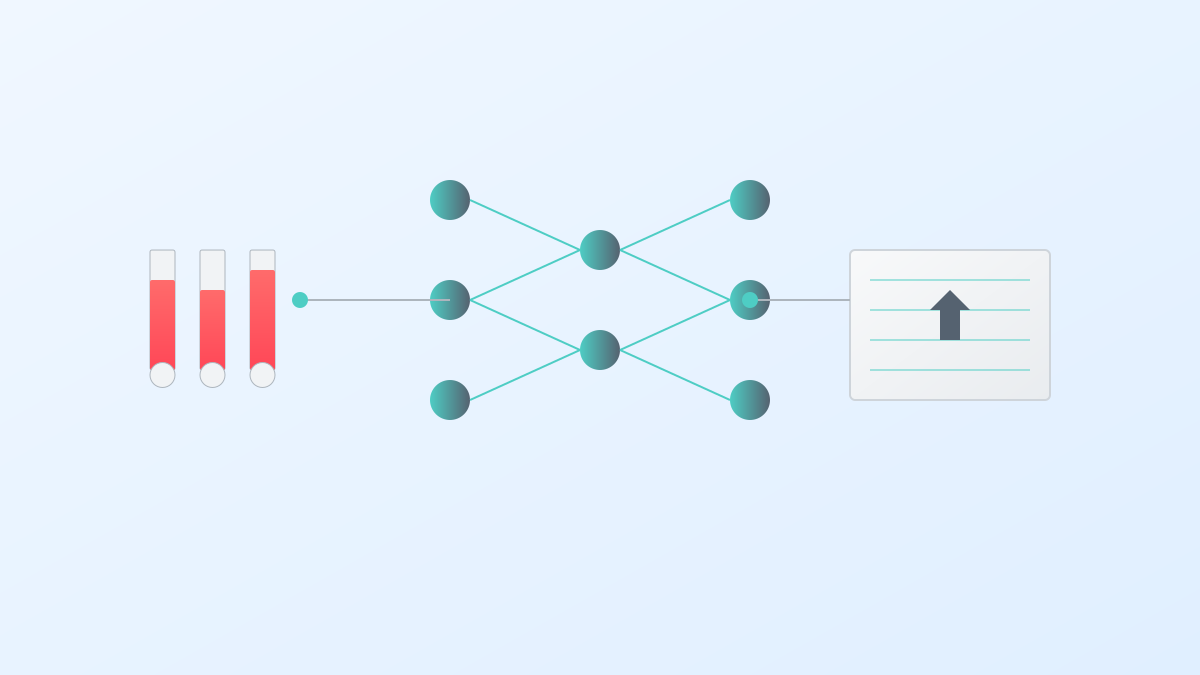
This project is a FastAPI-based backend system that combines Tesseract OCR (Optical Character Recognition) and machine learning technologies. It can extract CBC (Complete Blood Count) values from blood test report images and automatically predict diagnostic results for thalassemia and anemia.

地中海贫血贫血诊断OCRFastAPI机器学习医疗AI血液检查Tesseract
Published 2026-06-05 15:15Recent activity 2026-06-05 15:23Estimated read 6 min
Thalassemia and Anemia Intelligent Diagnosis System: Medical AI Application of OCR and Machine Learning
1

Section 01

Core Introduction to the Thalassemia and Anemia Intelligent Diagnosis System

This project is a FastAPI-based backend system that integrates Tesseract OCR (Optical Character Recognition) and machine learning technologies. It extracts CBC (Complete Blood Count) values from blood test report images and automatically predicts diagnostic results for thalassemia and anemia. The project is open-source, aiming to address issues like time-consuming, subjective, and unevenly distributed resources in traditional diagnostic processes, providing an intelligent auxiliary tool for the medical field.


2

Section 02

Project Background and Significance

Thalassemia and anemia are common blood diseases worldwide. Over 4% of the global population carries the thalassemia gene, with a higher carrier rate in southern China (e.g., Guangdong, Guangxi). Traditional diagnosis faces challenges such as time-consuming manual interpretation, subjective differences, lack of specialists in remote areas, and difficulty in large-scale screening. AI technology can address these issues through automated data extraction, standardized diagnosis, efficiency improvement, and decision support.

3

Section 03

System Architecture and Technical Implementation

The system uses FastAPI as the backend framework (high performance, automatic documentation generation, data validation); Tesseract OCR is used to process blood report images (including image preprocessing, layout analysis, character recognition, and post-processing steps); machine learning models are trained based on CBC indicators (related to red blood cells, white blood cells, platelets) to perform tasks such as normal/abnormal judgment, anemia type classification, and thalassemia detection.

4

Section 04

Core Function Modules

The system includes four core modules: 1. Image upload and processing (format conversion, enhancement, area cropping); 2. OCR data extraction (recognition of indicator names, values, and reference ranges); 3. Intelligent diagnosis prediction (output of diagnostic results, confidence levels, and indicator analysis); 4. API interface design (endpoints like /upload, /predict, /results/{id}, /history, etc.).

5

Section 05

Technical Challenges and Solutions

Three main challenges are faced: 1. OCR accuracy (solved via OpenCV preprocessing, template matching, medical term correction, and low-confidence prompts); 2. Data privacy and security (encrypted transmission and storage, role-based access control, audit logs, data desensitization); 3. Model generalization ability (multi-source data training, transfer learning, continuous model updates).

6

Section 06

Application Scenarios

Applicable to multiple scenarios: Hospitals and clinics (auxiliary diagnosis, quality control, training and education); Physical examination centers (batch screening, abnormal marking, report generation); Telemedicine (grassroots support, remote consultation, home monitoring); Public health (epidemiological research, disease surveillance, policy formulation).

7

Section 07

Limitations and Future Prospects

Current limitations: Dependence on image quality, single data source, lack of clinical validation, need to comply with medical regulatory requirements. Future directions: Technical improvements (multi-modal fusion, deep learning OCR, federated learning, explainable AI); Function expansion (multi-disease support, trend analysis, early warning system, personalized recommendations).

8

Section 08

Summary and Reflections

This project demonstrates the potential of AI in the medical diagnosis field. Through OCR + ML, it realizes intelligent analysis of blood reports, with values in improving efficiency, reducing costs, and enhancing medical equity. However, AI remains an auxiliary tool that requires human-machine collaboration, and issues such as data privacy, algorithm fairness, and responsibility definition need to be addressed.

