Zing Forum

Reading

Building a Deep Neural Network from Scratch: A Complete Practice of Binary Classification Task with NumPy

This article deeply analyzes a deep neural network project implemented purely with NumPy, covering the mathematical principles and code implementations of core mechanisms such as forward propagation, backpropagation, and gradient descent, helping readers truly understand the working mechanism of deep learning.

深度学习神经网络NumPy反向传播梯度下降机器学习二分类Python从零实现ReLU
Published 2026-06-01 00:16Recent activity 2026-06-01 00:18Estimated read 6 min
Building a Deep Neural Network from Scratch: A Complete Practice of Binary Classification Task with NumPy
1

Section 01

[Introduction] Implementing a Deep Neural Network from Scratch with NumPy: A Complete Practice to Understand Underlying Mechanisms

The project introduced in this article implements a binary classification deep neural network purely with NumPy, covering the mathematical principles and code implementations of core mechanisms such as forward propagation, backpropagation, and gradient descent. It aims to help readers break the black-box effect of deep learning frameworks and truly understand the essence of how neural networks work. The project was developed by Nikhil Kumar, and the source code is available on GitHub.


2

Section 02

Background: Why Do We Need to Build Neural Networks from Scratch?

In today's era where frameworks like TensorFlow and PyTorch are mature, the significance of implementing neural networks from scratch lies in breaking the black-box perception. Frameworks encapsulate details, allowing developers to quickly build models, but they also lead many people to have a superficial understanding of the internal working mechanisms. This project implements an L-layer DNN using pure Python and NumPy, helping to deeply understand each core component.

3

Section 03

Project Overview: Architecture and Core Components of a Fully Connected DNN

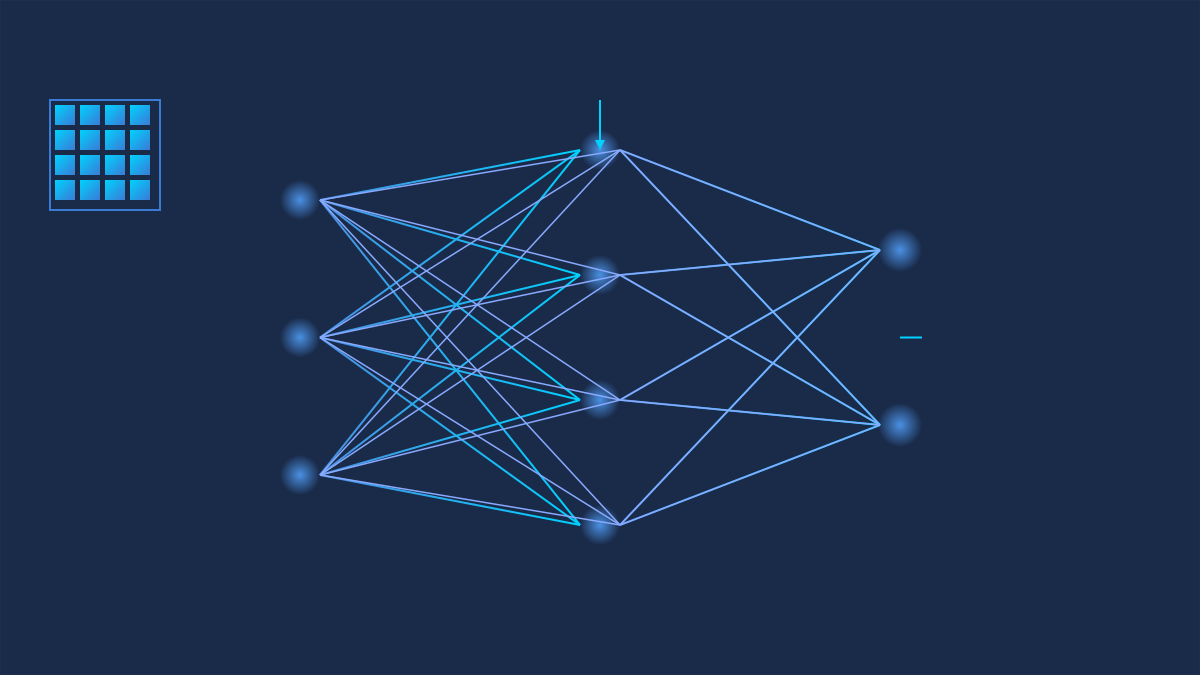
The project aims to implement a deep neural network for binary classification tasks, with an architecture of a fully connected feedforward network. The data flow is: input features → parameter initialization → forward propagation → loss calculation → backpropagation → gradient descent optimization → prediction evaluation. Core components include parameter initialization, forward propagation, ReLU/Sigmoid activation functions, cross-entropy loss, backpropagation, gradient descent, and modular design.

4

Section 04

Detailed Explanation of Core Mechanisms: Forward Propagation, Loss, and Backpropagation

Forward Propagation: Each layer undergoes linear transformation (Z=W·A+b) followed by non-linear activation (ReLU for hidden layers, Sigmoid for output layer). Loss Function: Binary cross-entropy loss J=-(1/m)Σ[y·log(a)+(1-y)log(1-a)]. Backpropagation: Uses the chain rule to calculate parameter gradients for each layer, relying on intermediate results cached during forward propagation. Gradient Descent: Updates parameters via W=W-α·dW and b=b-α·db, using batch gradient descent.

5

Section 05

Technical Highlights and Challenges: Vectorization and Dimension Management

Vectorized Computation: Uses NumPy vectorized operations to avoid Python loops and improve efficiency. Dimension Management: Strictly matching the dimensions of weights (number of neurons in current layer × previous layer), biases (current layer ×1), and activation values (number of neurons × number of samples) is a common debugging challenge. Numerical Stability: Need to avoid numerical underflow when implementing Sigmoid and cross-entropy.

6

Section 06

Practical Significance: Enhancing Capabilities from Theory to Engineering

This project helps understand: Neural networks are composites of multiple layers of non-linear functions; backpropagation efficiently calculates gradients via the chain rule; non-linear activation is the source of expressive power. It also exercises proficiency in matrix operations, debugging skills for complex systems, and modular design thinking, laying the foundation for learning optimizers, regularization, CNNs, etc.

7

Section 07

Future Improvement Directions: Expansion and Optimization

The expansion directions proposed by the author include:

  1. Mini-batch gradient descent (balancing efficiency and stability);
  2. Regularization techniques (L2 regularization, Dropout);
  3. Object-oriented refactoring (improving code maintainability);
  4. Comparison with TensorFlow/PyTorch versions to analyze performance bottlenecks.
8

Section 08

Conclusion and Tech Stack

Conclusion: Implementing DNN from scratch is an effective way to understand the underlying principles of deep learning, helping to advance from a 'framework user' to an algorithm engineer and make more reasonable architecture designs. Tech Stack: Python, NumPy, Jupyter Notebook, suitable for binary classification problems, teaching demonstrations, and algorithm understanding.