Zing Forum

Reading

notes2audio: An Intelligent Pipeline for Converting PDF Notes to High-Quality Audio

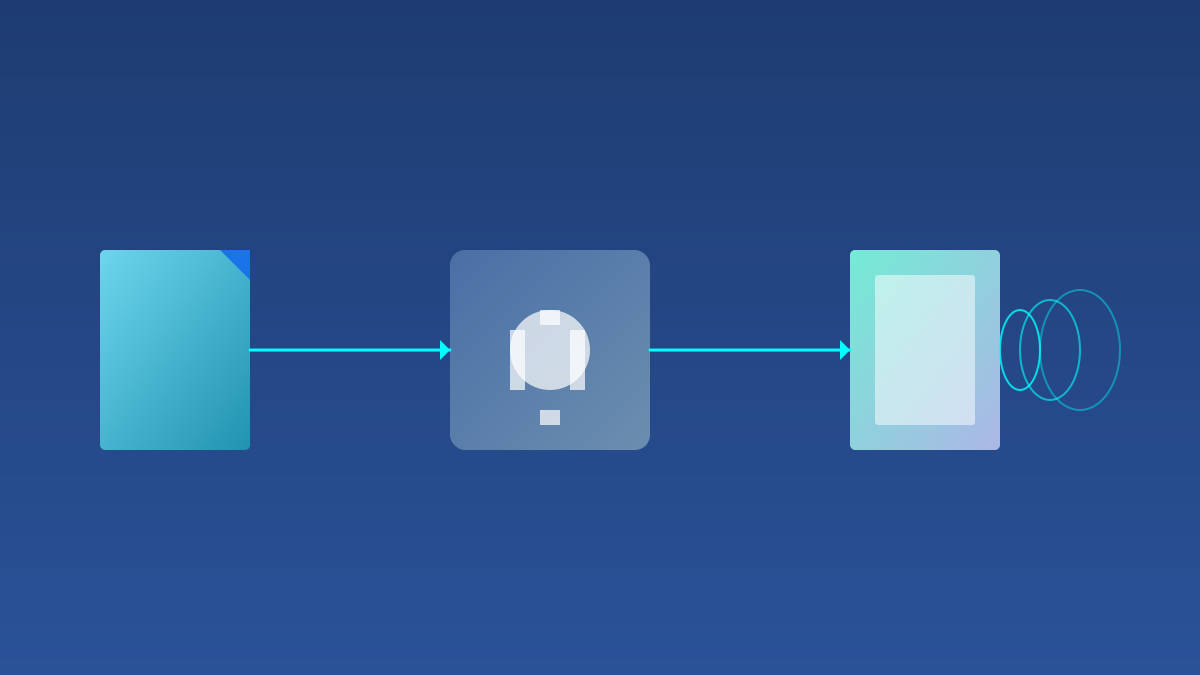
notes2audio is a Python pipeline that converts PDF study notes into high-quality listenable audio files. Unlike simple TTS tools, it uses large language models (LLMs) to rewrite messy notes into natural, fluent spoken scripts before synthesizing speech.

PDF文本转语音大语言模型学习工具音频生成Python
Published 2026-06-07 00:13Recent activity 2026-06-07 00:25Estimated read 6 min
notes2audio: An Intelligent Pipeline for Converting PDF Notes to High-Quality Audio
1

Section 01

Introduction to the notes2audio Project

notes2audio is a Python pipeline tool whose core function is to convert PDF study notes into high-quality listenable audio files. Unlike traditional TTS tools, it first uses large language models to rewrite messy notes into natural, fluent spoken scripts before synthesizing speech, solving the problem of stiff and obscure audio when directly converting written content to speech.


2

Section 02

Project Background and Pain Points of Traditional TTS

In the era of information explosion, a large amount of study materials in PDF format have been accumulated, but modern people have fragmented time and find it hard to read with focus. Traditional TTS tools directly convert text; when dealing with complex sentences in academic papers, code snippets in technical documents, or unordered note points, the result is stiff and obscure. Moreover, the fundamental difference between written language and spoken language makes the content unsuitable for listening. notes2audio addresses this pain point by proposing a solution of rewriting into spoken scripts first before synthesis.

3

Section 03

Core Workflow: Understand - Reconstruct - Express

First Phase: PDF Parsing and Content Extraction

Process multi-column layouts, tables, charts, headers/footers, special characters, etc., to extract valid text.

Second Phase: LLM-Driven Content Rewriting

Split sentences into short ones, add transition words, explain technical terms, adjust tone, clean up redundancy, converting written content into spoken scripts.

Third Phase: High-Quality Speech Synthesis

Support multi-tone selection, speed control, pause handling; generate MP3 files compatible with various devices.

4

Section 04

Technical Implementation Details and Architecture

Dependent Components

Use PyPDF2/pdfplumber for PDF processing, support OpenAI GPT/Claude and other LLM APIs, integrate multiple TTS engines, use pydub for audio processing.

Configuration and Customization

Provide rewriting style templates (academic lectures, podcasts, etc.), content filters, batch processing, segmentation strategies.

Hybrid Local and Cloud Architecture

PDF parsing and audio synthesis can be done locally; LLM rewriting can choose cloud APIs or local models; sensitive documents can be processed entirely locally to protect privacy.

5

Section 05

Application Scenarios and Use Cases

Student Learning

Commute review, bedtime review, multi-sensory learning to deepen memory.

Professionals

Digest technical documents, review meeting minutes, follow industry reports.

Content Creators

Prepare podcast materials, create audiobooks, multi-modal content distribution.

6

Section 06

Project Advantages and Innovations

  1. Semantic understanding first: LLM rewriting ensures content is truly listenable;
  2. Context coherence: clear logic for easy understanding;
  3. Technical term handling: automatic explanation lowers the barrier;
  4. Personalized customization: support adjusting rewriting styles;
  5. Open-source and extensible: code is open-source, community can contribute templates and integrations.
7

Section 07

Limitations and Future Development Directions

Current Limitations

  • Chart processing: pure text cannot convey chart information;
  • Mixed multi-language: unstable effect;
  • LLM cost: cloud APIs may incur fees.

Future Directions

  • Multi-modal support: combine image description models to generate voice explanations for charts;
  • Real-time conversion: stream processing for listening while writing;
  • Voice cloning: personalized speech synthesis;
  • Interactive audio: support chapter markers for jump and Q&A.
8

Section 08

Project Summary and Value

notes2audio represents a new content consumption paradigm, allowing machines to adapt to human listening habits, converting static documents into dynamic audio, and providing flexibility and efficiency for knowledge acquisition. It is suitable for users who use fragmented time, prefer auditory learning, or want to reduce visual fatigue, and is a tool worth trying.

