Zing Forum

Reading

NoAIMatch: An AI-Free Pure Mathematical Image Similarity Comparison System

A pure mathematical image similarity comparison tool entirely based on hard-coded algorithms, without relying on neural networks or machine learning. It achieves rotation, scaling, and brightness-invariant image comparison through five techniques including histogram, SSIM, and NCC.


图像相似度计算机视觉传统算法SSIMNCC直方图零样本学习Python开源项目
Published 2026-05-19 11:13Recent activity 2026-05-19 11:18Estimated read 6 min
NoAIMatch: An AI-Free Pure Mathematical Image Similarity Comparison System
1

Section 01

Introduction / Main Post: NoAIMatch: An AI-Free Pure Mathematical Image Similarity Comparison System

A pure mathematical image similarity comparison tool entirely based on hard-coded algorithms, without relying on neural networks or machine learning. It achieves rotation, scaling, and brightness-invariant image comparison through five techniques including histogram, SSIM, and NCC.

2

Section 02

Project Overview

In an era where deep learning is prevalent, the NoAIMatch project takes a completely different path. It is a 100% pure hard-coded image similarity comparison system that does not rely on artificial intelligence, neural networks, or machine learning at all. Instead, it uses pure mathematics and classic computer vision algorithms to achieve image comparison functions.

The core concept of the project is very clear: Zero-shot Learning—it is ready to use out of the box, suitable for any type of image, and requires no pre-trained models or large datasets.


3

Section 03

Technical Background: Why Not Use AI?

The current image recognition field is almost dominated by deep learning models, from ResNet to Vision Transformer. Neural networks have achieved amazing results in various visual tasks. However, these models also bring some inherent problems:

  1. Large model size: Model files often reach hundreds of MB or even several GB.
  2. High computational resource requirements: GPU acceleration is needed to achieve acceptable inference speed.
  3. Dependence on training data: Model performance heavily relies on the quality and diversity of training data.
  4. Black-box nature: The decision-making process of neural networks is difficult to explain.

The NoAIMatch project is a response to these pain points. It proves the point that traditional computer vision algorithms still have irreplaceable value in specific scenarios.


4

Section 04

Core Algorithm Architecture

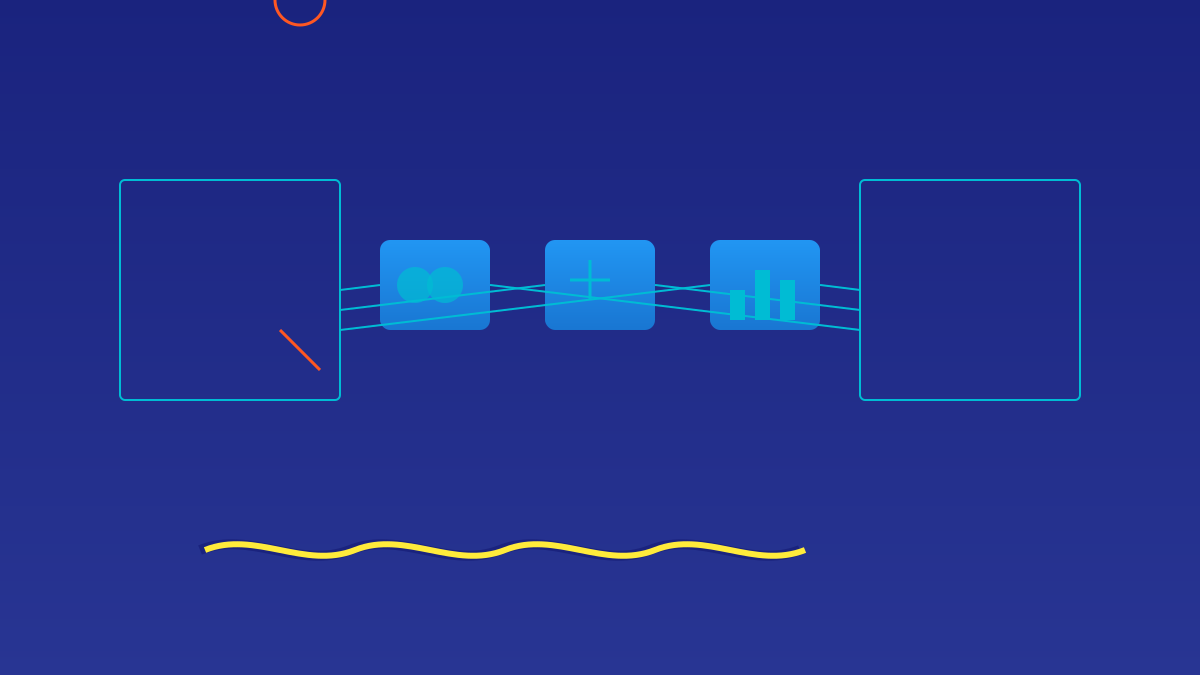
The NoAIMatch system cleverly integrates five complementary image comparison techniques and obtains robust comparison results through a weighted fusion strategy:

5

Section 05

1. Histogram Similarity

Histogram is a classic tool for describing the intensity distribution of image pixels. By comparing the grayscale or color histograms of two images, we can quickly determine whether their overall tone and brightness distribution are similar. This method has natural rotation invariance and scaling invariance because the histogram counts the global distribution, which is independent of the spatial position of pixels.

6

Section 06

2. Feature Comparison

The system extracts statistical features (mean, standard deviation) and gradient features of images for comparison. Statistical features reflect the overall brightness and contrast of the image, while gradient features capture edge and texture information. This combination can obtain a description of the image content while maintaining computational efficiency.

7

Section 07

3. SSIM (Structural Similarity Index Measure)

SSIM (Structural Similarity Index Measure) is an indicator for measuring the structural similarity of two images, proposed by Wang et al. in 2004. Similar to the human visual system, SSIM focuses on the similarity of three dimensions of images: brightness, contrast, and structure. NoAIMatch adds a rotation alignment mechanism in its implementation, enabling it to handle image comparison after rotation.

8

Section 08

4. NCC (Normalized Cross-Correlation)

Normalized Cross-Correlation (NCC) is a classic template matching algorithm that measures the similarity between two signals by calculating their correlation coefficient. NCC has good robustness to brightness changes. NoAIMatch also adds a rotation alignment function to it, supporting rotation comparison at any angle from 0 to 360 degrees.
