Zing Forum

Reading

Text-Driven Architectural Design Generation: Innovative Applications of NLP and Generative AI in the Field of Architectural Design

A machine learning project based on NLP and generative AI technologies that enables automatic generation of architectural design schemes from text descriptions, demonstrating the innovative application potential of artificial intelligence in the traditional architectural design field.

建筑设计生成式AINLP扩散模型文本到图像Stable Diffusion计算机视觉多模态AI
Published 2026-05-16 05:24Recent activity 2026-05-16 05:36Estimated read 8 min
Text-Driven Architectural Design Generation: Innovative Applications of NLP and Generative AI in the Field of Architectural Design
1

Section 01

Text-Driven Architectural Design Generation: Guide to Innovative Applications of NLP and Generative AI

Guide

The architectural-design-generation project on GitHub combines natural language processing (NLP) and generative AI technologies to automatically generate architectural design schemes from text descriptions, demonstrating the innovative application potential of artificial intelligence in the traditional architectural design field. This project aims to address pain points such as low design efficiency, difficulty in scheme exploration, and high communication costs, promoting the integration of AI with the creative industry.


2

Section 02

Project Background and Technology Trends

Project Background and Technology Trends

Cross-Disciplinary Applications of Generative AI

Generative AI technology has expanded from image generation (e.g., DALL-E, Stable Diffusion) to fields such as text, code, music, and video, with architectural design emerging as a new frontier.

AI Adoption Needs in Architectural Design

  • Design Efficiency: Accelerate the conceptual design phase
  • Scheme Exploration: Quickly generate diverse options
  • Communication Costs: Reduce understanding gaps between clients and designers
  • Design Democratization: Non-professionals can access professional schemes

Technical Feasibility

  • Diffusion models (e.g., Stable Diffusion) generate high-quality images
  • Conditional generation controls content via text
  • Domain fine-tuning enhances professionalism
  • 2D-to-3D generation technology is gradually maturing
3

Section 03

Technical Architecture and Implementation Methods

Technical Architecture and Implementation Methods

Text Understanding Module (NLP)

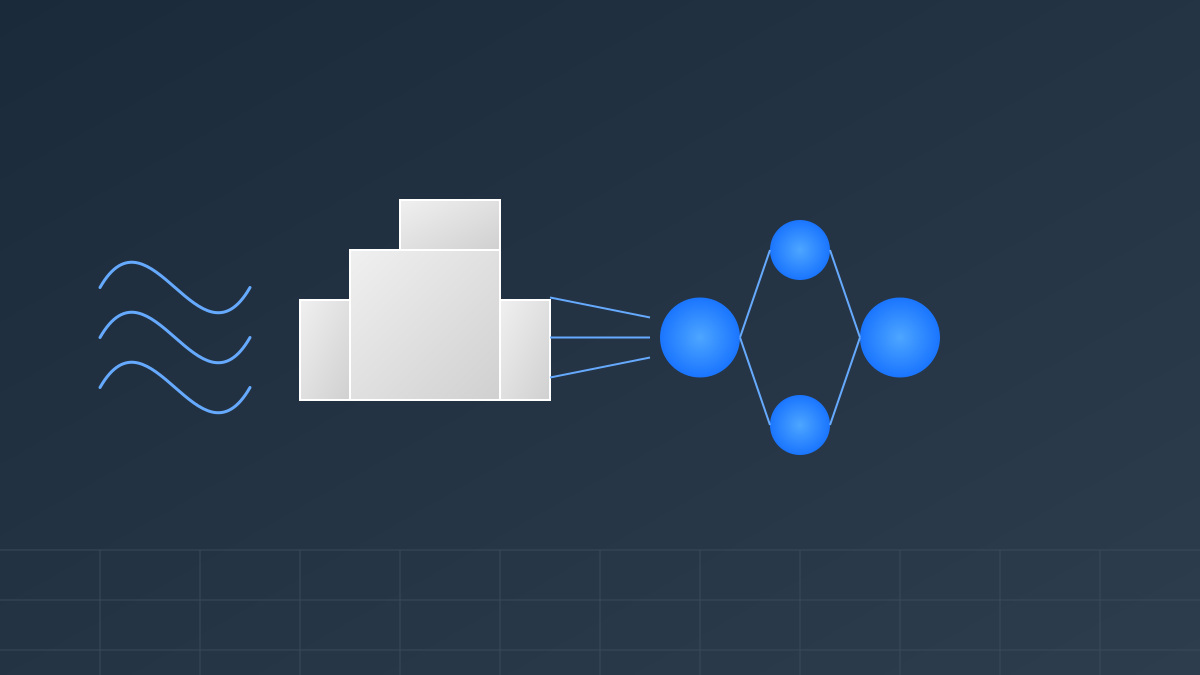
  • Text Encoder: Uses BERT/GPT/CLIP to extract key information such as architectural style, function, and dimensions
  • Semantic Parsing: Identifies architectural terms, spatial relationships, and quantitative information

Design Generation Module (Generative AI)

  • Image Generation Model: Based on diffusion models or GANs, using frameworks like Stable Diffusion/ControlNet
  • Architecture-Specific Optimization: Fine-tuning with architectural datasets and adding structural constraints

Multimodal Fusion

  • CLIP-like models align the semantic space of text and images, supporting text-guided editing
4

Section 04

Application Scenarios and Value

Application Scenarios and Value

Conceptual Design Phase

  • Quickly generate multiple schemes for further refinement
  • Generate contrasting schemes of different styles to aid decision-making

Client Communication

  • Convert client descriptions into visual schemes to reduce communication costs
  • Adjust schemes in real time based on feedback

Design Education

  • Assist students in learning concept transformation
  • Provide diverse inspiration to break through thinking stereotypes
5

Section 05

Technical Challenges and Solutions

Technical Challenges and Solutions

Challenge 1: Complexity of Architectural Design

Solutions: Layered generation (plan → elevation → rendering), constraint optimization, human-machine collaboration

Challenge 2: Ambiguity in Text Descriptions

Solutions: Interactive clarification, multi-scheme generation, template guidance

Challenge 3: Feasibility of Generated Results

Solutions: Post-processing verification, domain knowledge embedding, professional review

Challenge 4: Data Scarcity

Solutions: Synthetic data, transfer learning, crowdsourced annotation

6

Section 06

Related Technologies and Project Comparison

Related Technologies and Project Comparison

Similar Projects

  • ArchiGAN (MIT, GAN-generated floor plans)
  • Finch3D (multimodal AI-generated 3D models)
  • Maket.ai (diffusion model-generated floor plans)
  • Spacemaker (AI-assisted urban planning)

Technology Comparison Table

Project Technical Route Output Form Application Phase
ArchiGAN GAN Floor Plan Conceptual Design
Finch3D Multimodal AI 3D Model Scheme Design
Maket.ai Diffusion Model Floor Plan Conceptual Design
This Project NLP + Generative AI Rendering/Floor Plan Conceptual Design
7

Section 07

Future Development Directions

Future Development Directions

Technological Evolution

  • Direct 3D generation, integration of physical simulation, real-time interactive generation
  • Multimodal input (sketches, voice, etc.)

Application Expansion

  • Interior design, landscape design, urban planning, historical building preservation

Business Models

  • SaaS tools, on-demand generation services, API platforms, education platforms
8

Section 08

Ethical Considerations and Conclusion

Ethical and Social Considerations and Conclusion

Ethical Considerations

  • Transformation of designers' roles: from execution to decision-making, creativity, and communication
  • Clear regulations are needed for copyright ownership and originality
  • Generated designs require professional review to ensure safety

Conclusion

This project represents the cutting-edge exploration of AI in the creative industry. Despite its limitations, AI-assisted design will become an industry standard in the future. Human-machine collaboration is the mainstream model: AI handles rapid generation and iteration, while humans are responsible for creative decision-making and quality control.

