Zing Forum

Reading

NimbleML: A Lightweight Python Machine Learning Library to Understand Core Algorithms from Scratch

NimbleML is a lightweight Python machine learning library that provides concise implementations of core ML concepts such as linear regression, logistic regression, basic neural networks, loss functions, and gradient optimization, making it suitable for learning and teaching purposes.

机器学习Python库教育开源项目算法实现
Published 2026-05-31 12:13Recent activity 2026-05-31 12:28Estimated read 7 min
NimbleML: A Lightweight Python Machine Learning Library to Understand Core Algorithms from Scratch
1

Section 01

[Introduction] NimbleML: Core Introduction to a Lightweight Python Machine Learning Educational Library

NimbleML is a lightweight Python machine learning library developed and maintained by Raymond1134 (GitHub repository: https://github.com/Raymond1134/NimbleML, released on May 31, 2026). Oriented towards education, this library provides concise implementations of core ML concepts such as linear regression, logistic regression, basic neural networks, loss functions, and gradient optimization algorithms. It aims to help learners understand the underlying principles of algorithms from scratch, avoiding the complex abstractions of industrial-grade frameworks.


2

Section 02

Project Background: Addressing Beginners' Pain Points in Algorithm Understanding

Mainstream machine learning frameworks (like TensorFlow, PyTorch, scikit-learn) are powerful but have complex code, making it difficult for beginners to grasp the underlying algorithm implementations. NimbleML was born to address this pain point, emphasizing 'lightweight' and 'clarity'. It strips away the complex abstractions of industrial frameworks, allowing code to directly correspond to algorithm principles, thus becoming an ideal learning resource for machine learning beginners.

3

Section 03

Core Features and Algorithm Implementations

NimbleML includes the following core implementations:

  • Linear Regression: Least squares method, gradient descent, L1/L2 regularization;
  • Logistic Regression: Sigmoid function, log-likelihood loss, Softmax multi-class extension;
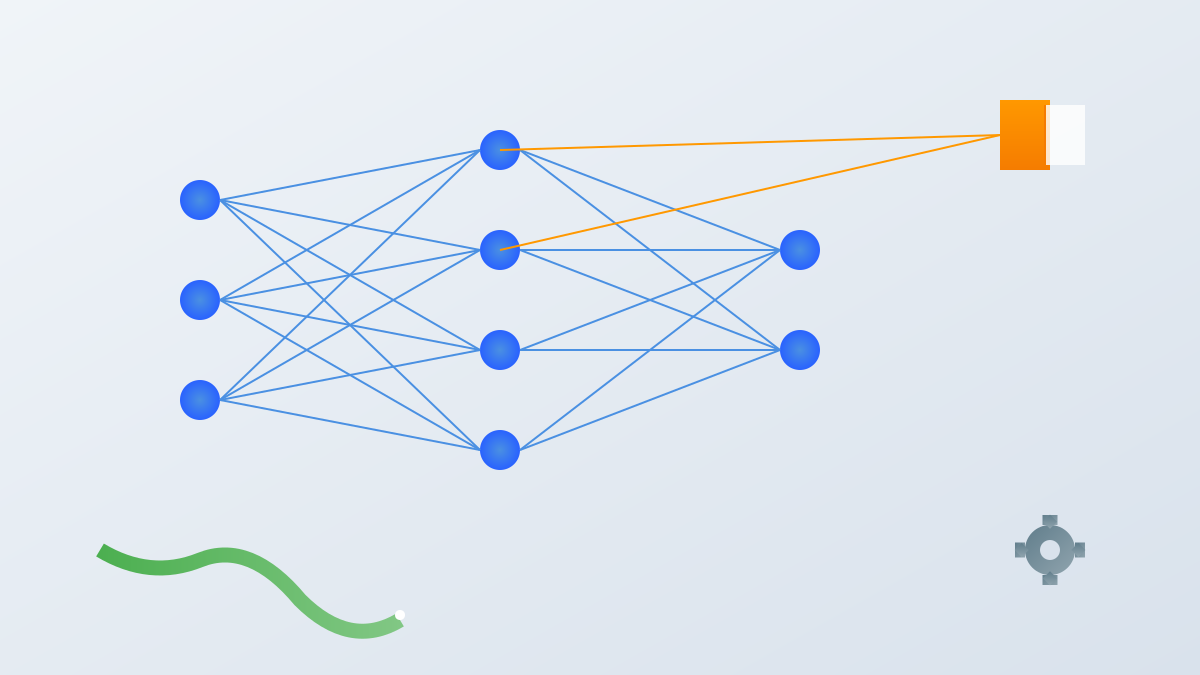
  • Basic Neural Networks: Forward propagation, backpropagation, common activation functions (ReLU/Sigmoid/Tanh), fully connected layers;
  • Loss Function Library: Mean Squared Error (MSE), cross-entropy loss, Huber loss;
  • Gradient Optimization Algorithms: Batch gradient descent, Stochastic Gradient Descent (SGD), Mini-batch gradient descent, learning rate scheduling.
4

Section 04

Educational Value and Learning Path

Target Audience: Machine learning beginners (to avoid the confusion of complex frameworks), algorithm reviewers (preparing for interviews/teaching), educators (as a demonstration tool). Recommended Learning Path:

  1. Linear Regression: Understand the basic framework of supervised learning (data, model, loss, optimization);
  2. Logistic Regression: Learn classification problem modeling and probability output;
  3. Neural Networks: Master forward/backward propagation and core deep learning mechanisms;
  4. Extended Experiments: Modify hyperparameters, try different datasets, compare algorithm effects.
5

Section 05

Comparison with Mainstream Frameworks and Applicable Scenarios

vs scikit-learn: Advantages (concise and easy-to-understand code, no external dependencies), Disadvantages (limited functionality, unoptimized performance); vs TensorFlow/PyTorch: Advantages (no need to understand complex concepts like computation graphs/automatic differentiation, code directly maps to mathematical formulas), Disadvantages (no GPU acceleration, lack of production-level features); Applicable Scenarios: Suitable for learning, teaching, and prototype verification; Not suitable for production environments, large-scale data, or complex models.

6

Section 06

Project Expansion and Improvement Directions

Algorithm Expansion: Support Vector Machine (SVM), decision trees and ensemble methods (ID3/C4.5/random forest/gradient boosting), clustering algorithms (K-Means/hierarchical clustering/DBSCAN), dimensionality reduction techniques (PCA/t-SNE); Engineering Improvements: NumPy vectorized computation, type annotations, unit tests, improved documentation (detailed comments and examples).

7

Section 07

Open Source Community Contributions and Summary

Community Contributions: Code contributions (new algorithms, optimizations, bug fixes), documentation contributions (README/tutorials/examples), issue feedback, experience sharing (learning/teaching cases) are welcome; Summary: NimbleML focuses on education, helping learners build a solid foundation in ML through concise code. Although it is not suitable for production environments, it is an ideal tool for beginners and educators, laying the groundwork for subsequent use of industrial frameworks.