Zing Forum

Reading

Nexus AI: Design and Implementation of a Multi-Model Intelligent Coordination System

Explore how Nexus AI builds a unified cognitive intelligence layer by coordinating multiple large language models (OpenAI, Gemini, DeepSeek) to achieve stronger reasoning and decision-making capabilities than a single model.

多模型协调AI 编排OpenAIGeminiDeepSeek集体智能大语言模型
Published 2026-05-28 05:31Recent activity 2026-05-28 05:50Estimated read 4 min
Nexus AI: Design and Implementation of a Multi-Model Intelligent Coordination System
1

Section 01

Nexus AI: Introduction to the Multi-Model Intelligent Coordination System

Nexus AI is a multi-model intelligent coordination system that builds a unified cognitive layer by integrating heterogeneous AI engines such as OpenAI, Gemini, and DeepSeek. It addresses the limitations of single models, achieves stronger reasoning and decision-making capabilities, and simulates the working mode of human collective intelligence.


2

Section 02

Background: Limitations of Single Models and the Need for Collective Intelligence

The current large language model field is thriving, but single models have inherent limitations (e.g., strong logic but lack of creativity, excellent in specific domains but insufficient generalization). Nexus AI aims to address this pain point by integrating the advantages of various models through a multi-model coordination system and simulating collective intelligence.

3

Section 03

System Architecture: Core Design Methods of the Coordination Layer

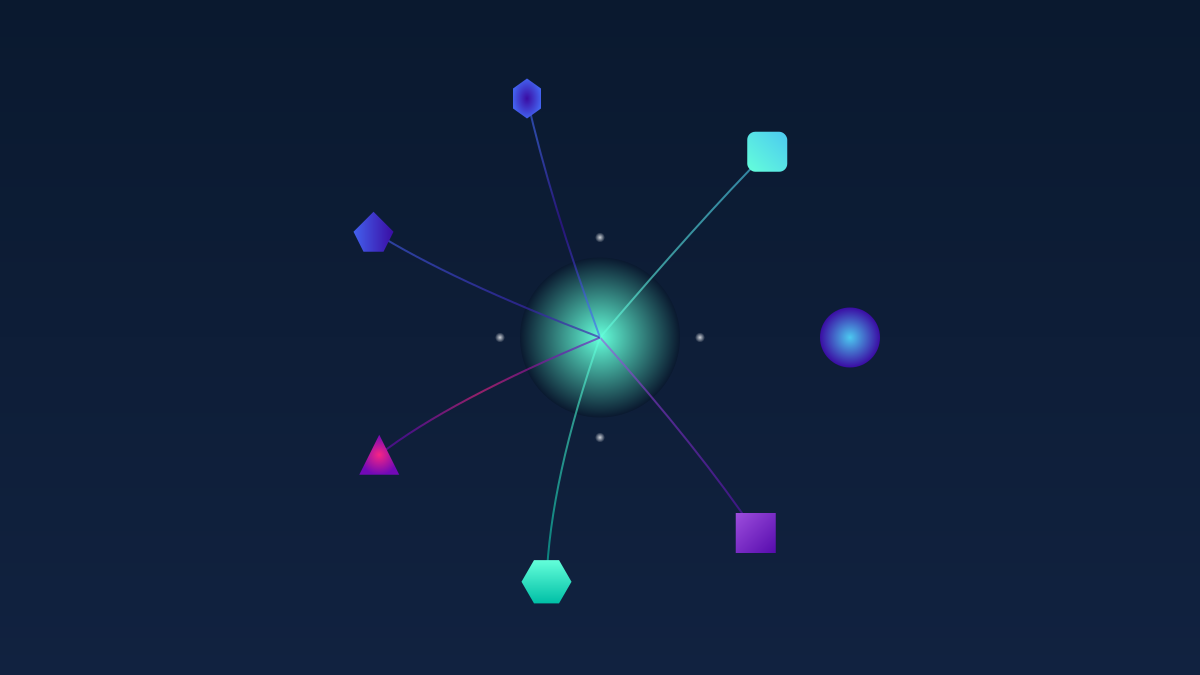
Nexus AI adopts the "Coordinator-Executor" model. The coordination layer is responsible for task analysis, model selection, and result integration; task decomposition and routing split complex queries and dynamically select the optimal model combination; result fusion uses hierarchical strategies: primary (deduplication and consistency), intermediate (confidence weighting), and advanced (negotiation mechanism) to reduce hallucination risks and improve reliability.

4

Section 04

Technical Implementation: Supported Model Ecosystem

Nexus AI supports mainstream models: OpenAI series (e.g., GPT-4o, good at reasoning and creative writing), Google Gemini (multimodal and long-context processing), and DeepSeek (code generation and mathematical reasoning, preferred for technical tasks).

5

Section 05

Application Scenarios: Practical Value of Collective Intelligence

Application scenarios include enterprise decision support (multi-model generation of comprehensive decision recommendations), complex problem solving (multi-dimensional analysis of interdisciplinary issues), and content creation and review (pipeline of creative generation + fact-checking + style optimization).

6

Section 06

Technical Challenges and Optimization Directions

It faces challenges such as latency and cost (mitigated through intelligent caching, preloading, and model compression), model semantic alignment (research on unified semantic space), and interpretability (developing decision traceability functions to show model contribution).

7

Section 07

Conclusion: Paradigm Significance and Outlook of Nexus AI

Nexus AI represents a paradigm shift in AI architecture from single models to multi-model collaboration, similar to moving from a super individual to an efficient team, which may be a feasible path to AGI. It provides developers and enterprises with solutions to flexibly combine the best capabilities, and as the model ecosystem enriches, the importance of the coordination layer will become more prominent.

