Zing Forum

Reading

NeuroStack-3B: Analysis of an Innovative Graduation Project Integrating Multiple Machine Learning Algorithms

An in-depth analysis of a comprehensive machine learning graduation project. This project constructs an integrated architecture named NeuroStack-3B by comparing algorithms such as decision trees, linear regression, neural networks, random forests, and KNN, combining data balancing techniques like SMOTE and SMOTEENN, and incorporating explainable AI (XAI) technology.

机器学习集成学习SMOTE可解释AI毕业设计NeuroStack
Published 2026-05-23 02:44Recent activity 2026-05-23 02:51Estimated read 9 min
NeuroStack-3B: Analysis of an Innovative Graduation Project Integrating Multiple Machine Learning Algorithms
1

Section 01

NeuroStack-3B Project Guide: Analysis of a Comprehensive Machine Learning Graduation Project

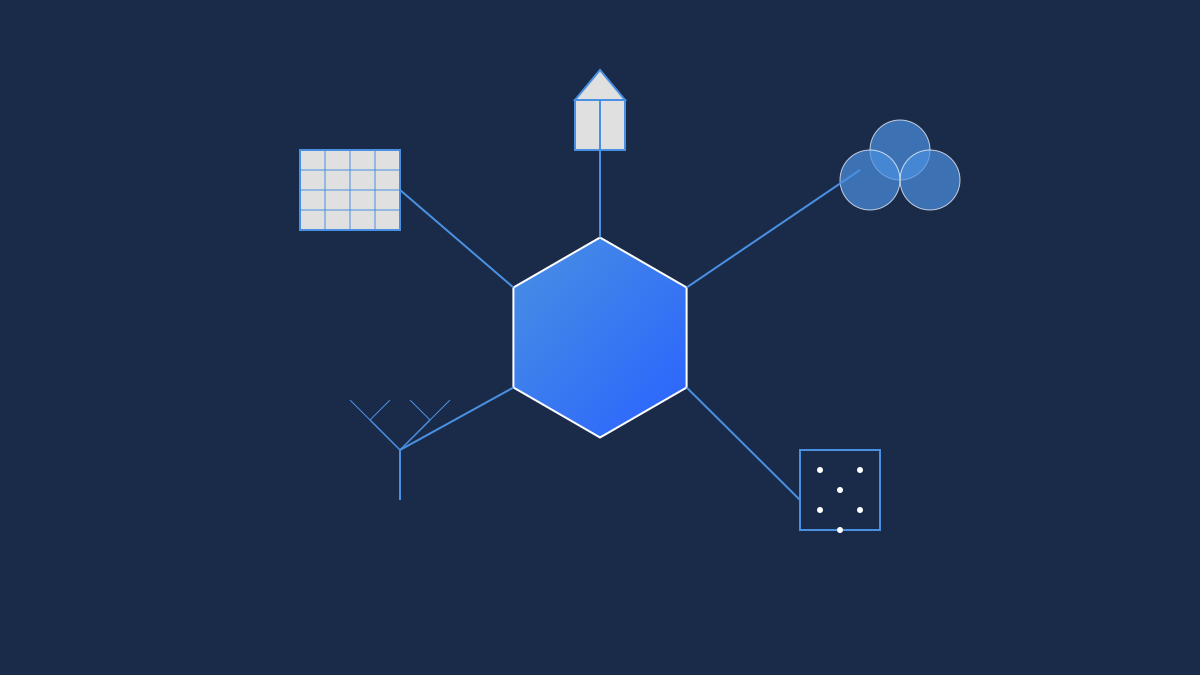
NeuroStack-3B is an innovative integrated architecture in the Machine-Learning-FYP project on GitHub. This graduation project is built by comparing five mainstream algorithms (decision trees, linear regression, neural networks, random forests, and KNN), combining data balancing techniques like SMOTE and SMOTEENN, and incorporating explainable AI (XAI) technology to achieve production-ready deployment. The project is of reference value to machine learning learners, algorithm practice developers, and integrated learning researchers.


2

Section 02

Project Background and Core Objectives

Project Background

Machine learning graduation projects need to demonstrate mastery of multiple technologies and practical application value within a limited time. This project addresses this challenge through an end-to-end pipeline.

Core Objectives

  1. Systematically compare the performance of five mainstream algorithms;
  2. Explore the impact of data balancing techniques such as SMOTE, SMOTEENN, ROS, and RUS;
  3. Propose the NeuroStack-3B integrated architecture;
  4. Integrate XAI to improve model transparency;
  5. Use Pickle for model serialization and production readiness.

Technical Stack Significance

Covers classic algorithms, deep learning components, integrated learning, and XAI, responding to industry ethics and transparency trends.

3

Section 03

Core Algorithm Comparative Analysis

Five Algorithm Features

  • Decision Tree: Strong interpretability, used as a baseline model;
  • Linear Regression: Basic supervised learning algorithm, provides a simple benchmark;
  • Neural Network: Non-linear modeling capability (e.g., MLP), includes deep learning elements;
  • Random Forest: Classic integrated learning method, balances accuracy and robustness;
  • KNN: Instance-based learning, provides a different perspective on decision boundaries.

Evaluation Dimensions

Prediction accuracy (accuracy rate, F1 score, etc.), computational efficiency (training/inference time), model complexity (number of parameters), generalization ability (cross-validation performance).

4

Section 04

In-depth Application of Data Balancing Techniques

Class Imbalance Problem

Common in practical applications (e.g., fraud detection, disease diagnosis), leading models to favor the majority class.

Four Balancing Techniques

  • SMOTE: Generates synthetic samples via interpolation between minority class samples to avoid overfitting;
  • SMOTEENN: SMOTE + ENN, cleans misclassified samples after oversampling;
  • ROS: Randomly duplicates minority class samples, prone to overfitting;
  • RUS: Randomly deletes majority class samples, may lose important information.

Technical Impact

Different algorithms have different sensitivities to balancing techniques; integrated methods are more robust, and the SMOTE series outperforms random sampling.

5

Section 05

Analysis of the NeuroStack-3B Integrated Architecture

Integrated Learning Basics

Core idea: Combine multiple base learners to improve generalization performance; common strategies include Bagging, Boosting, and Stacking.

NeuroStack-3B Architecture

Presumed to be a three-layer structure:

  1. Base Learner Layer: Contains diverse base learners such as tree models, linear models, and neural networks;
  2. Meta Learner Layer: Uses neural networks to fuse outputs from base learners;
  3. Decision Layer: Post-processing logic (threshold adjustment, confidence calibration).

Architecture Advantages

Improves performance, enhances robustness, expands expressive power, and is flexible and scalable.

6

Section 06

Practical Application of Explainable AI (XAI)

Necessity of XAI

High-risk fields (medical, finance) require model transparency; users and regulatory agencies need to understand the reasons for predictions.

Implementation Technologies

  • Feature Importance Analysis: Calculates feature contribution (built-in for tree models, SHAP/LIME for neural networks);
  • Local Explanation: LIME/SHAP provides explanations for individual predictions;
  • Visualization Tools: Decision tree visualization, confusion matrix, ROC curve, etc.

Value

Identifies potential biases, verifies domain knowledge, explains to non-technical personnel, and meets compliance requirements.

7

Section 07

Engineering and Production Deployment Practice

Pickle Serialization Application

  • Advantages: Easy to use, preserves complete object state, cross-platform compatible;
  • Risks: Security issues and version compatibility; joblib or ONNX can be considered for production environments.

Production Readiness Elements

Input validation, error handling, logging, performance optimization (inference latency and throughput).

8

Section 08

Educational Value and Summary Recommendations

Educational Value

  • Systematic Thinking: Demonstrates the construction of a complete ML pipeline;
  • Experimental Design: Scientifically compares multiple algorithms and technologies;
  • Engineering Practice: Code organization and production best practices;
  • Innovative Thinking: The NeuroStack-3B architecture reflects innovation based on existing technologies.

Improvement Directions

Hyperparameter optimization (grid search/Bayesian optimization), deep learning expansion, AutoML integration, Docker containerization deployment.

Summary

This project is an excellent example of an ML graduation project, connecting academia and practical applications, and is worth learning from.

Project URL: https://github.com/Kashi23432f/Machine-Learning-FYP

