Zing Forum

Reading

NeuralScope: A 3D Neural Network Visualization Inspector in the Browser

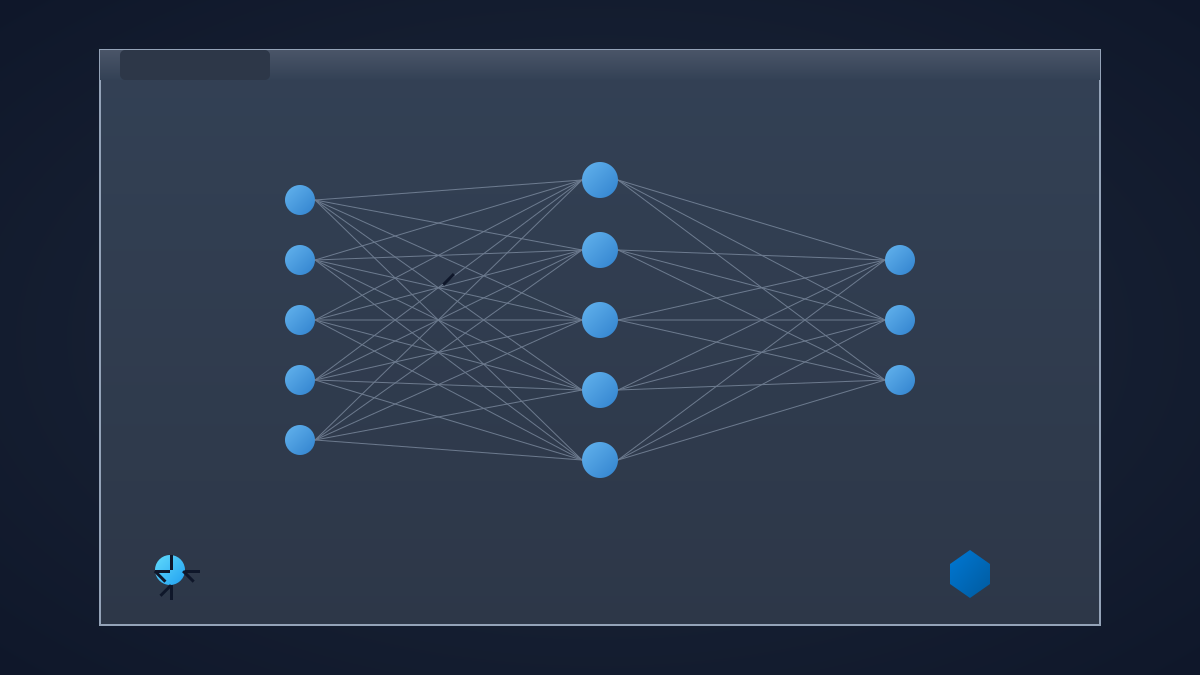
NeuralScope is a local-first, browser-based 3D neural network visualization tool that supports ONNX format models, allowing developers to intuitively observe the flow of inference data between layers of the network.

神经网络可视化ONNX3D可视化浏览器工具深度学习模型分析WebAssembly
Published 2026-05-11 19:25Recent activity 2026-05-11 19:32Estimated read 5 min
NeuralScope: A 3D Neural Network Visualization Inspector in the Browser
1

Section 01

【Introduction】NeuralScope: Core Introduction to the Browser-based 3D Neural Network Visualization Tool

NeuralScope is a local-first, browser-based 3D neural network visualization Inspector that supports ONNX format models. It addresses the issues of complex installation and static display in traditional visualization tools, allowing developers to intuitively observe the flow of inference data between layers of the network without uploading data to a server, balancing privacy and convenience.


2

Section 02

Background: Needs for Neural Network Visualization and Pain Points of Traditional Tools

As the complexity of deep learning models increases, understanding their internal mechanisms becomes more difficult. Traditional model visualization tools often require complex installation configurations or only provide static architecture diagrams. As a browser-based 3D tool, NeuralScope provides an intuitive and convenient new solution for model analysis.

3

Section 03

Project Overview: Local-First Design Philosophy

NeuralScope is designed for small ONNX neural networks and emphasizes "local-first"—all data processing is done locally in the browser without uploading to a remote server. This architecture not only protects model data privacy but also eliminates network latency barriers.

4

Section 04

Core Features: Drag-and-View and Dynamic Inference Flow Display

NeuralScope is easy to use: drag and drop an ONNX file to generate a 3D visualization. Core features include:

  1. Layer-by-layer inference flow visualization: real-time display of data flow between layers, shape changes, feature abstraction, and activation value propagation;
  2. 3D interactive exploration: supports rotation, zooming, and panning of the view, making it easy to understand complex branch structures (such as ResNet and attention networks).
5

Section 05

Technical Implementation: Pure Frontend Architecture Driven by WebAssembly and WebGL

NeuralScope leverages modern browser technologies: it efficiently parses and renders models through WebAssembly and WebGL. The pure frontend architecture brings four major advantages: zero installation cost, cross-platform compatibility, data privacy protection, and instant availability (analyze immediately upon opening the webpage).

6

Section 06

Applicable Scenarios: Teaching, Debugging, and Team Collaboration

NeuralScope is suitable for three types of scenarios:

  1. Model teaching and demonstration: helps students understand the spatial meaning of concepts such as convolutional layers and pooling layers;
  2. Model debugging and analysis: quickly checks whether the structure meets expectations and identifies issues like shape mismatches;
  3. Architecture design review: serves as a visual document, allowing team members to quickly view and discuss the model without sharing code or environments.
7

Section 07

Limitations: Focus on Lightweight Scenarios, Adapted to Small ONNX Models

NeuralScope is positioned as a visualization tool for small ONNX networks. For large models with huge parameter counts (such as large language models and ultra-deep networks), browser computing resources may become a bottleneck. The tool focuses on fast and lightweight needs and is not a full-featured model analysis platform.

8

Section 08

Conclusion: Promoting the Democratization of Deep Learning Tools

NeuralScope lowers the threshold for understanding and analyzing neural networks, benefiting both beginners and senior developers. It represents the trend of democratization of AI tools, and with the popularization of ONNX and advances in browser technology, such tools will become more important in the AI development ecosystem.

