Zing Forum

Reading

Neural Mario: Using Deep Reinforcement Learning to Teach AI to Play Super Mario, with Real-Time Visualization of Neural Network Decision-Making

An educational deep reinforcement learning project where an AI agent learns to play Super Mario Bros. on the NES platform, and users can intuitively observe the AI's decision-making process through a real-time 3D neural network visualization tool built with Three.js and WebSockets.

深度强化学习神经网络可视化Three.jsWebSockets超级马里奥NES教育工具AI可解释性
Published 2026-05-31 14:12Recent activity 2026-05-31 14:19Estimated read 7 min
Neural Mario: Using Deep Reinforcement Learning to Teach AI to Play Super Mario, with Real-Time Visualization of Neural Network Decision-Making
1

Section 01

Neural Mario Project Guide: AI Playing Mario + Real-Time Neural Network Visualization Educational Tool

Neural Mario is an educational deep reinforcement learning project whose core function is to enable an AI agent to learn to play Super Mario Bros. on the NES platform, and help users intuitively observe the AI's decision-making process through a real-time 3D visualization tool built with Three.js and WebSockets. The project was developed by abrahamVado and released on GitHub (link: https://github.com/abrahamVado/neural-mario) on May 31, 2026. It aims to solve the "black box" problem of deep reinforcement learning systems and serve as an educational tool to help learners understand the working mechanism of neural networks.


2

Section 02

Project Background and Motivation

Deep Reinforcement Learning (DRL) is a popular branch in the AI field, which has shown potential in cases like AlphaGo and OpenAI Five. However, most systems are like "black boxes" for learners, making them difficult to understand and debug. The Neural Mario project was born to address this pain point: it is not only a demonstration of AI playing games but also an educational tool that allows observers to "see" the internal working mechanism of neural networks through real-time visualization.

3

Section 03

Technical Architecture and Core Components

1. Deep Reinforcement Learning Engine

The core is the DRL agent, which uses classic algorithms (such as DQN or its variants) to learn to navigate Mario. It receives game pixel data as input, outputs control commands, and gets rewards based on game progress.

2. Real-Time 3D Neural Network Visualization

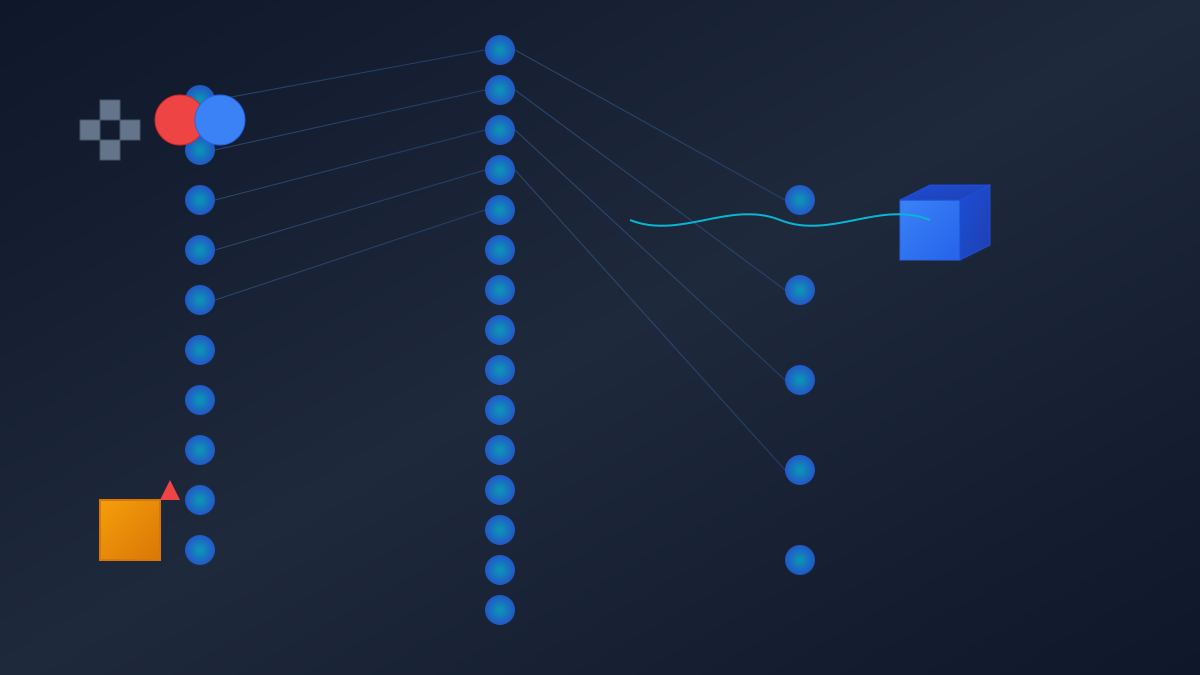
The featured part of the project: uses Three.js (a JavaScript 3D graphics library) to render 3D scenes, and WebSockets to realize real-time communication between the backend training process and the frontend, pushing neural network states. You can observe in real-time: neuron activation status, signal transmission between network layers, and the impact of inputs (Mario's position, enemies, etc.) on decisions.

3. NES Simulator Integration

Integrates an NES simulator, allowing the AI to train in the real Super Mario Bros. environment. This environment provides rich visual feedback and clear win/lose conditions, making it suitable for DRL training.

4

Section 04

Project Value and Significance

1. Educational Value

Helps beginners in reinforcement learning intuitively understand the impact of neural network forward propagation, weight updates on decisions, and the importance of state representation; educators can use it as a classroom demonstration tool to make abstract concepts concrete.

2. Open Source and Extensibility

Open source provides complete training code and visualization components, supporting modifications to network architecture and hyperparameters. Theoretically, it can be adapted to other NES games.

3. Technical Inspiration

The visualization solution can inspire other AI applications: autonomous driving decision visualization, robot control system state monitoring, and risk assessment display for financial transaction models.

5

Section 05

Usage Scenarios and Target Users

Neural Mario is particularly suitable for the following groups:

  1. Reinforcement learning beginners: Understand algorithm principles through visualization, which is more efficient than reading papers or code;
  2. Educators: A classroom demonstration tool to make abstract concepts concrete;
  3. Frontend developers: Learn to combine Three.js with real-time data streams to create interactive visualizations;
  4. AI researchers: A rapid prototyping tool to test new network architectures or training strategies.
6

Section 06

Summary and Outlook

Neural Mario represents an important direction for AI educational tools: not only letting AI do complex things but also allowing humans to understand its decision-making process. As AI systems become increasingly complex today, interpretability and visualization capabilities are becoming more and more important. For developers who are new to DRL or want to add visualization functions, this project is an excellent reference case, proving that technical demonstrations can be "usable", "good-looking", and "easy to understand". If you are interested in reinforcement learning, game AI, or real-time visualization, you can visit the project repository to experience the AI's thinking process.