Zing Forum

Reading

Neural Amp Modeler: Clone Your Guitar Amp Tone with Neural Networks

An open-source Python toolkit that uses deep learning to accurately model the tonal characteristics of guitar amplifiers, effects pedals, and other audio devices, allowing musicians to digitally reproduce the sound of classic hardware.

neural networkguitaramplifieraudio modelingmachine learningWaveNetdeep learningmusic productionVST pluginopen source
Published 2026-05-23 07:12Recent activity 2026-05-23 07:18Estimated read 7 min
Neural Amp Modeler: Clone Your Guitar Amp Tone with Neural Networks
1

Section 01

Neural Amp Modeler (NAM) - Open Source AI Tool for Guitar Amp Tone Cloning

Neural Amp Modeler (NAM) Overview

Neural Amp Modeler (NAM) is an open-source Python tool kit that uses deep learning to accurately model the tonal characteristics of guitar amplifiers, effects pedals, and other audio devices. It enables musicians to digitally reproduce the sound of classic hardware.

Source Information:

Key keywords: neural network, guitar, amplifier, audio modeling, machine learning, WaveNet, deep learning, music production, VST plugin, open source


2

Section 02

Project Background & Core Concept

Project Background

For guitarists and producers, achieving ideal tones often requires expensive physical amps (thousands of dollars) that are bulky and high-maintenance. Traditional digital modeling struggles to capture the subtle nonlinearities of analog circuits.

Core Concept

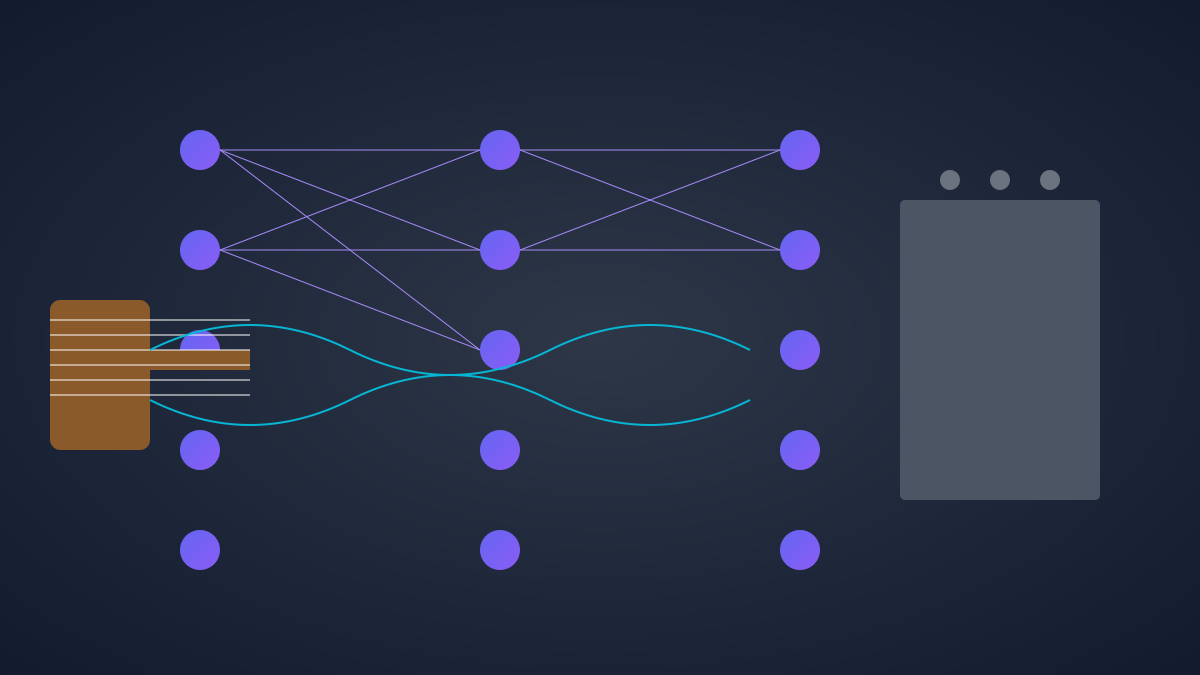
NAM addresses this by using deep neural networks to learn the mapping between input signals (DI) and output responses from target devices. This allows it to create highly accurate digital models of real hardware without needing to know internal circuit designs

3

Section 03

Technical Principles & Workflow

Technical Workflow

NAM uses a data-driven approach:

  1. Send test signals (DI) to the target device.
  2. Record the device's output.
  3. Train a neural network to learn the input-output conversion.

Supported Architectures

  • WaveNet: Optimized for audio time-series (originally from DeepMind for speech synthesis), enables real-time inference while maintaining quality.
  • Packed Model: An optimized format for efficient operation on resource-limited devices
4

Section 04

Usage Methods & Ecosystem

Training Options

NAM offers three flexible training methods:

  1. Google Colab: Free GPU access for users without high-performance hardware.
  2. Local GUI: Intuitive interface for non-command-line users to load audio, configure parameters, and train.
  3. Command Line (nam-full): Full control via JSON configs (data, model architecture, learning algorithms) for professionals.

Ecosystem

  • Training Repo: Current project for model training and .nam file export.
  • Plugin: VST/AU/AAX format for real-time performance.
  • Official Website: https://www.neuralampmodeler.com (community resources, model sharing).
  • Documentation: ReadTheDocs-hosted guides, tutorials, and API references
5

Section 05

Application Scenarios & Industry Significance

Musician Value

  • Digital Tone Library: Model your entire amp collection for easy travel.
  • Convenient Recording: No volume issues—record tube amp tones at night.
  • Community Sharing: Access free user-created models.

Industry Impact

NAM represents a shift in audio modeling:

  • More accurate capture of analog device complexities than traditional DSP.
  • Data-driven learning reduces manual tuning.
  • Extendable to effects pedals, microphones, and mixers
6

Section 06

Technical Details & Best Practices

Key Technical Details

  • Delay Calibration: Critical for accurate modeling—NAM supports sample-level delay compensation (positive/negative) to avoid prediction errors.
  • PyTorch Lightning: Used as the training framework, providing automated workflow, distributed training, and flexible configuration.
  • .nam File Format: Saved model files contain weights and configs, compatible with official plugins. Third-party integration is enabled via documented specs
7

Section 07

Summary & Future Outlook

Summary

NAM combines open-source collaboration and AI to make professional guitar tones accessible. It offers a new paradigm for audio device modeling.

Future Outlook & Suggestions

  • For Users: Start with Colab using sample data, then model your own devices.
  • Community Growth: Expect more high-quality free models and improved tools.
  • Expansion: Developers can extend NAM to other audio devices or experiment with new network architectures

