Zing Forum

Reading

NEAT Algorithm: Enabling AI to Evolve Autonomously into a Flappy Bird Expert

Explore how the NeuroEvolution of Augmenting Topologies (NEAT) algorithm automatically evolves neural networks capable of mastering the Flappy Bird game through simulating natural selection processes, without the need for manually writing game strategy code.

NEAT算法神经进化Flappy Bird强化学习遗传算法拓扑进化Pygame自动机器学习游戏AI进化计算
Published 2026-05-02 18:44Recent activity 2026-05-02 18:53Estimated read 8 min
NEAT Algorithm: Enabling AI to Evolve Autonomously into a Flappy Bird Expert
1

Section 01

NEAT Algorithm: Enabling AI to Evolve Autonomously into a Flappy Bird Expert (Introduction)

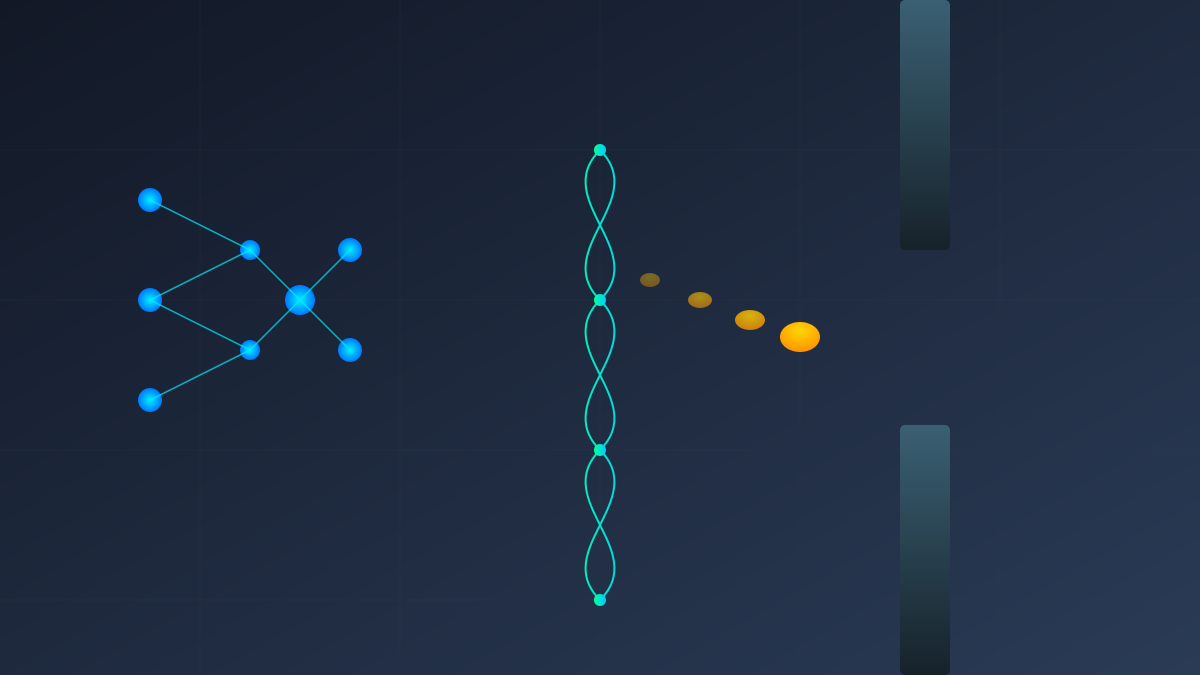
This article explores how the NeuroEvolution of Augmenting Topologies (NEAT) algorithm automatically evolves neural networks that master the Flappy Bird game through simulating natural selection processes, without manually writing game strategy code. NEAT addresses key challenges of traditional neuroevolution through unique strategies like historical marking, speciation, and incremental complexity, demonstrating the potential of neuroevolution as an optimization paradigm. This article will elaborate on aspects including background, core innovations, specific design, evolutionary process, technical implementation, comparison with other methods, and extended applications.


2

Section 02

Neuroevolution: An Optimization Paradigm Beyond Gradient Descent (Background)

In the development of artificial intelligence, most deep learning systems rely on backpropagation with gradient descent to optimize parameters, but they have limitations such as requiring differentiable objective functions, being prone to local optima, and depending on manually designed network topologies. Neuroevolution, on the other hand, simulates biological evolution and optimizes both network structure and parameters simultaneously. Flappy Bird, as a challenging reinforcement learning problem, requires AI to learn complex temporal control strategies in a high-dimensional state space, making it an ideal scenario to test neuroevolution algorithms.

3

Section 03

Core Innovations of the NEAT Algorithm

NEAT (NeuroEvolution of Augmenting Topologies) was proposed by Kenneth Stanley and Risto Miikkulainen in 2002, with three key innovations:

  1. Historical Marking and Crossover Operation: Assign historical markers to genes to solve the crossover challenge in topological evolution, making it possible to combine complex network structures.
  2. Speciation and Diversity Preservation: Divide the population into species, grouping similar structures into the same species to protect innovative mutations and prevent simple structures from dominating the population.
  3. Incremental Evolution from Minimal to Complex: Start with simple networks without hidden layers, gradually increasing complexity by adding nodes/connections to improve search efficiency and obtain streamlined networks.
4

Section 04

State Representation and Fitness Design in Flappy Bird

  • State Input: Bird's vertical position, vertical velocity, horizontal distance to the next pipe, upper/lower edge heights of the next pipe (total 5 values).
  • Output: A single neuron; if it exceeds the threshold, the bird jumps.
  • Fitness Function: Intuitively defined as survival time or number of pipes passed, but simple designs can easily lead to local optima; more refined designs may consider factors like number of pipes passed, survival time, and exploration of flight heights.
5

Section 05

Dynamic Observation of the Evolutionary Process

The process of NEAT training a Flappy Bird AI demonstrates autonomous evolution:

  • Initial Phase: Most individuals perform poorly; occasionally, 'pioneers' that can pass a few pipes appear.
  • Middle Phase: Individuals begin to adjust their flight height based on pipe positions.
  • Late Phase: The AI demonstrates skilled techniques, passing dozens or even hundreds of pipes consecutively, showing predictive abilities similar to human experts. The entire process involves no manual strategy code; effective control strategies are discovered solely through evolutionary pressure.
6

Section 06

Technical Implementation and Open-Source Value

The project is implemented in Python, using Pygame as the game engine and the neat-python library to provide core NEAT functions (historical marking, speciation, structural mutation, etc.). Its open-source nature provides resources for educators and learners: the Flappy Bird + NEAT combination has simple rules, high visualization, and a gentle learning curve, which can demonstrate complex emergent behaviors and help students intuitively understand the principles of evolutionary algorithms.

7

Section 07

Comparison with Other Reinforcement Learning Methods

Comparison between NEAT and deep reinforcement learning methods (e.g., DQN, PPO):

  • NEAT Advantages: Automatically searches for optimal network structures without manually specifying the number of hidden layers or connection patterns; the evolved networks are streamlined and efficient.
  • NEAT Limitations: When dealing with high-dimensional inputs (e.g., raw pixels), the search space becomes too large, leading to decreased evolutionary efficiency—hybrid deep neuroevolution may be better in such cases. Deep reinforcement learning relies on fixed network structures and gradient descent, requiring manual topology design.
8

Section 08

Extended Applications and Insights

The success of NEAT can be extended to control problem domains such as robot motion control, game character AI, autonomous driving decision-making, and resource scheduling optimization. It demonstrates the potential of computational evolution as a general problem-solving paradigm: through simulating natural selection, it discovers solutions that are difficult for humans to design or understand. Insight for AI researchers: Do not overlook concise algorithm design; understanding the essential structure of a problem is more likely to lead to breakthroughs than simply increasing computational resources.

