Zing Forum

Reading

NanonetCpp: A Minimalist High-Performance C++ Neural Network Library

NanonetCpp is a C++ neural network library focused on ultra-lightweight design and execution speed, providing basic deep learning capabilities for embedded systems and performance-sensitive applications.

C++神经网络深度学习嵌入式AI边缘计算轻量级框架高性能计算机器学习推理
Published 2026-06-12 14:13Recent activity 2026-06-12 14:24Estimated read 8 min
NanonetCpp: A Minimalist High-Performance C++ Neural Network Library
1

Section 01

NanonetCpp: Guide to the Minimalist High-Performance C++ Neural Network Library

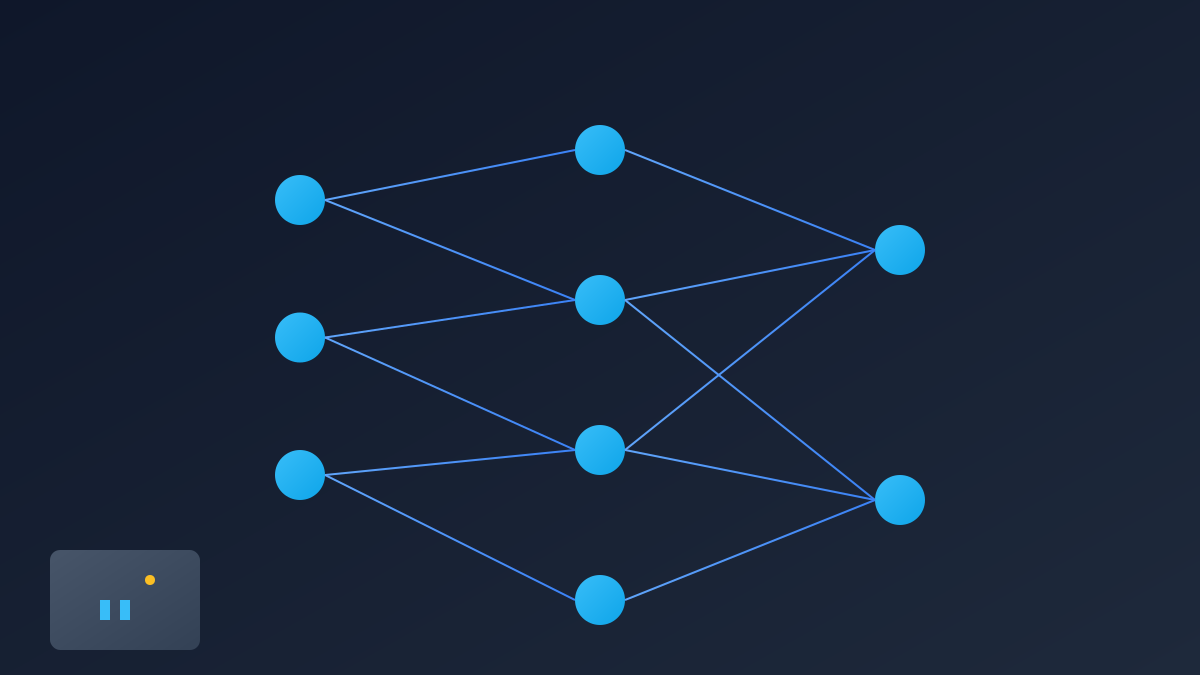
NanonetCpp is a C++ neural network library focused on ultra-lightweight design and execution speed, providing basic deep learning capabilities for embedded systems and performance-sensitive applications. Its core philosophy is Tiny, Very Fast, and Minimal—it does not pursue covering all cutting-edge features but focuses on the efficient implementation of core functions. This thread will introduce its background, design, application scenarios, technical points, and other content in separate floors to help everyone fully understand this library.


2

Section 02

Project Background and Motivation

In today's era of flourishing deep learning frameworks, heavyweight tools like PyTorch and TensorFlow are powerful but bulky, have complex dependencies, and high resource requirements, making them difficult to adapt to scenarios sensitive to memory and startup speed, such as embedded devices, real-time systems, and game engine integration. NanonetCpp emerged to provide core neural network functions while keeping the code concise and running efficiently.

3

Section 03

Design Philosophy and Technical Architecture

NanonetCpp's design is influenced by embedded development and the game industry, following these principles:

  1. Zero or minimal dependencies: Avoid complex dependencies, enabling simple integration with no risk of version conflicts;
  2. Header-first or single-file library: Support copy-paste usage to lower the trial threshold;
  3. Manual memory management and cache-friendly: Explicitly control memory layout to optimize cache hit rate;
  4. Forward propagation priority: Focus on inference rather than training, adapting to the model division needs of embedded scenarios.
4

Section 04

Application Scenarios and Practical Value

NanonetCpp is suitable for the following scenarios:

  • Embedded AI and edge computing: Resource-constrained IoT devices, smart homes, etc.;
  • AI in game development: NPC behavior, procedural content generation, etc., with seamless integration into game engines;
  • Real-time systems and high-frequency trading: Fields with extremely low latency requirements (e.g., robot control, autonomous driving perception);
  • Teaching and learning: The minimalist codebase helps developers understand the underlying implementation of neural networks.
5

Section 05

Key Technical Implementation Points

Based on the project description, its technical points are speculated to include:

  • Network layer types: Fully connected layers, convolutional layers, activation functions (ReLU/Sigmoid/Tanh), pooling layers;
  • Optimized matrix operations: Loop unrolling, SIMD instruction sets (SSE/AVX/NEON), cache blocking;
  • Model format support: Import subsets of ONNX or custom lightweight binary formats, and work with mainstream training frameworks.
6

Section 06

Comparison with Other Frameworks

Feature NanonetCpp PyTorch TensorFlow Lite
Size Extremely small (possibly <100KB) Large (hundreds of MB) Medium (several MB)
Dependencies Very few Many Fewer
Performance Optimized for CPU General optimization Optimized for mobile
Usability Requires C++ knowledge Python-first Requires conversion process
Functionality Core functions Full features Inference functions

Note: Different tools are suitable for different scenarios, and NanonetCpp fills the niche of "extremely lightweight CPU inference".

7

Section 07

Usage Suggestions and Best Practices

Suggestions for using NanonetCpp:

  1. Evaluate demand matching: Choose it if you need extreme lightweightness and speed; choose PyTorch/TensorFlow if you prioritize development efficiency and features;
  2. Model conversion process: Plan the conversion from training frameworks to NanonetCpp (via custom scripts or project tools);
  3. Performance benchmarking: Verify indicators such as latency, throughput, and memory usage on target hardware;
  4. Error handling and debugging: The minimalist library has few error checks, so comprehensive test coverage and logging are needed.
8

Section 08

Summary and Outlook

NanonetCpp embodies the engineering philosophy that "doing subtraction is harder and more worthwhile than doing addition". Amidst the trend of AI framework complexity, it provides efficient implementation of core functions. It is highly attractive to developers of resource-constrained devices, real-time systems, and users learning the fundamentals of neural networks. With the rise of edge AI, such lightweight inference frameworks will receive more attention, and NanonetCpp may become an entry choice in the embedded AI field.

