Zing Forum

Reading

MScFE Agent: A Dialogue System Combining Large Language Models and Vector Semantic Search

This article introduces the MScFE Agent project, an AI dialogue system that combines large language models (LLMs) with vector semantic search. It delves into the Retrieval-Augmented Generation (RAG) architecture, LangChain framework, vector database technology, and how to build an intelligent dialogue agent capable of providing context-aware responses.

RAG检索增强生成LangChain向量搜索大语言模型PineconeHugging Face语义搜索对话系统知识库问答
Published 2026-04-28 22:13Recent activity 2026-04-28 22:32Estimated read 6 min
MScFE Agent: A Dialogue System Combining Large Language Models and Vector Semantic Search
1

Section 01

MScFE Agent: Guide to an Intelligent Dialogue System Combining LLMs and Vector Semantic Search

This article introduces the MScFE Agent project, an AI dialogue system based on the Retrieval-Augmented Generation (RAG) architecture. Its core is combining large language models (LLMs) with vector semantic search technology to address the limitations of static knowledge and hallucination issues in LLMs. The system uses the LangChain framework, Hugging Face embedding models, and Pinecone vector database to achieve context-aware and accurate responses. It is suitable for scenarios such as intelligent customer service and internal knowledge base Q&A, providing engineering references for enterprise-level LLM applications.


2

Section 02

Background: Limitations of LLMs and the Emergence of RAG Architecture

Large language models (such as GPT-4 and Claude) have strong language capabilities, but their knowledge is static—they cannot access new information or internal documents and are prone to hallucinations. The Retrieval-Augmented Generation (RAG) architecture combines the generation capabilities of LLMs with external knowledge base retrieval, allowing the model to consult relevant documents before generating responses, thus providing accurate and traceable outputs. MScFE Agent is a typical implementation of the RAG architecture.

3

Section 03

Core Methods: RAG Architecture and Vector Semantic Search Technology

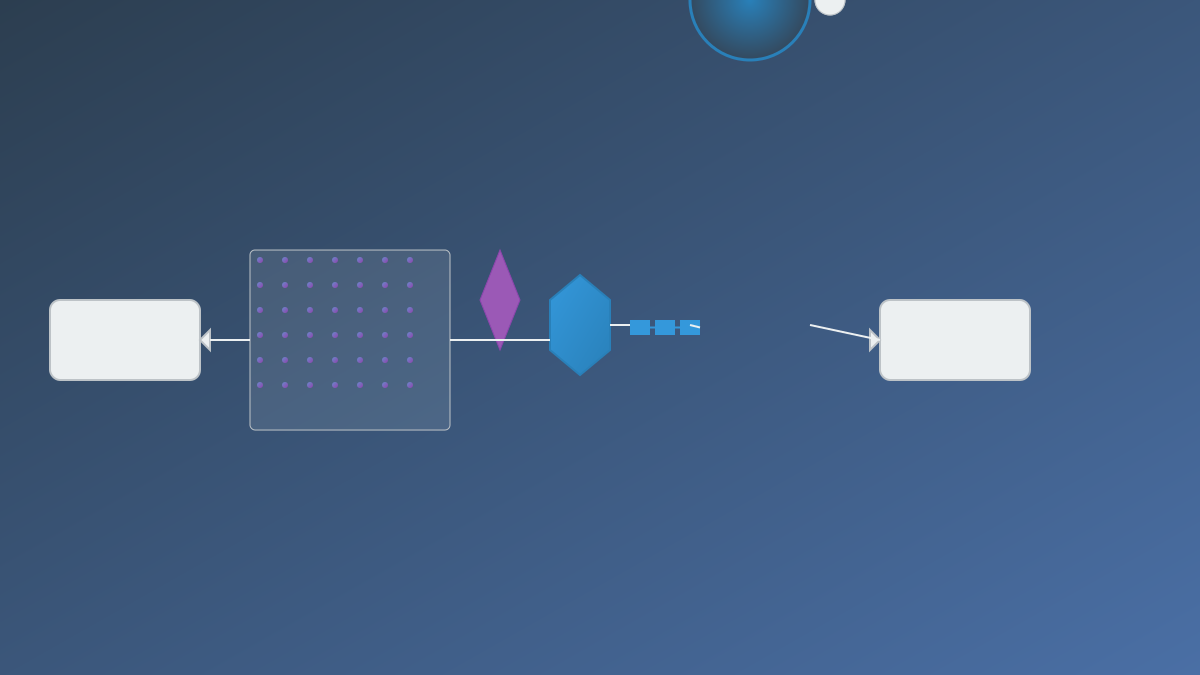
Core steps of the RAG architecture: Query understanding (extracting requirements) → Document retrieval (dynamically obtaining external information) → Context construction (integrating documents and queries) → Response generation (output based on reference documents). Key technologies for vector semantic search: Embedding (Hugging Face Sentence Transformers convert text into high-dimensional vectors), vector database (Pinecone for storage and indexing), cosine similarity measurement, and Approximate Nearest Neighbor (ANN) search to optimize performance.

4

Section 04

Technical Implementation: LangChain Framework and System Workflow

Using the LangChain framework to simplify RAG development: Document loaders handle multi-format inputs, text splitters segment long documents, vector storage encapsulates embedding and storage logic, retrievers implement query mapping, chains combine components to form a pipeline, and memory manages dialogue context. The system workflow is divided into an indexing phase (offline: document ingestion → extraction → chunking → embedding → storage) and a query phase (online: receive query → embedding → similarity search → context assembly → prompt construction → LLM call → return response).

5

Section 05

Application Scenarios and Performance Optimization Strategies

Application scenarios include intelligent customer service (answering based on product documents), internal knowledge base Q&A (employees' natural language queries), legal compliance assistants (interpreting professional information), education and training (personalized learning support), and research analysis (accelerating literature processing). Performance optimization: Latency optimization (embedding caching, index optimization, asynchronous processing), cost optimization (lightweight embedding models, appropriate database selection), and quality monitoring (retrieval evaluation, user feedback, A/B testing).

6

Section 06

Limitations and Future Evolution Directions

Limitations: Restricted knowledge boundaries (only answers questions within the knowledge base), insufficient complex reasoning capabilities. Future directions: Multimodal expansion (support for images/tables, etc.), agent-based evolution (calling tools/executing code).

7

Section 07

Conclusions and Recommendations

RAG is a standard architecture for LLM applications, solving the timeliness and accuracy issues of pure LLMs. MScFE Agent provides an engineering implementation reference. It is recommended that organizations take RAG as the entry path for LLM applications—no model training or large amounts of labeled data are needed; only a knowledge base needs to be prepared to build an intelligent dialogue system.

