Quantum Neural Network Structure
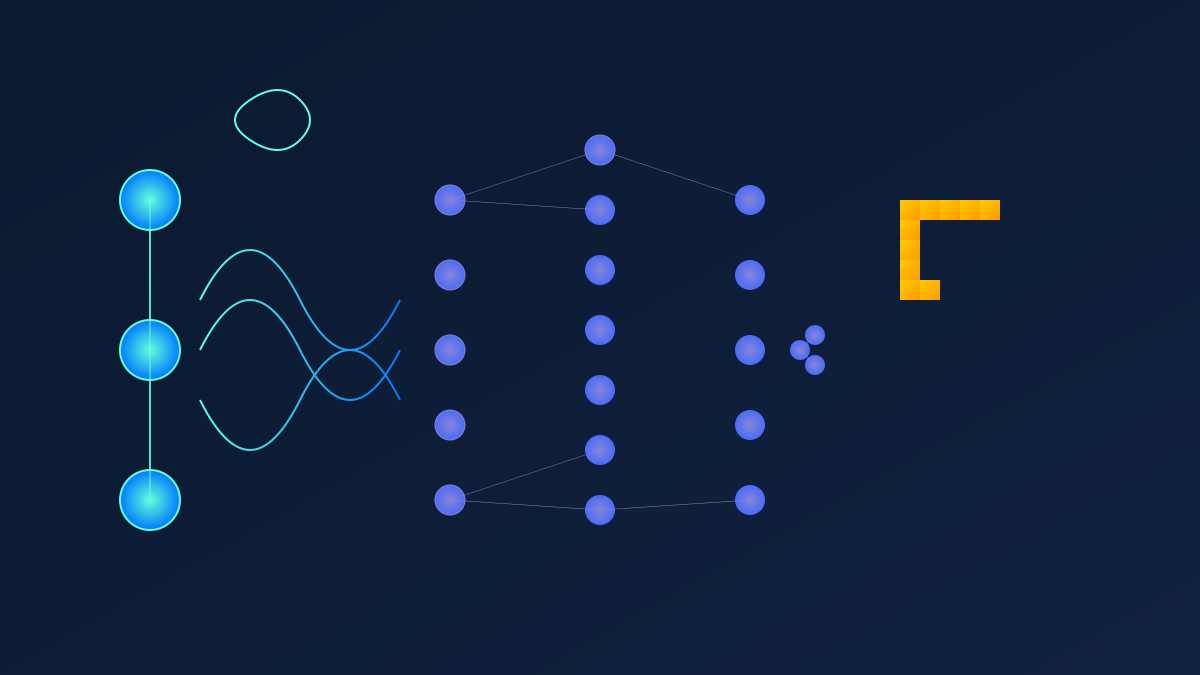
The QNN consists of three parts: data encoding layer (classical to quantum state conversion), parameterized quantum circuit (trainable quantum operations), and measurement layer (quantum to classical output conversion).
Innovation in Black-and-White Amplitude Encoding
Traditional methods require 784 qubits to process MNIST images. This project uses amplitude encoding: the square of the quantum state amplitude corresponds to the pixel probability distribution, allowing the image to be represented with far fewer qubits than the number of pixels, leveraging quantum parallelism.
Parameter Efficiency
Only 24 trainable parameters, which is a significant reduction compared to classical fully connected networks (tens of thousands of parameters) and lightweight CNNs (thousands of parameters).
Technology Selection
The Qiskit framework is adopted (mature ecosystem, flexible circuit design, compatibility with simulation and real hardware); training uses the parameter-shift rule to calculate gradients, combined with classical optimizers (e.g., Adam) and mini-batch processing.