Zing Forum

Reading

Building a Production-Grade Machine Learning System from Scratch: A Complete Analysis of ML-Engineering-System-Template

This article provides an in-depth analysis of the ML-Engineering-System-Template project, an end-to-end machine learning engineering template for computer vision, natural language processing, and tabular data. It covers core MLOps practices such as modular architecture design, configuration-driven training, FastAPI deployment, and model registration.

MLOps机器学习工程FastAPIHydra模型部署CI/CD开源模板
Published 2026-05-17 06:15Recent activity 2026-05-17 06:17Estimated read 6 min
Building a Production-Grade Machine Learning System from Scratch: A Complete Analysis of ML-Engineering-System-Template
1

Section 01

Building a Production-Grade ML System from Scratch: Introduction to ML-Engineering-System-Template

The ML-Engineering-System-Template analyzed in this article is an end-to-end ML engineering template for computer vision, NLP, and tabular data. It covers core MLOps practices like modular architecture, configuration-driven training, FastAPI deployment, and model registration. It aims to solve problems such as code chaos, difficult configuration management, and opaque deployment in ML projects from prototype to production, providing a reusable industry-standard framework.


2

Section 02

Background: Pain Points of ML Projects from Prototype to Production

When ML projects move from experimental prototypes to production, they often face challenges like disorganized code structure, difficult configuration management, and opaque deployment processes. Many teams reinvent the wheel across different projects, leading to low efficiency and soaring maintenance costs. ML-Engineering-System-Template was created to address these issues.

3

Section 03

Design Philosophy: Three-Stage Progressive Architecture Evolution

This template adopts a progressive design, gradually introducing complex engineering practices from V1 to V3: V1 focuses on basic functions and clean code structure; V2 introduces configuration-driven development and experiment tracking, supporting hyperparameter tuning and model version management; V3 fully implements an MLOps pipeline, integrating model registration, automated testing, and containerized deployment. The layered design allows teams to choose the architecture based on project maturity, avoiding over-engineering.

4

Section 04

Core Architecture: Modular and Extensible Layered Design

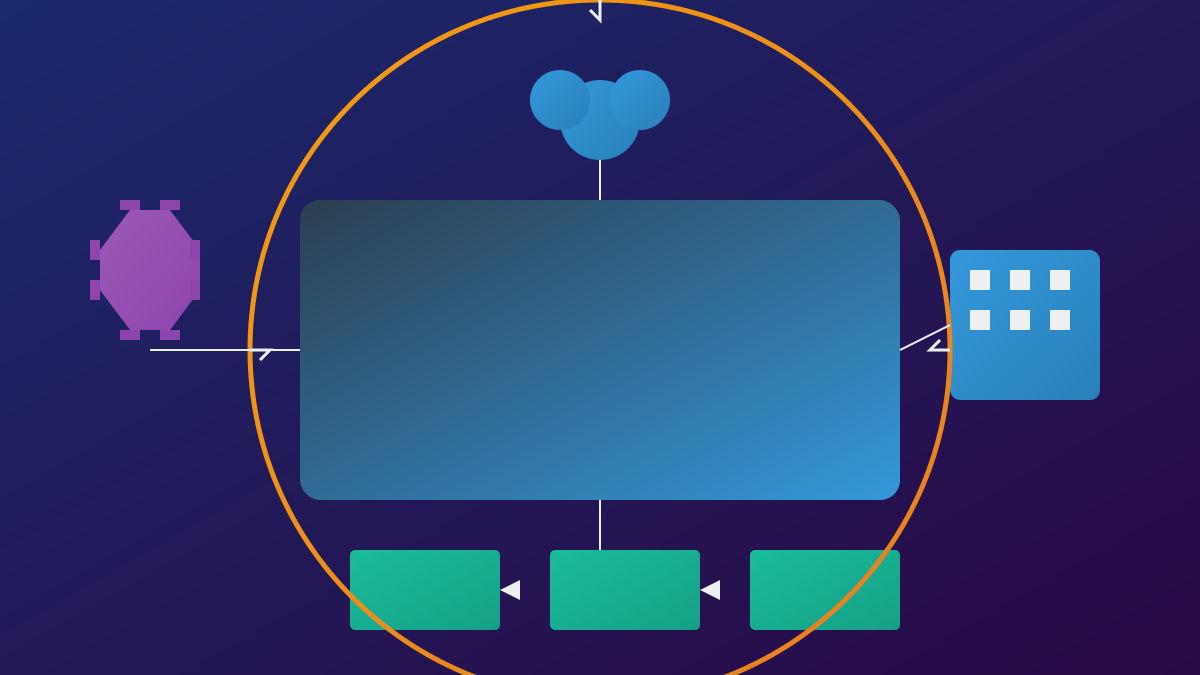
The template uses clear module division: the data layer handles loading, preprocessing, and feature engineering (supporting multiple data sources/formats); the model layer encapsulates common model architectures for CV, NLP, and tabular data; the training layer implements distributed training, mixed-precision training, and early stopping mechanisms; the evaluation layer provides metric calculation and visualization. Modules interact via well-defined interfaces to ensure testability and maintainability.

5

Section 05

Configuration-Driven: Hydra+YAML for Reproducible Experiments and Flexible Deployment

The project deeply integrates the Hydra configuration framework, externalizing hyperparameters, path settings, and runtime options into YAML files. Benefits include: reproducible experiments (restore the environment by saving the configuration); simple hyperparameter search (supports automated tuning with Optuna); flexible multi-environment deployment (different configurations for development/testing/production without code changes); hierarchical configuration combination mechanism simplifies complex experiment management.

6

Section 06

Deployment and Serving: Production Workflow with FastAPI+MLflow+Containerization

For production deployment, the template provides a high-performance inference service based on FastAPI (supports batch inference, streaming responses, built-in request validation, error handling, and monitoring); integrates with MLflow model registry for version tracking, stage marking (development/staging/production), and automatic rollback; containerization configurations include Dockerfile and docker-compose, supporting K8s deployment and horizontal scaling; provides a complete CI/CD example showing the automated workflow from code submission to production deployment.

7

Section 07

Application Value and Recommendations: From Template to Engineering Methodology Implementation

This template is not just a collection of code but also an engineering methodology: it demonstrates how to refactor research code into production code, establish unified team development standards, and balance development speed with system reliability. Recommendations: first understand the core logic of V1, then gradually introduce V2/V3 advanced features; startup teams can directly use V3 to launch projects; existing projects can learn from the modular idea for progressive refactoring.

