Zing Forum

Reading

Telecom Customer Churn Prediction: Engineering Practice of Production-Grade ML Pipeline

This article analyzes the churn-prediction-mlp project, a production-grade customer churn prediction system based on PyTorch neural networks, covering complete engineering practices such as MLflow experiment tracking and FastAPI inference services.

客户流失预测机器学习PyTorchMLflowFastAPI生产级MLMLOps神经网络电信行业模型部署
Published 2026-05-05 16:08Recent activity 2026-05-05 16:25Estimated read 7 min
Telecom Customer Churn Prediction: Engineering Practice of Production-Grade ML Pipeline
1

Section 01

Telecom Customer Churn Prediction: Guide to Engineering Practice of Production-Grade ML Pipeline

This article analyzes the churn-prediction-mlp project, a production-grade telecom customer churn prediction system based on PyTorch neural networks. It covers complete engineering practices including data engineering, model training, MLflow experiment tracking, and FastAPI inference services, demonstrating the end-to-end implementation from lab to production environment and providing references for similar projects.


2

Section 02

Business Background and Project Tech Stack

In the telecom industry, a 5% increase in customer retention can boost profits by 25%-95%. Traditional churn prediction relies on rules and simple statistics, while modern ML methods are more accurate. The project uses a production-grade tech stack including PyTorch (deep learning), MLflow (experiment management), FastAPI (inference service), Scikit-learn (preprocessing), and Pandas/NumPy (data processing), balancing modeling capability, reproducibility, and service performance.

3

Section 03

Detailed Explanation of End-to-End ML Pipeline Architecture

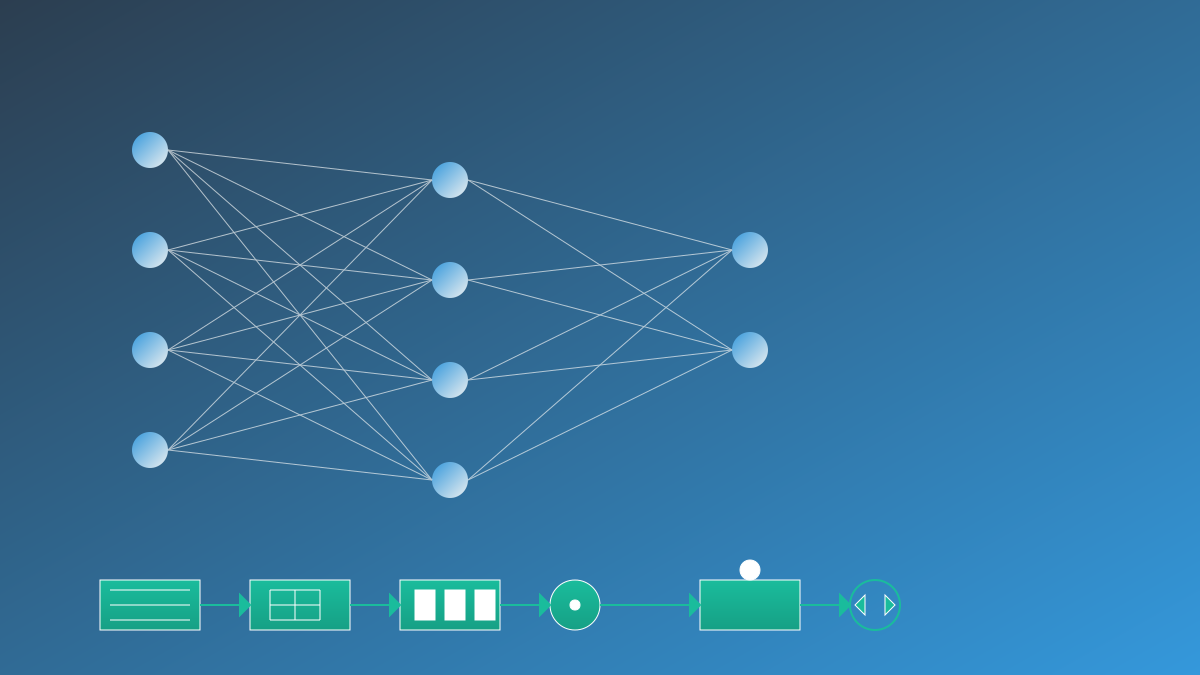
The project pipeline consists of four parts: 1. Data Engineering Layer: Processes multi-dimensional data such as demographics, accounts, and usage behavior, resolves missing values and outliers, and constructs features like RFM, trends, and risk signals; 2. Model Training Layer: Uses MLP architecture (input → batch normalization → hidden layer → Dropout → output), binary cross-entropy loss, Adam optimizer, and handles class imbalance; 3. Experiment Tracking Layer: Records hyperparameters and metrics via MLflow, manages model versions, and ensures reproducibility; 4. Service Deployment Layer: Builds high-performance inference services with FastAPI, supports asynchronous processing and type safety, and adopts a deployment architecture with load balancing + monitoring.

4

Section 04

Model Effect Evaluation and Business Intervention Strategies

Model evaluation uses classification metrics (accuracy, precision, recall, F1), ranking metrics (AUC-ROC, AUC-PR), and business metrics (retention success rate, ROI). Intervention strategies are divided into tiered (manual contact for extremely high risk, coupons for high risk, etc.) and personalized (custom offers based on churn reasons), converting predictions into actual value.

5

Section 05

Best Practices for Production-Grade ML Engineering

The project follows these practices: 1. Code Organization: Clear structure (modules like data, models, src, etc.); 2. Configuration Management: Uses configuration files/environment variables to manage different environments; 3. Testing Strategy: Unit tests (data processing, feature logic), integration tests (pipeline, API), data tests (schema validation, drift detection); 4. Containerization: Docker multi-stage builds, supporting single-machine/cluster/serverless deployment.

6

Section 06

Project Challenges and Solutions

Facing four major challenges: 1. Data Drift: Monitor distribution changes and retrain regularly; 2. Concept Drift: Monitor business metrics and update with manual review; 3. Interpretability Requirements: Use SHAP values and feature importance visualization; 4. Privacy Compliance: Data desensitization, access control, compliance policies, in line with regulations like GDPR.

7

Section 07

Technology Evolution Trends and Future Directions

Trends include: 1. Model Complexity Trade-off: Explore upper limits with complex models, then approximate with simple models to improve maintainability; 2. MLOps Maturity: Develop towards feature platforms, automated pipelines, and real-time monitoring; 3. Real-time Prediction: Stream processing architecture, online feature calculation, low-latency inference to enable event-driven intervention.

8

Section 08

Project Summary and Core Insights

churn-prediction-mlp demonstrates that production-grade ML systems need to have a complete pipeline, reproducible experiments, reliable deployment, and continuous monitoring. Successful ML projects not only require algorithmic innovation but also rely on engineering rigor (data quality, code organization, testing, monitoring). The core concept is that technology serves business and models serve users, providing references for similar projects.

