Zing Forum

Reading

Mistral Function Calling Practice: Enabling Large Language Models to Automate SQL Database Operations

This project demonstrates how to use the Function Calling feature of Mistral Large Language Models (LLMs) to enable AI to automatically identify user needs and call the corresponding SQL query tools. By defining function specifications via JSON Schema, the model can intelligently determine when to call database queries and what parameters are needed, achieving seamless interaction between natural language and structured data.

Mistral函数调用Function CallingSQL大语言模型数据库自然语言处理AI应用
Published 2026-06-08 20:15Recent activity 2026-06-08 20:20Estimated read 8 min
Mistral Function Calling Practice: Enabling Large Language Models to Automate SQL Database Operations
1

Section 01

Mistral Function Calling Practice: Enabling AI to Automate SQL Database Operations (Introduction)

This project was published by botextractai on GitHub (repository link: https://github.com/botextractai/ai-mistral-sql-functions, release date: June 8, 2026). Its core is to use the function calling feature of Mistral LLMs to achieve seamless interaction between natural language and SQL databases. By defining function specifications via JSON Schema, the model can intelligently determine when to call database query tools, what parameters are needed, and even proactively ask for missing information, solving the problem that LLMs cannot directly interact with external systems.


2

Section 02

Project Background: The Rise of Function Calling Technology

Large Language Models (LLMs) excel at natural language understanding and generation, but they are essentially stateless text generators and cannot directly interact with the external world. The emergence of function calling technology bridges this gap, allowing models to call external tools/APIs to expand their capabilities. As a leading European LLM provider, Mistral AI's models support multiple languages (English, French, Spanish, German, Italian) and powerful function calling capabilities. This project demonstrates the conversion from natural language to SQL operations based on the Mistral Large model.

3

Section 03

Core Method: Working Principle of Function Calling

The key steps of function calling include:

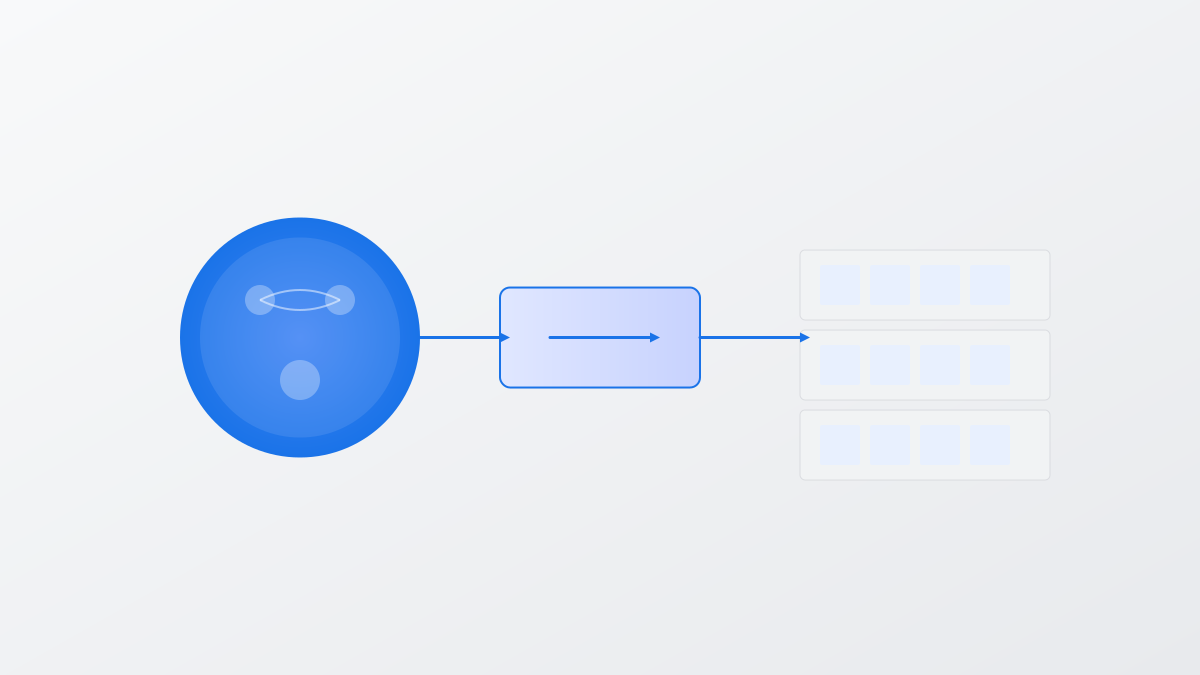
  1. JSON Schema Definition: Describe functions (type, name, description, parameters, required items) in a standardized format so that the model understands the function's purpose;
  2. Function Registration and Mapping: Organize function definitions into an array and map function names to actual Python functions;
  3. Intelligent Decision-Making and Interaction: The model analyzes the user's question intent, determines whether to call a tool, and proactively asks the user if parameters are missing.
4

Section 04

Practical Evidence: Implementation of Customer Information Query System

The project built a customer information query system based on SQLite:

  • Database Design: Includes a CUSTOMERS table (storing customer IDs and names) and a PAYMENTS table (storing payment records);
  • Core Functions: a. retrieve_customer_name: Query the name based on the customer ID (example: when the user asks "What is my customer name?", the model calls this function); b. retrieve_payments_sum: Calculate the total payment amount of a customer (example: when the user does not provide an ID, the model proactively asks "My customer ID is C1003." before calling this function).
5

Section 05

Interaction Flow and Key Technical Implementation Points

Interaction Flow:

  1. Intent Recognition: Analyze the user's question and needs;
  2. Parameter Inference: Check the parameters required by the function and ask if any are missing;
  3. Function Execution: Call the corresponding SQL query;
  4. Result Generation: Convert the query result into a natural language answer. Technical Points:
  • Multilingual Support: Serve global users;
  • Flexible Model Selection: Support multiple Mistral function calling models;
  • API Key Management: It is recommended to store securely (e.g., environment variables);
  • Database Initialization: Provide a db_create.py script to quickly set up a test environment.
6

Section 06

Application Scenarios and Expansion Ideas

The model of this project can be extended to multiple scenarios:

  1. Enterprise Knowledge Base Query: Combine with vector databases to implement intelligent Q&A for internal documents;
  2. E-commerce Intelligent Customer Service: Integrate functions such as order query and logistics tracking;
  3. Data Analysis Assistant: Allow business personnel to query business data using natural language;
  4. IoT Device Control: Define device control functions to implement a smart home hub.
7

Section 07

Current Limitations and Future Outlook

Current Limitations: Function execution needs to be handled by the user (the model only generates call requests); Future Outlook: Mistral may introduce server-side executed "useful functions" to simplify the development process. Developers only need to define business logic, and the platform will automatically handle function execution and scheduling.

8

Section 08

Project Insights and Development Key Points

This project reveals an AI trend: from passive Q&A tools to intelligent agents that actively call tools. Developers mastering function calling technology need to pay attention to:

  1. Clear Function Definition: Accurately describe the purpose;
  2. Reasonable Parameter Design: Necessary and sufficient;
  3. Elegant Interaction Design: Proactively ask for missing information;
  4. Security Awareness: Avoid unauthorized access or operations. This project is an excellent starting point for getting started with function calling technology.

